• Fri frakt över 249 kr
  • •
  • Snabba leveranser
  • •
  • Billiga böcker
Kundservice

Du är på sajten för privatpersoner.

Företag, bibliotek eller offentlig verksamhet?

Du handlar på classic.bokus.com, där alla dina funktioner finns intakta.
Till classic.bokus.com
Bokus logotyp. Gå till startsidan.
  • Erbjudanden
  • Nyheter
  • Student
  • Topplistor
  • Barn & ungdom
  • Bokus Play
  • E-böcker
  • Pocketböcker
  • Spel & pussel

10% rabatt på allt med kod: NYSTART10 →

Sidfot

Mina sidor

    Hjälp

    • Kundservice
    • Vanliga frågor och svar
    • Frakt och leverans
    • Retur vid ångerrätt
    • Reklamera vara
    • Betalning
    • Köpvillkor
    • Allmänna villkor
    • Information om webbplatsens tillgänglighet

    Om Bokus

    • Om oss
    • Pressrum
    • För studenter
    • För företag
    • För bibliotek och offentlig verksamhet
    • För leverantörer
    • Hållbarhet

    Populärt

    • Aktuella erbjudanden
    • Presentkort
    • Studentlitteratur
    • Nya böcker
    • Topplistor
    • Signerade böcker
    • Engelska böcker

    Inspiration

    • Boktips
    • BookTok
    • Populära bokserier
    • Barnbokskaraktärer
    • Populära författare
    Logotyp för Bokus
    Följ oss på Facebook (extern länk)Följ oss på Instagram (extern länk)Följ oss på YouTube (extern länk)Följ oss på TikTok (extern länk)
    bokus @ CookiesAnpassa cookiesIntegritetspolicyKöpvillkor
    Till Citymail hemsida (extern länk)Till Budbee hemsida (extern länk)Till Postnord hemsida (extern länk)Till Schenker hemsida (extern länk)Till Early Bird hemsida (extern länk)Till Walleys hemsida (extern länk)
    1. Samhälle och politik
    2. Samhälle och kultur
    3. Kultur och medier
    4. Referensverk och tvärvetenskap

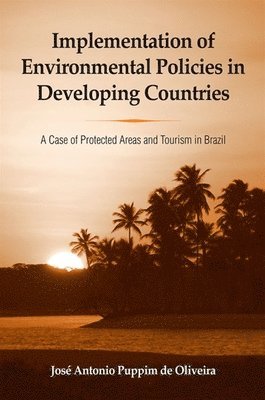
    Implementation of Environmental Policies in Developing Countries

    A Case of Protected Areas and Tourism in Brazil

    AvJose Antonio Puppim de Oliveira

    Inbunden, Engelska, 2008

    Del i serien SUNY series in Global Environmental Policy

    1 076 kr

    Tillfälligt slut

    Fler format och utgåvor

    Häftad

    Tillf. slut

    Beskrivning

    Uses Brazil as a case study of how governments implement environmental policies despite urgent needs for economic development.Environmental policy implementation in developing countries faces a number of institutional obstacles. Using the case of protected areas and tourism development in the state of Bahia in northeastern Brazil, Jose Antonio Puppim de Oliveira explores how economic development interests tend to have a higher priority on most governments' agendas in developing countries. Government agencies often fail to implement environmental protection policies mainly because they lack political support, have insufficient resources, have underdeveloped institutional capacity, and tend to overlook the importance of cooperation at the local level. Puppim de Oliveira explains how this trend may be reversed by decentralizing policy implementation into the hands of development-oriented agencies. To make the process work, central authorities should offer incentives to ensure increased attention to environmental protection objectives in the development process. At the same time, an independent body with oversight authority should be in place to prevent development agencies from neglecting environmental concerns.

    Produktinformation

    • Utgivningsdatum:2008-02-28
    • Mått:152 x 229 x 7 mm
    • Vikt:340 g
    • Format:Inbunden
    • Språk:Engelska
    • Serie:SUNY series in Global Environmental Policy
    • Antal sidor:150
    • Förlag:State University of New York Press
    • ISBN:9780791473252

    Utforska kategorier

    • Referensverk och tvärvetenskap inom Samhälle och politik
    • Regional planering inom Naturvetenskap och teknik

    Mer om författaren

    Jose Antonio Puppim de Oliveira is Associate Professor at the Brazilian School of Public and Business Administration, Getulio Vargas Foundation in Rio de Janeiro, Brazil.

    Recensioner i media

    "In the clarity and precision of its arguments, this is an exemplary text." — Environmental Conservation"Puppim de Oliveira brings the best of the Bahia environment and culture together with brilliancy in his scientific analysis of the value of nature." — Durval Olivieri, former Director of the Bahia State Environmental Agency"This book makes an important contribution to the public policy literature, especially the emerging theory of environmental policy implementation. It will help international agencies and multilateral corporations make smarter investments." — Lawrence E. Susskind, coauthor of Better Environmental Policy Studies: How to Design and Conduct More Effective Analysis

    Innehållsförteckning

    • List of TablesList of FiguresList of AbbreviationsAcknowledgments1. Introduction1.1 The Case Study1.2 Arguments in Brief 2. The Implementation of Environmental Policies in Developing Countries2.1 The Dual Mandate of Governments2.2 Organizing the State: Centralization versus Decentralization2.3 Implementing Public Policies2.4 Implementing Environmental Policy in Developing Countries 3. Obstacles to Policy Implementation in the Creation of Protected Areas3.1 A Short History of the Evolution of the Concept of Protected Areas3.2 Categories of Protected Areas3.3 Costs and Benefits of Protected Areas3.4 The Framework for Explaining Failed Efforts to Establish Protected Areas3.4.1 Lack of Political Support3.4.2 Lack of Funding for Protected Areas3.4.3 Lack of Institutional Capacity3.4.4 Lack of Cooperation and Coordination at the Local Level3.5 Tourism as a Force for Establishing Protected Areas3.6 Protected Areas in Brazil3.6.1 Evolution of Environmental Institutions in the Brazilian State3.6.2 Evolution of Protected Areas in Brazil4 Overcoming the Obstacles for Policy Implementation: The Case of the Establishment of Protected Areas in Bahia4.1 Introduction4.2 The Background of Bahia and Tourism Development4.2.1 State Tourism Development Program4.3 Understanding Environmental Policy and APAs in Brazil and Bahia4.4 Evolution of Environmental Management in Bahia and the Outcome: The Creation of APAs 4.5 Establishment of Protected Areas in Bahia: Obtaining Political, Institutional, and Financial Support4.5.1 Getting Political Support at the State Level from Pro-Development Actors4.5.2 Funding APAs by Involving Nonenvironmental Agencies4.5.3 Competition among Governmental Agencies can Improve Institutional Capacity4.5.4 Getting Local Support: APAs as Potential Investment Magnets4.6 The "Bahian Model": Horizontal Decentralization with Checks and Balances 5. Lessons for Policy Studies5.1 Learning from the Research: A New Framework of Analysis5.1.1 Learning from the Case: How to Overcome the Four Obstacles5.2 Lessons for the Classical Policy Implementation Literature5.3 Integrating Economic Development and Environmental Protection in the Public Sector5.4 Horizontal Decentralization for Policy Implementation: Incentives with Checks and Balances5.4.1 Decentralization without Much Coordination But with Checks and Balances5.4.2 The Forgotten Type of Decentralization: HorizontalDecentralization5.5 The Role of Local Actors and Central Governments in Decentralized Policy Implementation5.6 Learning the Tough Reality of the Development Process5.7 A New Role for Environmental Agencies?NotesBibliographyIndex