• Fri frakt över 249 kr
  • •
  • Snabba leveranser
  • •
  • Billiga böcker
Kundservice

Du är på sajten för privatpersoner.

Företag, bibliotek eller offentlig verksamhet?

Du handlar på classic.bokus.com, där alla dina funktioner finns intakta.
Till classic.bokus.com
Bokus logotyp. Gå till startsidan.
  • Erbjudanden
  • Nyheter
  • Student
  • Topplistor
  • Barn & ungdom
  • Bokus Play
  • E-böcker
  • Pocketböcker
  • Spel & pussel

10% rabatt på allt med kod: NYSTART10 →

Sidfot

Mina sidor

    Hjälp

    • Kundservice
    • Vanliga frågor och svar
    • Frakt och leverans
    • Retur vid ångerrätt
    • Reklamera vara
    • Betalning
    • Köpvillkor
    • Allmänna villkor
    • Information om webbplatsens tillgänglighet

    Om Bokus

    • Om oss
    • Pressrum
    • För studenter
    • För företag
    • För bibliotek och offentlig verksamhet
    • För leverantörer
    • Hållbarhet

    Populärt

    • Aktuella erbjudanden
    • Presentkort
    • Studentlitteratur
    • Nya böcker
    • Topplistor
    • Signerade böcker
    • Engelska böcker

    Inspiration

    • Boktips
    • BookTok
    • Populära bokserier
    • Barnbokskaraktärer
    • Populära författare
    Logotyp för Bokus
    Följ oss på Facebook (extern länk)Följ oss på Instagram (extern länk)Följ oss på YouTube (extern länk)Följ oss på TikTok (extern länk)
    bokus @ CookiesAnpassa cookiesIntegritetspolicyKöpvillkor
    Till Citymail hemsida (extern länk)Till Budbee hemsida (extern länk)Till Postnord hemsida (extern länk)Till Schenker hemsida (extern länk)Till Early Bird hemsida (extern länk)Till Walleys hemsida (extern länk)
    1. Naturvetenskap och teknik
    2. Teknik och industri
    3. Maskinteknik och material

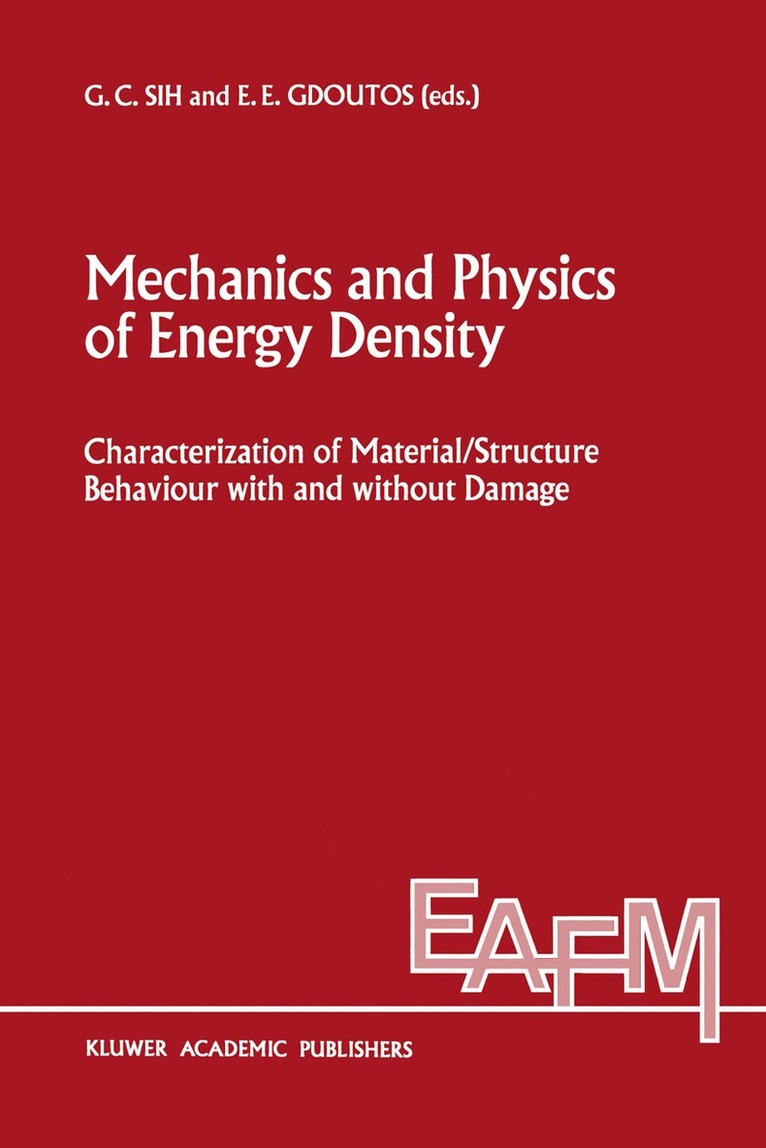
    Mechanics and Physics of Energy Density

    Characterization of material/structure behaviour with and without damage

    AvGeorge C. Sih,E.E. Gdoutos

    Inbunden, Engelska, 1992

    Del i serien Engineering Applications of Fracture Mechanics

    1 626 kr

    Beställningsvara. Skickas inom 10-15 vardagar. Fri frakt över 249 kr.

    Beskrivning

    Material technology has become so diversified in theories and the construction of novel microstructures that the researchers and practitioners are drifting further apart. This book is based on material presented at an International Symposium in Zanthi, Greece, in July 1989. It attracted a group of individual engineers and scientists from the East and West who tackled the question of why particular manipulations of a given material have particular effects. Emphasis is laid on the strain energy function because of the versatile role it plays in mechanics and physics. It has been used successfully not only in predicting the failure of solids but also in formulating constitutive relations in continuum mechanics. The material presented falls within the areas of fundamentals of strain energy density; damage analysis on strain energy density; strain energy density as a failure criterion; applications; and composites.

    Produktinformation

    • Utgivningsdatum:1992-01-31
    • Mått:156 x 234 x 18 mm
    • Vikt:527 g
    • Format:Inbunden
    • Språk:Engelska
    • Serie:Engineering Applications of Fracture Mechanics
    • Antal sidor:210
    • Upplaga:1992
    • Förlag:Kluwer Academic Publishers
    • ISBN:9780792306047

    Utforska kategorier

    • Maskinteknik och material inom Naturvetenskap och teknik

    Innehållsförteckning

    • 1. Synchronization of thermal and mechanical disturbances in uniaxial specimens.- 1.1 Introductory remarks.- 1.2 System inhomogeneity and continuity.- 1.3 Simultaneity of displacement and temperature change.- 1.4 Isoenergy density theory.- 1.5 Axisymmetric deformation.- 1.6 Nonequilibrium response of cylindrical bar specimen in tension.- 1.7 Conclusions.- References.- 2. Thoughts on energy density, fracture and thermal emission.- 2.1 Introduction.- 2.2 The F-111 wing pivot fitting.- 2.3 Damage assessment of an F/A-18 stabilator.- 2.4 The finite element model.- 2.5 Thermoelastic evaluation of damage.- 2.6 Stress fields from temperature measurements.- 2.7 Conclusions.- References.- 3. Effects of fillers on fracture performance of thermoplastics: strain energy density criterion.- 3.1 Introduction.- 3.2 Experimental consideration.- 3.3 Fracture analysis.- 3.4 Strain energy density criterion.- 3.5 Conclusions.- References.- 4. Strain energy density criterion applied to characterize damage in metal alloys.- 4.1 Introduction.- 4.2 Strain energy density criterion.- 4.3 Thermal/mechanical interaction in solids.- 4.4 Damage characterization.- 4.5 Transition of micro- to macrodamage.- 4.6 Concluding remarks.- References.- 5. Local and global instability in fracture mechanics.- 5.1 Introduction.- 5.2 Strain energy density fracture criterion.- 5.3 Strain-hardening materials.- 5.4 Strain-softening materials.- 5.5 Size effects on strength and ductility.- References.- 6. A strain-rate dependent model for crack growth.- 6.1 Introduction.- 6.2 Description of the method.- 6.3 Specimen geometry and material properties.- 6.4 Stress analysis.- 6.5 Crack growth initiation.- 6.6 Concluding remarks.- References.- 7. Extrusion of metal bars through different shape die: damage evaluation by energy density theory.- 7.1 Introduction.- 7.2 Yielding/fracture initiation in plastic deformation.- 7.3 Nonlinear behavior of extruded metal.- 7.4 Analysis of failure initiation sites.- 7.5 Conclusions 135 References.- References.- 8. Failure of a plate containing a partially bonded rigid fiber inclusion.- 8.1 Introduction.- 8.2 A partially bonded rigid elliptical inclusion in an infinite plate.- 8.3 Local stress distribution and stress intensity factors.- 8.4 Failure initiation from the crack tip or the fiber end.- References.- 9. Crack growth in rate sensitive solids.- 9.1 Introductory remarks.- 9.2 Sih criterion.- 9.3 Linear viscoelastic solid.- 9.4 Crack growth in uniformly applied stress field.- 9.5 Conclusions.- References.- 10. Strain energy density criterion applied to mixed-mode cracking dominated by in-plane shear.- 10.1 Preliminary remarks.- 10.2 Sih’s strain energy density criterion.- 10.3 Mixed-mode cracking dominated by in-plane shear.- 10.4 Discussions.- References.- 11. Group-averaging methods for generating constitutive equations.- 11.1 Introduction.- 11.2 Generation of scalar-valued invariants.- 11.3 Generation of tensor-valued invariant functions.- 11.4 Applications.- References.- 12. A dislocation theory based on volume-to-surface ratio: fracture behavior of metals.- 12.1 Introduction.- 12.2 Super-dislocation model.- 12.3 Plastic zone size.- 12.4 Dislocation distribution in plastic zone.- 12.5 Crack in semi-infinite medium.- 12.6 Relation of volume/surface ratio to plate ligament.- 12.7 Specimens with different volume/surface ratio.- 12.8 Conclusions 191 References.- 13. The effect of microcracks on energy density.- 13.1 Introduction.- 13.2 Microcracked solid with given crack density.- 13.3 Microcrack nucleation.- References.- 14. Convex energyfunctions for two-sided solution bounds in elastomechanics.- 14.1 Introduction.- 14.2 General problem in elastostatics.- 14.3 Convexity of strain energy and Hubert space: elastic system.- 14.4 Global solution bounds.- 14.5 Local solution bounds.- 14.6 Concluding remarks.- References.