• Fri frakt över 249 kr
  • •
  • Snabba leveranser
  • •
  • Billiga böcker
Kundservice

Du är på sajten för privatpersoner.

Företag, bibliotek eller offentlig verksamhet?

Du handlar på classic.bokus.com, där alla dina funktioner finns intakta.
Till classic.bokus.com
Bokus logotyp. Gå till startsidan.
  • Erbjudanden
  • Nyheter
  • Student
  • Topplistor
  • Barn & ungdom
  • Bokus Play
  • E-böcker
  • Pocketböcker
  • Spel & pussel

10% rabatt på allt med kod: NYSTART10 →

Sidfot

Mina sidor

    Hjälp

    • Kundservice
    • Vanliga frågor och svar
    • Frakt och leverans
    • Retur vid ångerrätt
    • Reklamera vara
    • Betalning
    • Köpvillkor
    • Allmänna villkor
    • Information om webbplatsens tillgänglighet

    Om Bokus

    • Om oss
    • Pressrum
    • För studenter
    • För företag
    • För bibliotek och offentlig verksamhet
    • För leverantörer
    • Hållbarhet

    Populärt

    • Aktuella erbjudanden
    • Presentkort
    • Studentlitteratur
    • Nya böcker
    • Topplistor
    • Signerade böcker
    • Engelska böcker

    Inspiration

    • Boktips
    • BookTok
    • Populära bokserier
    • Barnbokskaraktärer
    • Populära författare
    Logotyp för Bokus
    Följ oss på Facebook (extern länk)Följ oss på Instagram (extern länk)Följ oss på YouTube (extern länk)Följ oss på TikTok (extern länk)
    bokus @ CookiesAnpassa cookiesIntegritetspolicyKöpvillkor
    Till Citymail hemsida (extern länk)Till Budbee hemsida (extern länk)Till Postnord hemsida (extern länk)Till Schenker hemsida (extern länk)Till Early Bird hemsida (extern länk)Till Walleys hemsida (extern länk)
    1. Naturvetenskap och teknik
    2. Matematik och naturvetenskap
    3. Naturvetenskap:allmänt
    4. Naturvetenskapens filosofi

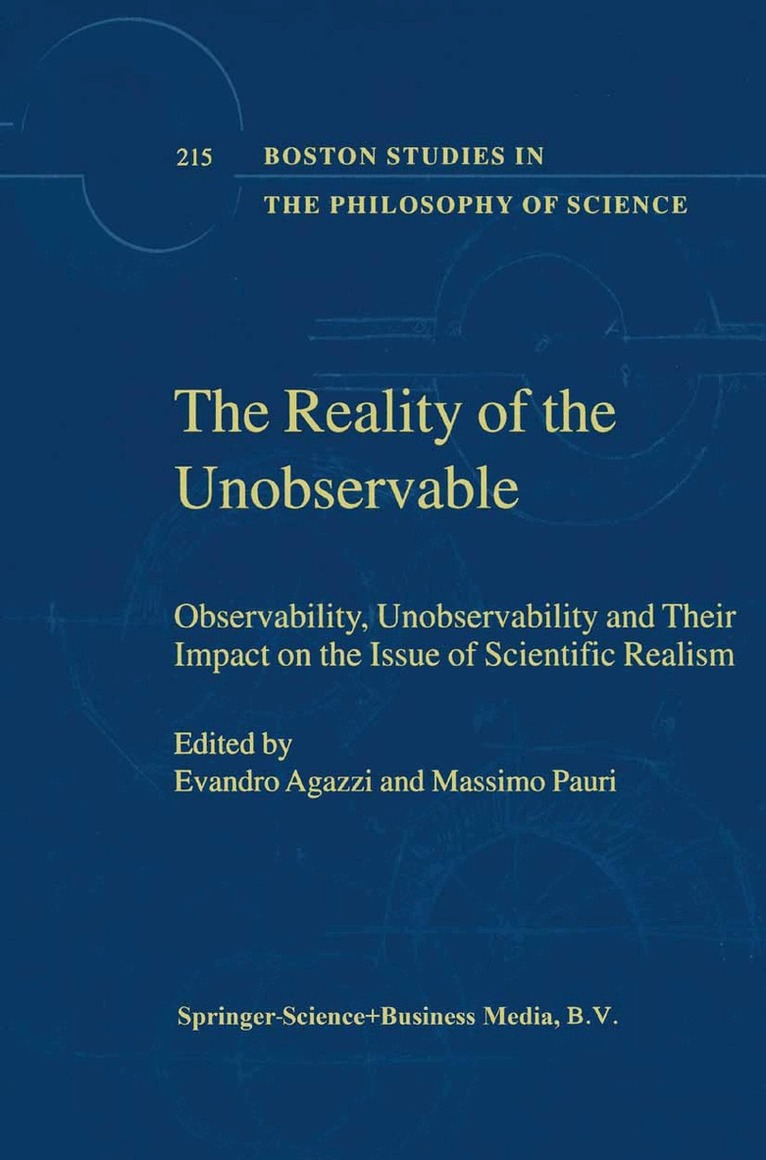
    Reality of the Unobservable

    Observability, Unobservability and Their Impact on the Issue of Scientific Realism

    AvE. Agazzi,M. Pauri

    Inbunden, Engelska, 2000

    Del 215 i serien Boston Studies in the Philosophy and History of Science

    1 625 kr

    Beställningsvara. Skickas inom 10-15 vardagar. Fri frakt över 249 kr.

    Beskrivning

    Observability and Scientific Realism It is commonly thought that the birth of modern natural science was made possible by an intellectual shift from a mainly abstract and specuJative conception of the world to a carefully elaborated image based on observations. There is some grain of truth in this claim, but this grain depends very much on what one takes observation to be. In the philosophy of science of our century, observation has been practically equated with sense perception. This is understandable if we think of the attitude of radical empiricism that inspired Ernst Mach and the philosophers of the Vienna Circle, who powerfully influenced our century's philosophy of science. However, this was not the atti tude of the f ounders of modern science: Galileo, f or example, expressed in a f amous passage of the Assayer the conviction that perceptual features of the world are merely subjective, and are produced in the 'anima!' by the motion and impacts of unobservable particles that are endowed uniquely with mathematically expressible properties, and which are therefore the real features of the world. Moreover, on other occasions, when defending the Copernican theory, he explicitly remarked that in admitting that the Sun is static and the Earth turns on its own axis, 'reason must do violence to the sense' , and that it is thanks to this violence that one can know the tme constitution of the universe.

    Produktinformation

    • Utgivningsdatum:2000-07-31
    • Mått:155 x 235 x 28 mm
    • Vikt:738 g
    • Format:Inbunden
    • Språk:Engelska
    • Serie:Boston Studies in the Philosophy and History of Science
    • Antal sidor:378
    • Förlag:Kluwer Academic Publishers
    • ISBN:9780792363118

    Utforska kategorier

    • Naturvetenskapens filosofi inom Naturvetenskap och teknik

    Innehållsförteckning

    • Observability and Scientific Realism.- History.- The Origin of Scientific Realism: Boltzman, Planck, Einstein.- General Philosophy, Scientific Realism.- Observability and Referentiality.- A new Approach to Human Cognition and its Significance for the Philosophy of Science.- Abduction and Non-Observability — Some Examples from Language Science and the Cognitive Science.- ‘Scientific Realism’ and Scientific Practice.- Random Philosophy.- Formal Representation and the Subjective Side of Scientific Realism.- Convention and Observability — Poincaré once again.- Scientific Realism, Objectivity, and ‘Technological Realism’.- Philosophy of Observation.- Testability and Empiricism.- Observing the Unobservable.- What does it Mean to Observe Physical Reality?.- Realism, and the Case of Rival Theories without Observable Differences.- Measurability, Computability and the Existence of Theoretical Entities.- Observation, Construction and Speculation in Cosmology.- Where did the Notion that Forces are Unobservable come from?.- Philosophy of Quantum Theory.- Quantum Mechanics without the Observables.- Observation, Contextuality and Realism.- Leibniz, Kant and the Quantum — A Provocative Point of View about Observation, Space-Time, and the Mind-Body Issue.- Efficient and Final Causes as CPT Reciprocals.- Specific Issues of Observability in Quantum Theory.- Observability and Realism in Modern Experiments with Correlated Quantum Systems.- Quantum Mechanics, Realism and the Ultimate Observer.- Individualistic and Statistical Interpretation of Quantum Mechanics.- How to Observe Quarks.- Common Experience and Quantum Theory — Observables and Beables.- On the Relationships between Classical and Quantum Mechanics.