• Fri frakt över 249 kr
  • •
  • Snabba leveranser
  • •
  • Billiga böcker
Kundservice

Du är på sajten för privatpersoner.

Företag, bibliotek eller offentlig verksamhet?

Du handlar på classic.bokus.com, där alla dina funktioner finns intakta.
Till classic.bokus.com
Bokus logotyp. Gå till startsidan.
  • Erbjudanden
  • Student
  • Topplistor
  • Barn & ungdom
  • Bokus Play
  • E-böcker
  • Ljudböcker
  • Pocketböcker
  • Spel & pussel

Upp till 25% på utvalda nyheter →

Sidfot

Mina sidor

    Hjälp

    • Kundservice
    • Vanliga frågor och svar
    • Frakt och leverans
    • Retur vid ångerrätt
    • Reklamera vara
    • Betalning
    • Köpvillkor
    • Allmänna villkor
    • Information om webbplatsens tillgänglighet

    Om Bokus

    • Om oss
    • Pressrum
    • För studenter
    • För företag
    • För bibliotek och offentlig verksamhet
    • För leverantörer
    • Hållbarhet

    Populärt

    • Aktuella erbjudanden
    • Presentkort
    • Studentlitteratur
    • Nya böcker
    • Topplistor
    • Signerade böcker
    • Engelska böcker

    Inspiration

    • Boktips
    • BookTok
    • Populära bokserier
    • Barnbokskaraktärer
    • Populära författare
    Logotyp för Bokus
    Följ oss på Facebook (extern länk)Följ oss på Instagram (extern länk)Följ oss på YouTube (extern länk)Följ oss på TikTok (extern länk)
    bokus @ CookiesAnpassa cookiesIntegritetspolicyKöpvillkor
    Till Citymail hemsida (extern länk)Till Budbee hemsida (extern länk)Till Postnord hemsida (extern länk)Till Schenker hemsida (extern länk)Till Early Bird hemsida (extern länk)Till Walleys hemsida (extern länk)
    1. Naturvetenskap och teknik
    2. Geovetenskap
    3. Miljövetenskap och miljöpolitik

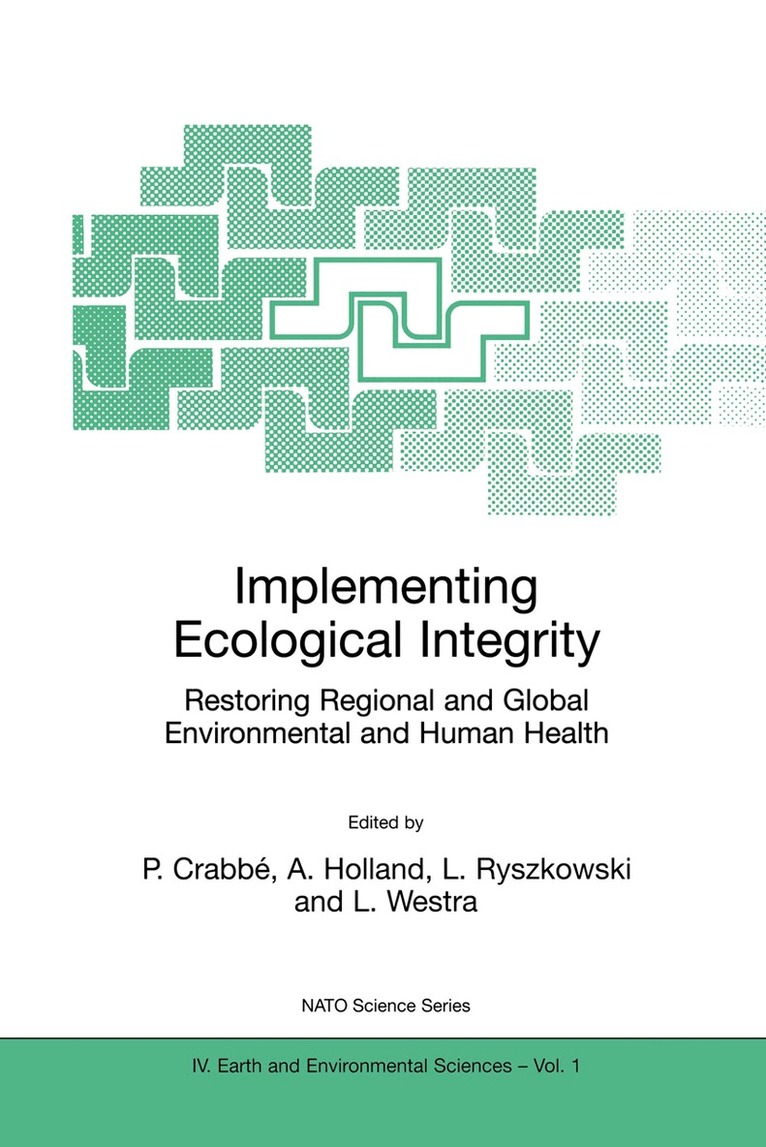
    Implementing Ecological Integrity

    Restoring Regional and Global Environmental and Human Health

    AvPhilippe Crabbé,Alan J. Holland

    Häftad, Engelska, 2000

    Del i serien NATO Science Series: IV:

    2 157 kr

    Beställningsvara. Skickas inom 10-15 vardagar. Fri frakt över 249 kr.

    Beskrivning

    This book contains some of the papers which were presented at the NATO Science, Environmental Security, Advanced Research Workshop on "Implementing Ecological Integrity: Restoring Regional and Global Environmental and Human Health" held in Budapest from June 26 to July 1, 1999. All papers presented are summarized in the Introduction and, in some cases, shorter versions are published. A mUltidisciplinary core of American and Western European participants had met over the preceeding years to discuss the concept of ecological integrity. The term "ecological integrity" is found in environmental policy documents but, generally, is not defined. It competes with other recent terms, or environmental narratives, such as "ecosystem health" and "sustainable development" and also with older ones such as "conservation". Therefore, it is deemed important not only to sort out the definitions of these concepts but also to find out whether their practical implications differ. Moreover, it was interesting to find out whether participants from Central and Eastern European Countries (CEEC) and, more generally, from NATO partner countries would be, first, responsive to this concept and, second, would hold different views of it. This explains the broad, albeit not always consistent, range oftopics which are covered in this book. The core group learned that CEEC and other NATO partners participants were responsive to the concept but that they were less exclusive of human influence.

    Produktinformation

    • Utgivningsdatum:2000-06-30
    • Mått:160 x 240 x 27 mm
    • Vikt:739 g
    • Format:Häftad
    • Språk:Engelska
    • Serie:NATO Science Series: IV:
    • Antal sidor:478
    • Förlag:Kluwer Academic Publishers
    • ISBN:9780792363521

    Utforska kategorier

    • Miljövetenskap och miljöpolitik inom Naturvetenskap och teknik

    Innehållsförteckning

    • 1 The Global Integrity Project and the Ethics of Integrity.- 2 The Coming Change in the Environmental Protection Paradigm.- 3 Approaches to Ecological Integrity: Divergence, Convergence and Implementation.- 4 Ecosystem Integrity and Its Implementation in Eastern Siberia.- 5 The Regional Scope of Implementing Global Ecological Integrity: the Šumava Mountains.- 6 Natural Transborder Parks: the Direction of Biodiversity Preservation in Romania.- 7 State Parks — as a Model of Nature and Culture Protection and Sustainable Development.- 8 Uncertainty, Complexity, and Ecological Integrity: Insights from an Ecosystem Approach.- 9 Ecological Functions and Integrity: Approaches to Valuation.- 10 Rare Species Indicate Ecological Integrity: an Example of an Urban Nature Reserve Island.- 11 Systems Modeling of Brazilian Sustainability with Emergy Flows Diagrams.- 12 Ecological Functions and Socio-Economic Values of Critical Natural Capital as a Measure for Ecological Integrity and Environmental Health.- 13 Strategies for Assessing the Health Impacts of Global Environmental Change.- 14 Environmental & Human Health Aspects of Burning Arsenic Reach Coal Ecology Restoring Issues.- 15 The Problem-Solving Approach in a Community-Lead Pollution Chronic Exposure Situation.- 16 Mothers and Mother Nature: Attachment, Detachment and Human Ecological Integrity.- 17 A Decisional System for the Ethical Evaluation of Animal Experiments.- 18 The Use of Existing Legal Tools to Protect Ecological Integrity.- 19 A Behavioural Approach to Understand the Distinctive Influence of Environmental Instruments on Ecological Integrity.- 20 The Water Conflict in the Middle East: A Test Case for International Intervention.- 21 Instruments for Management in Integral Environment Policy.- 22 Design ofSustainable Development Strategy for a Region.- 23 Global Bioethics: a Suggested Distinction between Ethic and Morality.- 24 The Conception of Natural Goods in Economics.- 25 Agriculture, Food, Populations, Natural Resources and Ecological Integrity.- 26 A Human Ecological Assessment of Economic and Population Health.- 27 Discourse of a “New Alliance” between Neo-Classical Environmental Economics and Other Environmental Narratives.- Conclusion.