• Fri frakt över 249 kr
  • •
  • Snabba leveranser
  • •
  • Billiga böcker
Kundservice

Du är på sajten för privatpersoner.

Företag, bibliotek eller offentlig verksamhet?

Du handlar på classic.bokus.com, där alla dina funktioner finns intakta.
Till classic.bokus.com
Bokus logotyp. Gå till startsidan.
  • Erbjudanden
  • Nyheter
  • Student
  • Topplistor
  • Barn & ungdom
  • Bokus Play
  • E-böcker
  • Pocketböcker
  • Spel & pussel

10% rabatt på allt med kod NYSTART10 →

Sidfot

Mina sidor

    Hjälp

    • Kundservice
    • Vanliga frågor och svar
    • Frakt och leverans
    • Retur vid ångerrätt
    • Reklamera vara
    • Betalning
    • Köpvillkor
    • Allmänna villkor
    • Information om webbplatsens tillgänglighet

    Om Bokus

    • Om oss
    • Pressrum
    • För studenter
    • För företag
    • För bibliotek och offentlig verksamhet
    • För leverantörer
    • Hållbarhet

    Populärt

    • Aktuella erbjudanden
    • Presentkort
    • Studentlitteratur
    • Nya böcker
    • Topplistor
    • Signerade böcker
    • Engelska böcker

    Inspiration

    • Boktips
    • BookTok
    • Populära bokserier
    • Barnbokskaraktärer
    • Populära författare
    Logotyp för Bokus
    Följ oss på Facebook (extern länk)Följ oss på Instagram (extern länk)Följ oss på YouTube (extern länk)Följ oss på TikTok (extern länk)
    bokus @ CookiesAnpassa cookiesIntegritetspolicyKöpvillkor
    Till Citymail hemsida (extern länk)Till Budbee hemsida (extern länk)Till Postnord hemsida (extern länk)Till Schenker hemsida (extern länk)Till Early Bird hemsida (extern länk)Till Walleys hemsida (extern länk)
    1. Ekonomi och Ledarskap
    2. Nationalekonomi

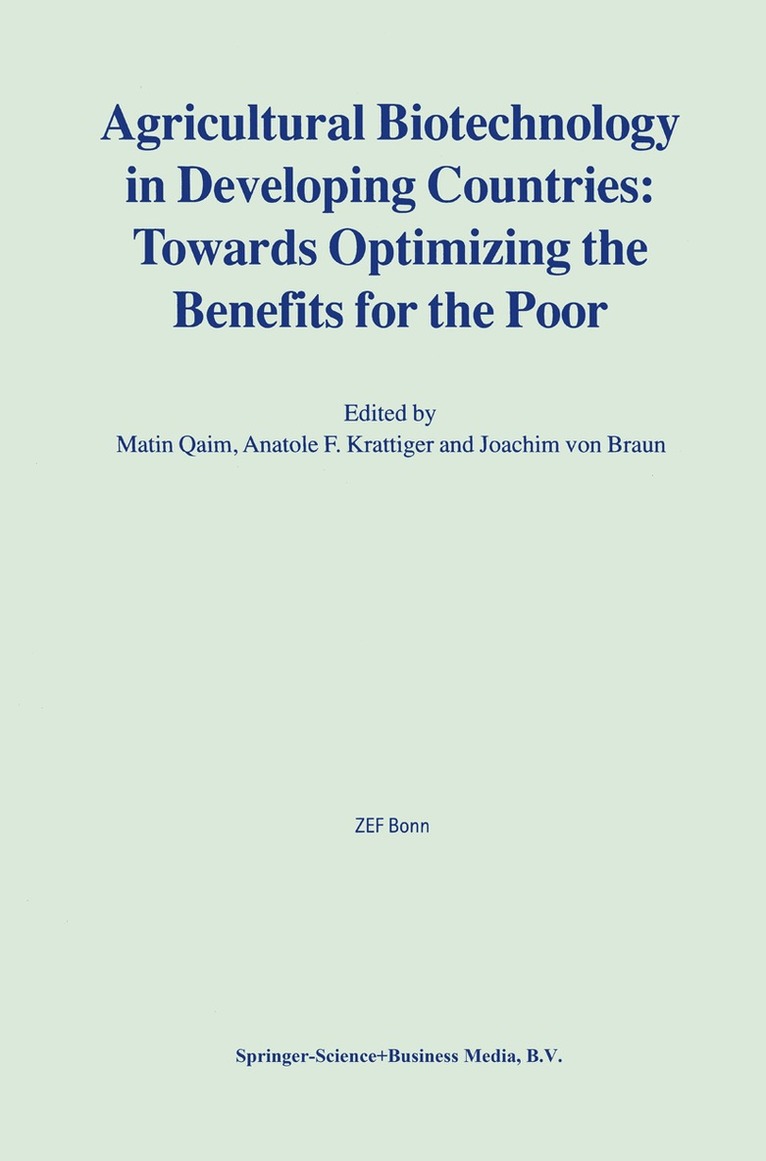
    Agricultural Biotechnology in Developing Countries

    Towards Optimizing the Benefits for the Poor

    AvMatin Qaim,Anatole F. Krattiger

    Inbunden, Engelska, 2000

    1 623 kr

    Beställningsvara. Skickas inom 10-15 vardagar. Fri frakt över 249 kr.

    Beskrivning

    Biotechnology offers great potential to contribute to sustainable agricultural growth, food security and poverty alleviation in developing countries. Yet there are economic and institutional constraints at national and international levels that inhibit the poor people's access to appropriate biotechnological innovations. Agricultural Biotechnology in Developing Countries: Towards Optimizing the Benefits for the Poor addresses the major constraints. Twenty-three chapters, written by a wide range of scholars and stake-holders, provide an up-to-date analysis of agricultural biotechnology developments in Latin America, Africa and Asia. Besides the expected economic and social impacts, the challenges for an adjustment of the international research structure are discussed, with a special focus on intellectual property rights and the roles of the main research organizations. Harnessing the comparative advantages of the public and private sectors through innovative partnerships is the only way forward to optimize the benefits of biotechnology for the poor. The book will be an invaluable resource for both academics and policy-makers concerned with agricultural biotechnology in context of developing-countries.

    Produktinformation

    • Utgivningsdatum:2000-10-31
    • Mått:156 x 234 x 29 mm
    • Vikt:840 g
    • Format:Inbunden
    • Språk:Engelska
    • Antal sidor:434
    • Upplaga:2000
    • Förlag:Kluwer Academic Publishers
    • ISBN:9780792372301

    Utforska kategorier

    • Nationalekonomi inom Ekonomi och Ledarskap
    • Agronomi och lantbruk inom Naturvetenskap och teknik
    • Lantbruk, fiske och skogsbruk inom Ekonomi och Ledarskap

    Mer om författaren

    Matin Qaim is a Research Fellow at the Center for Development Research (ZEF), University of Bonn, Germany.Anatole F. Krattiger is Executive Director of the International Service for the Acquisition of Agri-biotech Applications (ISAAA).Joachim von Braun is Director of ZEF.

    Innehållsförteckning

    • 1 Introduction.- I The General Framework.- 2 Transgenic Crops Worldwide: Current Situation and Future Outlook.- 3 Molecular Tools for Plant Breeding.- 4 Managing Biosafety Capacity Development: Technical and Political Aspects.- II Regional Outlook.- 5 The Situation of Agricultural Biotechnology Capacities and Exploitation in Latin America and the Caribbean.- 6 The Current and Future Situation of Agricultural Biotechnology in Africa: Challenges and Opportunities.- 7 Biotechnology Research in Rice for Asia: Priorities, Focus and Directions.- III Expected Impacts.- 8 The Roles of Economic Research in the Evolution of International Agricultural Biotechnology.- 9 Welfare Prospects of Transgenic Crops in Developing Countries.- 10 Institutional Issues in Biotechnology Applications: Concepts and Empirical Evidence from Kenya.- 11 The Role of Biotechnology for Food Consumers in Developing Countries.- 12 Biotechnology and Global Food Security: A Private-Sector View.- 13 Agricultural Biotechnology and the Seed Industry: Some Implications for Food Production and Security.- 14 A Danger to the World’s Food: Genetic Engineering and the Economic Interests of the Life-Science Industry.- 15 Of Terminator Genes and Developing Countries: What are the Impacts of Appropriation Technologies on Technological Diffusion?.- IV Intellectual Property Rights.- 16 The Economics of Intellectual Property Rights in the Agricultural Biotechnology Sector.- 17 Intellectual Property Rights Issues and Developing Countries: A Private-Sector Perspective.- 18 Intellectual Property Rights Challenges and International Research Collaborations in Agricultural Biotechnology.- V The Role of Different Players.- 19 The Role of the Private Sector in Providing Biotechnology Access to the Poor.- 20 Bringing the Benefitsof Biotechnology to the Poor: The Role of the CGIAR Centers.- 21 The Role of National Agricultural Research Systems in Providing Biotechnology Access to the Poor: Grassroots for an Ivory Tower?.- 22 Agricultural Biotechnology and the Poor: The Role of Development Assistance Agencies.- 23 Conclusions.- Contributing Authors.