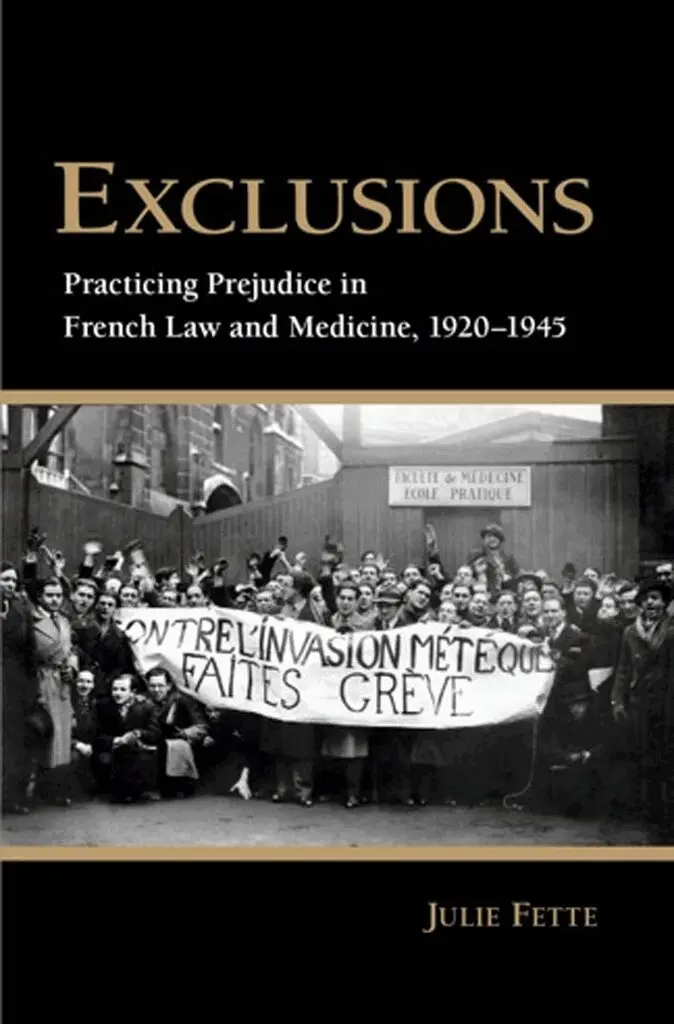
Inbunden, Engelska, 2012
Exclusions
Practicing Prejudice in French Law and Medicine, 1920–1945
Av Julie Fette
754 kr
Beställningsvara. Skickas inom 10-15 vardagar. Fri frakt över 249 kr.
Beskrivning
Produktinformation
- Utgivningsdatum: 2012-04-15
- Mått: 155 x 235 x 25 mm
- Vikt: 907 g
- Format: Inbunden
- Språk: Engelska
- Antal sidor: 328
- Förlag: Cornell University Press
- ISBN: 9780801450211
Utforska kategorier
Mer om författaren
Julie Fette is Associate Professor of French Studies at Rice University.
Recensioner i media
Although other scholars have considered aspects of her subject, this book stands out by systematically comparing the development of exclusion in two French professions, and it provides new information on how the process worked in practice. Fette analyzes the role of students, professionals, and governments and the motives behind exclusion, including not just the prejudices invoked in the book's subtitle, but also economic protectionism and 'professional identity formation'....All in all, Fette's sobering account makes a valuable contribution to the history of the professions.- Matthew Ramsey (Journal of the History of Medicine) Her study is extremely detailed, often technical, and has the advantage of underlining the differences from one region to another.... In sum this is an excellent essay in social history that expands our knowledge of the years of the occupation as well as of those that preceded it.- Renée Poznanski, Ben-Gurion University (Contemporary French Civilization) Julie Fette argues in this definitive work that medical and legal professionals helped prepare the ground for the Holocaust through generations of systematic efforts to limit professional competition by progressively narrowing the definition of eligibility to practice. Efforts to protect professional monopolies are as old as the professions themselves, but a confluence of time and circumstance made them deadly in Europe in the years leading up to World War II.- Robert Nye (Journal of Modern History) This book contains the first comparative analysis of the laws initiated from the professions themselves. This was necessary to understand that what happened during the Vichy regime was a mere continuation of this process, giving much satisfaction to the professions that had so firmly advocated for what could be seen as anticipatory policies. Even the anti-Semitic legislation, that did not exist as such before the occupation, was rendered acceptable by the fact that xenophobia was long tainted by prejudice against Jews, notably from Eastern Europe... If lawyers and doctors applied those exclusion laws, in the wake of a more general policy in favor of their corporatist organizations, Fette's careful attention to the details of this implementation stresses the limits to their independence that those groups accepted in applying exclusion laws, particularly when it came to the control of their membership, causing the ruin, despair, and, indirectly, the death of colleagues. It is all the more striking that this legislation—and the myth of overcrowding justifying it—had not been totally erased by the new era opened by the liberation of the country.- Liora Israël, École des Hautes Études en Sciences Sociales (Law and History Review)
Betyg & recensioner
0 recensioner
Inga recensioner tillgängliga.