• Fri frakt över 249 kr
  • •
  • Snabba leveranser
  • •
  • Billiga böcker
Kundservice

Du är på sajten för privatpersoner.

Företag, bibliotek eller offentlig verksamhet?

Du handlar på classic.bokus.com, där alla dina funktioner finns intakta.
Till classic.bokus.com
Bokus logotyp. Gå till startsidan.
  • Erbjudanden
  • Nyheter
  • Student
  • Topplistor
  • Barn & ungdom
  • Bokus Play
  • E-böcker
  • Pocketböcker
  • Spel & pussel

10% rabatt på allt med kod NYSTART10 →

Sidfot

Mina sidor

    Hjälp

    • Kundservice
    • Vanliga frågor och svar
    • Frakt och leverans
    • Retur vid ångerrätt
    • Reklamera vara
    • Betalning
    • Köpvillkor
    • Allmänna villkor
    • Information om webbplatsens tillgänglighet

    Om Bokus

    • Om oss
    • Pressrum
    • För studenter
    • För företag
    • För bibliotek och offentlig verksamhet
    • För leverantörer
    • Hållbarhet

    Populärt

    • Aktuella erbjudanden
    • Presentkort
    • Studentlitteratur
    • Nya böcker
    • Topplistor
    • Signerade böcker
    • Engelska böcker

    Inspiration

    • Boktips
    • BookTok
    • Populära bokserier
    • Barnbokskaraktärer
    • Populära författare
    Logotyp för Bokus
    Följ oss på Facebook (extern länk)Följ oss på Instagram (extern länk)Följ oss på YouTube (extern länk)Följ oss på TikTok (extern länk)
    bokus @ CookiesAnpassa cookiesIntegritetspolicyKöpvillkor
    Till Citymail hemsida (extern länk)Till Budbee hemsida (extern länk)Till Postnord hemsida (extern länk)Till Schenker hemsida (extern länk)Till Early Bird hemsida (extern länk)Till Walleys hemsida (extern länk)
    1. Samhälle och politik
    2. Politik och statsskick
    3. Politiska partier

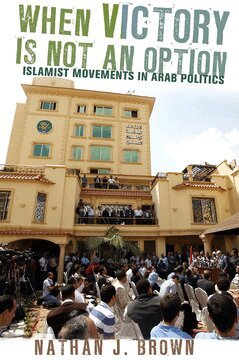
    When Victory Is not an Option

    Islamist Movements in Arab Politics

    AvNathan J. Brown

    Häftad, Engelska, 2012

    393 kr

    Beställningsvara. Skickas inom 10-15 vardagar. Fri frakt över 249 kr.

    Fler format och utgåvor

    Inbunden

    1 666 kr

    Beskrivning

    Throughout the Arab world, Islamist political movements are joining the electoral process. This change alarms some observers and excites other. In recent years, electoral opportunities have opened, and Islamist movements have seized them. But those opportunities, while real, have also been sharply circumscribed. Elections may be freer, but they are not fair. The opposition can run but it generally cannot win. Semiauthoritarian conditions prevail in much of the Arab world, even in the wake of the Arab Spring. How do Islamist movements change when they plunge into freer but unfair elections? How do their organizations (such as the Muslim Brotherhood) and structures evolve? What happens to their core ideological principles? And how might their increased involvement affect the political system? In When Victory Is Not an Option, Nathan J. Brown addresses these questions by focusing on Islamist movements in Egypt, Jordan, Kuwait, and Palestine. He shows that uncertain benefits lead to uncertain changes. Islamists do adapt their organizations and their ideologies do bend—some. But leaders almost always preserve a line of retreat in case the political opening fizzles or fails to deliver what they wish. The result is a cat-and-mouse game between dominant regimes and wily movements. There are possibilities for more significant changes, but to date they remain only possibilities.

    Produktinformation

    • Utgivningsdatum:2012-03-15
    • Mått:155 x 235 x 16 mm
    • Vikt:454 g
    • Format:Häftad
    • Språk:Engelska
    • Antal sidor:272
    • Förlag:Cornell University Press
    • ISBN:9780801477720

    Utforska kategorier

    • Politiska partier inom Samhälle och politik
    • Politisk aktivism inom Samhälle och politik
    • Mellanösterns historia inom Historia och arkeologi

    Mer om författaren

    Nathan J. Brown is Professor of Political Science and International Affairs at George Washington University. He is the author of several books, including The Dynamics of Democratization; Palestinian Politics after the Oslo Accords; and Constitutions in a Nonconstitutional World.

    Recensioner i media

    Brown examines the organization, operation, and impact of Islamist movements in semi-authoritarian states, or systems in which opposition parties are permitted to participate but not win, arguing that while these movements become 'politicized' (i.e., they are participants in politics and elections), they are so in a limited way.... He provides an excellent framework for understanding the recent political dynamics of the Arab world.(Choice) Brown's book... captures the main dynamics of Arab politics today, and it serves as a guideline to predict the future of Arab Islamists. This theoretically deep, empirically rich, and politically insightful book is a must-read for students of Middle East politics.- Ahmet T. Kuru (Political Science Quarterly) His metaphor of 'Islamist' survival, that they survive 'as a cat-and-mouse game so long as the cat allows the mouse to live and the mouse remains a mouse' (p. 240) is prophetic as well as salient. The value of Brown's approach is that he compares and contrasts movements across the Middle East and not just on one organization or country.- Daniel Martin Varisco (Contemporary Islam) This is an important book not only for its rich empirical exploration of the Muslim Brotherhood in four settings (Egypt, Jordan, Kuwait, and the Palestinian territories) but also for its insights into semiauthoritarian regimes, which allow opposition groups just enough room to organize and compete but not enough to win elections or form governments. Relying on extensive contacts with Brotherhood leaders, Brown explains how they saw advantages—such as gaining the right to legal assembly and being allowed to propagate their views and deliver basic services to the needy—to playing a game they were destined to lose.- John Waterbury (Foreign Affairs)

    Innehållsförteckning

    • Preface1. Partially Political Movements in Semiauthoritarian Systems2. Running to Lose? Elections, Authoritarianism, and Islamist Movements3. Beyond Analogy Mongering: Ideological Movements and the Debate over the Primacy of Politics4. The Model and the Mother Movement5. The Model in Practice in Four Semiauthoritarian Settings6. Can Islamists Party? Political Participation and Organizational Change7. Ideological Change: Flirtation and Commitment8. Arab Politics and Societies as They Might Be9. Islamist Parties and Arab Political Systems as They AreBibliographyIndex