• Fri frakt över 249 kr
  • •
  • Snabba leveranser
  • •
  • Billiga böcker
Kundservice

Du är på sajten för privatpersoner.

Företag, bibliotek eller offentlig verksamhet?

Du handlar på classic.bokus.com, där alla dina funktioner finns intakta.
Till classic.bokus.com
Bokus logotyp. Gå till startsidan.
  • Erbjudanden
  • Nyheter
  • Student
  • Topplistor
  • Barn & ungdom
  • Bokus Play
  • E-böcker
  • Pocketböcker
  • Spel & pussel

10% rabatt på allt med kod NYSTART10 →

Sidfot

Mina sidor

    Hjälp

    • Kundservice
    • Vanliga frågor och svar
    • Frakt och leverans
    • Retur vid ångerrätt
    • Reklamera vara
    • Betalning
    • Köpvillkor
    • Allmänna villkor
    • Information om webbplatsens tillgänglighet

    Om Bokus

    • Om oss
    • Pressrum
    • För studenter
    • För företag
    • För bibliotek och offentlig verksamhet
    • För leverantörer
    • Hållbarhet

    Populärt

    • Aktuella erbjudanden
    • Presentkort
    • Studentlitteratur
    • Nya böcker
    • Topplistor
    • Signerade böcker
    • Engelska böcker

    Inspiration

    • Boktips
    • BookTok
    • Populära bokserier
    • Barnbokskaraktärer
    • Populära författare
    Logotyp för Bokus
    Följ oss på Facebook (extern länk)Följ oss på Instagram (extern länk)Följ oss på YouTube (extern länk)Följ oss på TikTok (extern länk)
    bokus @ CookiesAnpassa cookiesIntegritetspolicyKöpvillkor
    Till Citymail hemsida (extern länk)Till Budbee hemsida (extern länk)Till Postnord hemsida (extern länk)Till Schenker hemsida (extern länk)Till Early Bird hemsida (extern länk)Till Walleys hemsida (extern länk)
    1. Medicin
    2. Medicin: allmänt
    3. Medicinhistoria

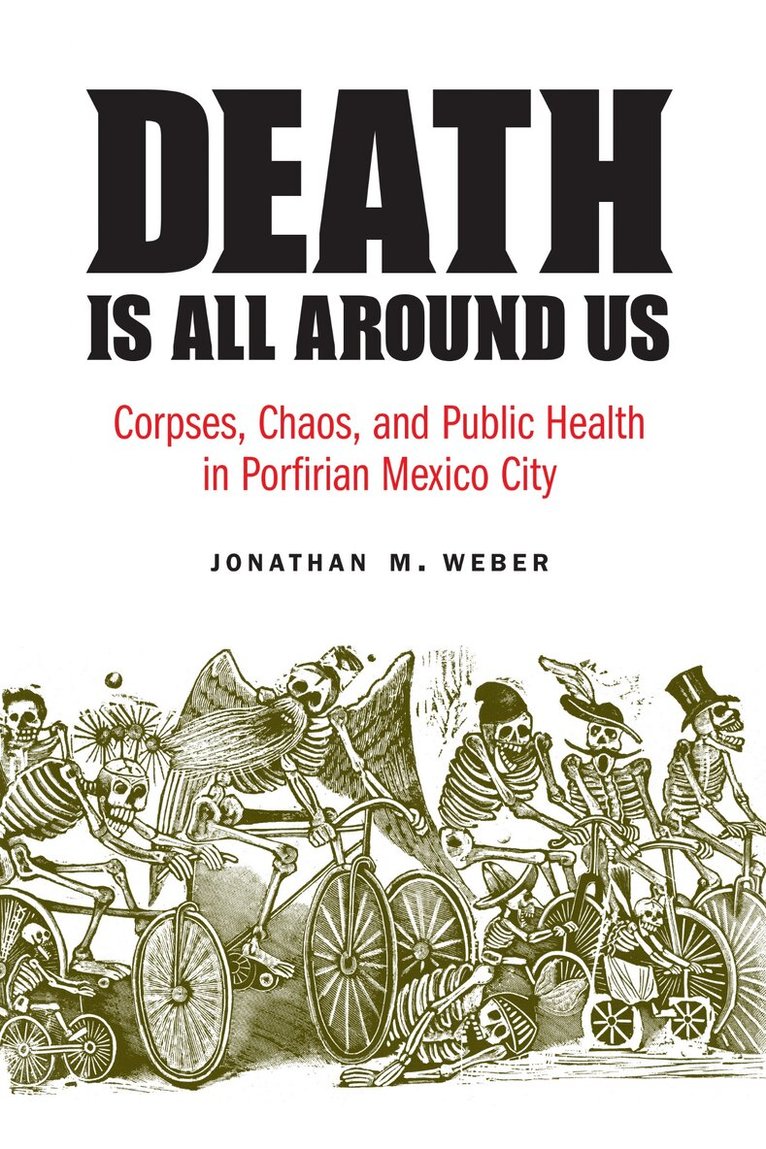
    Death Is All Around Us

    Corpses, Chaos, and Public Health in Porfirian Mexico City

    AvJonathan M. Weber

    Inbunden, Engelska, 2019

    Del i serien Mexican Experience

    579 kr

    Beställningsvara. Skickas inom 10-15 vardagar. Fri frakt över 249 kr.

    Fler format och utgåvor

    Häftad

    336 kr

    Beskrivning

    Late nineteenth-century Mexico was a country rife with health problems. In 1876, one out of every nineteen people died prematurely in Mexico City, a staggeringly high rate when compared to other major Western world capitals at the time, which saw more modest premature death rates of one out of fifty-two (London), one out of forty-four (Paris), and one out of thirty-five (Madrid). It is not an exaggeration to maintain that each day dozens of bodies could be found scattered throughout the streets of Mexico City, making the capital city one of the most unsanitary places in the Western Hemisphere.In light of such startling scenes, in Death Is All around Us Jonathan M. Weber examines how Mexican state officials, including President Porfirio DÍaz, tried to resolve the public health dilemmas facing the city. By reducing the high mortality rate, state officials believed that Mexico City would be seen as a more modern and viable capital in North America. To this end the government used new forms of technology and scientific knowledge to deal with the thousands of unidentified and unburied corpses found in hospital morgues and cemeteries and on the streets. Tackling the central question of how the government used the latest technological and scientific advancements to persuade citizens and foreigners alike that the capital city-and thus Mexico as a whole-was capable of resolving the hygienic issues plaguing the city, Weber explores how the state’s attempts to exert control over procedures of death and burial became a powerful weapon for controlling the behavior of its citizens.

    Produktinformation

    • Utgivningsdatum:2019-04-01
    • Mått:152 x 229 x 21 mm
    • Vikt:603 g
    • Format:Inbunden
    • Språk:Engelska
    • Serie:Mexican Experience
    • Antal sidor:294
    • Förlag:University of Nebraska Press
    • ISBN:9780803284661

    Utforska kategorier

    • Medicinhistoria inom Medicin
    • Amerikas historia inom Historia och arkeologi
    • Folkhälsa och hälsopedagogik inom Medicin

    Mer om författaren

    Jonathan M. Weber is a teacher and independent scholar living in Dallas, Texas. He received his PhD from the Department of History at Florida State University in 2013 and has worked in a wide range of archives in the United States and Mexico to research this study. He has presented this work at more than a dozen conferences, including the American Historical Association, Latin American Studies Association, and the Rocky Mountain Council for Latin American Studies.

    Recensioner i media

    "As we toil with the many ways in which life overwhelms us-climate change, COVID-19, and global inequality-Death Is All around Us helps us to consider the deep challenge facing any society hoping to bring the forces of nature to heel simply through the power of technology."-John Mckiernan-Gonzalez, New Mexico Historical Review "Death Is All around Us draws on and contributes to foundational scholarship on Porfirian public health by Claudia Agostoni, Ana MarÍa Carrillo, Pablo Piccatto, Katherine Bliss, and others. It is also inspired by the conceptual frameworks set out by Michel Foucault, James Scott, Bruno Latour, and Nayan Shah, and situates itself neatly within the historiography of science and technology studies. Weber succeeds in showcasing Porfirian Mexico’s unique history of corpse management, and the work will be a useful resource for historians of public health and sanitation in other regions, too. The themes at hand-trust in authority (or lack thereof), autonomy of the people, moral economies of life and death, and the disposal of the dead-are all too relevant in light of the public health crisis that currently rages in the Americas."-Elizabeth O'Brien, H-LatAm "With memorable examples and clear prose, Death Is All Around Us persuasively makes the case for the relative failure of the Porfirian state of this important realm of popular life (and death)."-Nora E. Jaffary, Bulletin of the History of Medicine “Weber goes beyond monolithic studies of an oppressive dictatorship. Rather, he creatively assembles narratives culled from multiple archival sources demonstrating how burial practices, cemetery construction, cremation, coffin design, and embalming advanced goals to create a modern, cosmopolitan, and hygienic citizen. An important contribution to our understanding of Mexico City and the Porfiriato, Weber’s book furthers understandings about the history of medicine, public health, technology, and modernity.”-Heather McCrea, author of Diseased Relations: Epidemics, Public Health, and State-Building in YucatÁn, Mexico, 1847–1924 “Fascinating. . . . Readers will be delighted at the stories that Weber has brought to light through a thorough combing of underutilized archives even as they will be reminded of the ubiquity of death and corpses in late nineteenth-century Mexico.”-Andrae Marak, professor of history and political science at Governors State University “A highly innovative contribution to the histories of death, public health, and mortuary science.”-Kathryn A. Sloan, author of Death in the City: Suicide and the Social Imaginary in Modern Mexico “Morbidity and decomposing bodies fill the pages of Weber’s engagingly written account of how officials tried to control death as a way of controlling life in Mexico City. Weber adeptly explores how death became modernized through science, medicine, and technology.”-Anna Rose Alexander, assistant professor of history at California State University, East Bay “Death Is All around Us addresses the often troublesome, always gruesome subject of dead bodies as practical problems of sanitary disposal, objects of scientific study, and powerful symbols of human mortality in a cultural milieu obsessed with ‘order and progress.’”-Robert M. Buffington, author of A Sentimental Education for the Working Man: The Mexico City Penny Press, 1900–1910

    Innehållsförteckning

    • ContentsList of IllustrationsAcknowledgmentsIntroduction1. Moving into the Modern Era: Transporting the Dead in Mexico City2. “An Extraordinary Tool”: Building a Modern Public Health System through Anatomical Dissection3. Wet or Dry Remains: Funerary Technology and Protecting Public Health4. Undermining Progress: Workers, Citizens, and the Moral Economy of DeathConclusionNotesBibliographyIndex