• Fri frakt över 249 kr
  • •
  • Snabba leveranser
  • •
  • Billiga böcker
Kundservice

Du är på sajten för privatpersoner.

Företag, bibliotek eller offentlig verksamhet?

Du handlar på classic.bokus.com, där alla dina funktioner finns intakta.
Till classic.bokus.com
Bokus logotyp. Gå till startsidan.
  • Erbjudanden
  • Nyheter
  • Student
  • Topplistor
  • Barn & ungdom
  • Bokus Play
  • E-böcker
  • Pocketböcker
  • Spel & pussel

10% rabatt på allt med kod: NYSTART10 →

Sidfot

Mina sidor

    Hjälp

    • Kundservice
    • Vanliga frågor och svar
    • Frakt och leverans
    • Retur vid ångerrätt
    • Reklamera vara
    • Betalning
    • Köpvillkor
    • Allmänna villkor
    • Information om webbplatsens tillgänglighet

    Om Bokus

    • Om oss
    • Pressrum
    • För studenter
    • För företag
    • För bibliotek och offentlig verksamhet
    • För leverantörer
    • Hållbarhet

    Populärt

    • Aktuella erbjudanden
    • Presentkort
    • Studentlitteratur
    • Nya böcker
    • Topplistor
    • Signerade böcker
    • Engelska böcker

    Inspiration

    • Boktips
    • BookTok
    • Populära bokserier
    • Barnbokskaraktärer
    • Populära författare
    Logotyp för Bokus
    Följ oss på Facebook (extern länk)Följ oss på Instagram (extern länk)Följ oss på YouTube (extern länk)Följ oss på TikTok (extern länk)
    bokus @ CookiesAnpassa cookiesIntegritetspolicyKöpvillkor
    Till Citymail hemsida (extern länk)Till Budbee hemsida (extern länk)Till Postnord hemsida (extern länk)Till Schenker hemsida (extern länk)Till Early Bird hemsida (extern länk)Till Walleys hemsida (extern länk)
    1. Samhälle och politik
    2. Sociologi och antropologi
    3. Antropologi

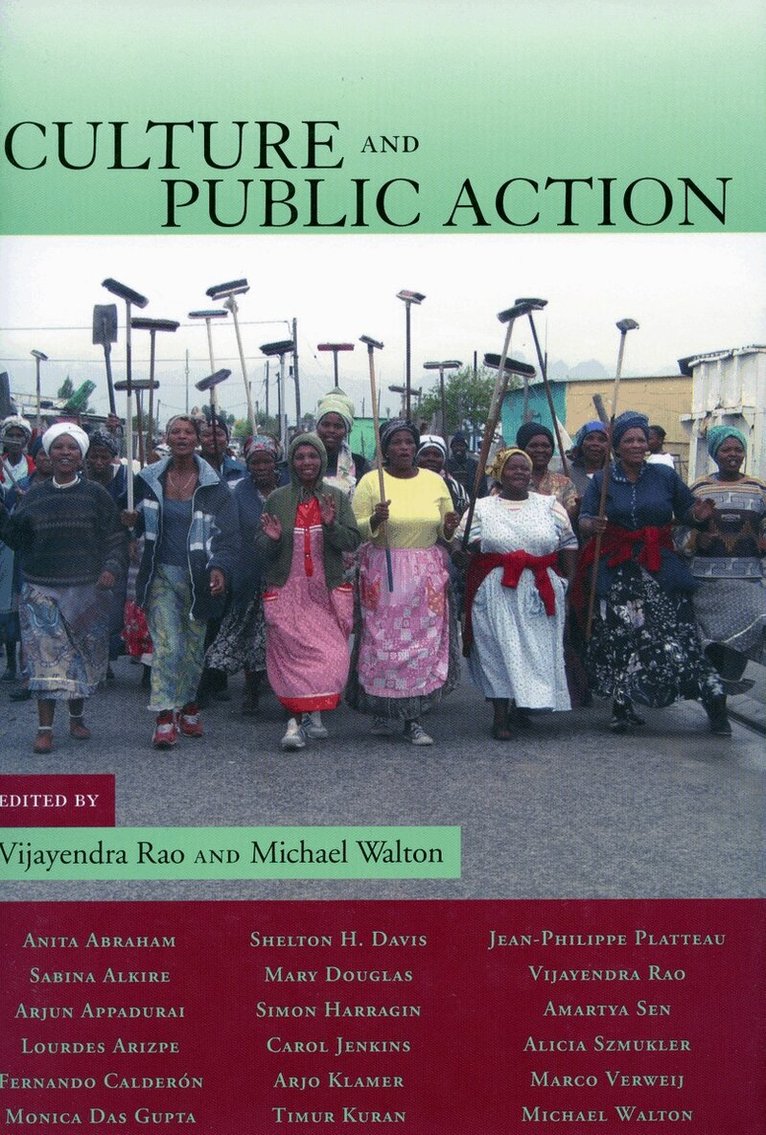
    Culture and Public Action

    AvVijayendra Rao,Michael Walton

    Inbunden, Engelska, 2004

    1 563 kr

    Beställningsvara. Skickas inom 10-15 vardagar. Fri frakt över 249 kr.

    Beskrivning

    How does culture matter for development? Do certain societies have cultures which condemn them to poverty? Led by Arjun Appadurai, Mary Douglas, and Amartya Sen, the anthropologists and economists in this volume contend that culture is central to development, and that cultural processes are neither inherently good nor bad and never static. Rather, they are contested and evolving, and can be a source of profound social and economic transformation through their influence on aspirations and collective action; yet they can also be exploitative, exclusionary, and can lead to inequality.Culture and Public Action includes case studies from Africa, Asia, and Latin America, which examine the role of culture in community-based development, ethnic conflict, famine relief, gender discrimination, and HIV-AIDS policy. The editors conclude by proposing how a "cultural lens" can better inform future research and public policy on development. Accessible, balanced, and engaging, this book will be of interest to anyone concerned with the relationship between culture and economics, and the design and implementation of development policy. For further information on the book and related essays, please visit:http://www.cultureandpublicaction.orgFor orders from India, Bangladesh, Nepal, and Sri Lanka, please e-mailPermanent Black at perblack@ndb.vsnl.net.in.

    Produktinformation

    • Utgivningsdatum:2004-07-08
    • Mått:152 x 229 x 35 mm
    • Vikt:776 g
    • Format:Inbunden
    • Språk:Engelska
    • Antal sidor:464
    • Förlag:Stanford University Press
    • ISBN:9780804747868

    Utforska kategorier

    • Antropologi inom Samhälle och politik
    • Internationell ekonomi inom Ekonomi och Ledarskap
    • Sociala grupper och identitet inom Samhälle och politik

    Mer om författaren

    Vijayendra Rao is senior economist in the Development Research Group of the World Bank. Michael Walton is adviser on poverty reduction and human development in the Latin America and Caribbean Region of the World Bank.

    Recensioner i media

    "The observation that cultural norms affect economic development has been made repeatedly, yet it has been very hard to use it effectively, whether for policy or for prediction. The essays in this volume present authoritatively the present state of knowledge and point out new aspects which hold out the prospect of greater usefulness."—Kenneth Arrow, Stanford University, and Winner of the 1972 Nobel Prize in Economics "The editors are to be congratulated on having attracted three heavy hitters to their enterprise—Amartya Sen, Mary Douglas, and Arjun Appadurai. And these luminaries have come up with the goods, writing papers any one of which would attract readers. This book will have a diverse readership and it will deserve to do so."—Dr. Keith Hart, University of Aberdeen "This impressive collection of essays combines outstanding theoretical essays on the complex interrelation between culture and development with well-researched case studies that ground these observations in the everyday reality of the poor. The book does not seek to resolve all debates on these issues, but rather asks what kinds of agreements are possible that will yield insights to move public action in meaningful ways. It is an invitation to go beyond polemics and to deepen our stakes in the dialogue between anthropology and economics. The introduction and conclusion by the two editors are models of clarity and hospitable thought."—Veena Das, Krieger-Eisenhower Professor of Anthropology, Johns Hopkins University "This book provides us with valuable insights into the relationship between culture and development, and with practical advice on the implications of this for development policy. It should be read by all who are interested in reducing poverty and deprivation in our increasingly interconnected world."—James D. Wolfensohn, President, The World Bank "Rao and Walton's Culture and Public Action . . . . develops a remarkably different approach both to the conceptualization of culture and to the understanding of its role - primarily in regard to poverty and inequality. A collection of essays by economists, anthropologists, and political scientists, the book robustly critiques cultural determinism."—Governance and Development Review