• Fri frakt över 249 kr
  • •
  • Snabba leveranser
  • •
  • Billiga böcker
Kundservice

Du är på sajten för privatpersoner.

Företag, bibliotek eller offentlig verksamhet?

Du handlar på classic.bokus.com, där alla dina funktioner finns intakta.
Till classic.bokus.com
Bokus logotyp. Gå till startsidan.
  • Erbjudanden
  • Nyheter
  • Student
  • Topplistor
  • Barn & ungdom
  • Bokus Play
  • E-böcker
  • Pocketböcker
  • Spel & pussel

10% studentrabatt med kod TERM26

Sidfot

Mina sidor

    Hjälp

    • Kundservice
    • Vanliga frågor och svar
    • Frakt och leverans
    • Retur vid ångerrätt
    • Reklamera vara
    • Betalning
    • Köpvillkor
    • Allmänna villkor
    • Information om webbplatsens tillgänglighet

    Om Bokus

    • Om oss
    • Pressrum
    • För studenter
    • För företag
    • För bibliotek och offentlig verksamhet
    • För leverantörer
    • Hållbarhet

    Populärt

    • Aktuella erbjudanden
    • Presentkort
    • Studentlitteratur
    • Nya böcker
    • Topplistor
    • Signerade böcker
    • Engelska böcker

    Inspiration

    • Boktips
    • BookTok
    • Populära bokserier
    • Barnbokskaraktärer
    • Populära författare
    Logotyp för Bokus
    Följ oss på Facebook (extern länk)Följ oss på Instagram (extern länk)Följ oss på YouTube (extern länk)Följ oss på TikTok (extern länk)
    bokus @ CookiesAnpassa cookiesIntegritetspolicyKöpvillkor
    Till Citymail hemsida (extern länk)Till Budbee hemsida (extern länk)Till Postnord hemsida (extern länk)Till Schenker hemsida (extern länk)Till Early Bird hemsida (extern länk)Till Walleys hemsida (extern länk)
    1. Ekonomi och Ledarskap
    2. Nationalekonomi
    3. Ekonomisk politik

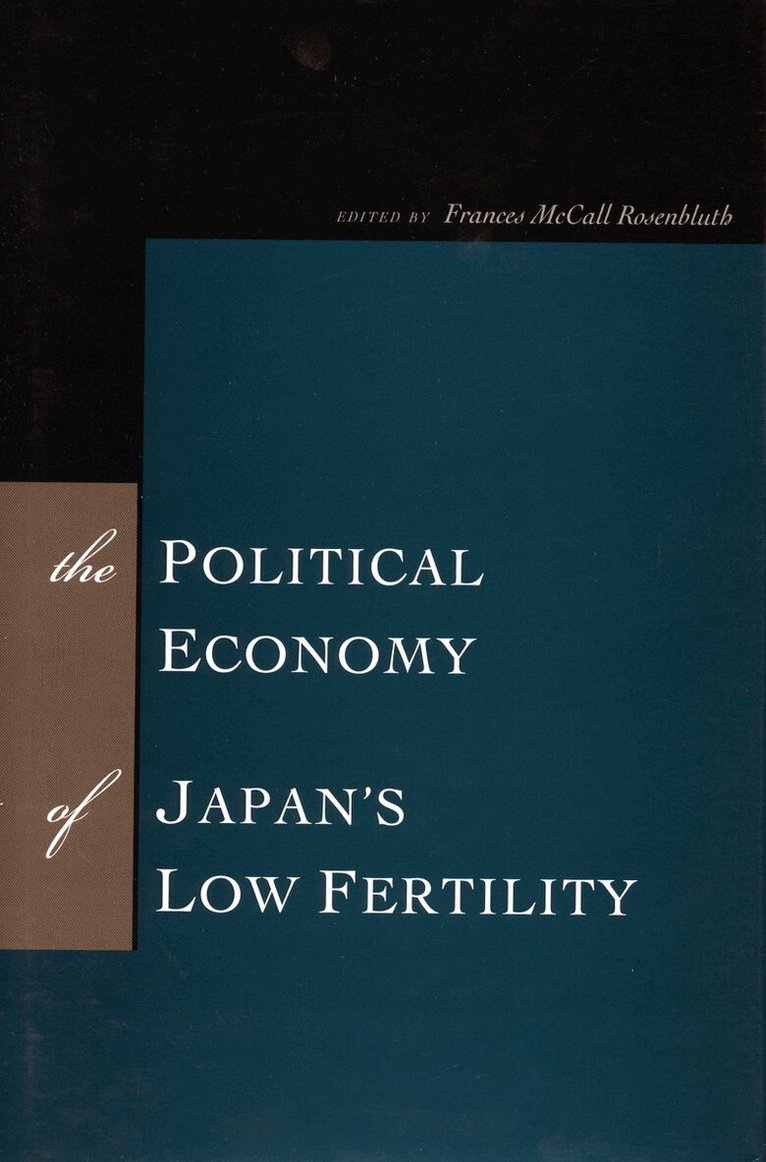
    Political Economy of Japan's Low Fertility

    AvFrances McCall Rosenbluth

    Inbunden, Engelska, 2006

    674 kr

    Beställningsvara. Skickas inom 10-15 vardagar. Fri frakt över 249 kr.

    Beskrivning

    This book takes an interdisciplinary approach to one of Japan's thorniest public policy issues: why are women increasingly forgoing motherhood? At the heart of the matter lies a paradox: although the overall trend among rich countries is for fertility to decrease as female labor participation increases, gender-friendly countries resist the trend. Conversely, gender-unfriendly countries have lower fertility rates than they would have if they changed their labor markets to encourage the hiring of women—and therein lies Japan's problem. The authors argue that the combination of an inhospitable labor market for women and insufficient support for childcare pushes women toward working harder to promote their careers, to the detriment of childbearing. Controversial and enlightening, this book provides policy recommendations for solving not just Japan's fertility issue but those of other modern democracies facing a similar crisis.

    Produktinformation

    • Utgivningsdatum:2006-12-08
    • Mått:152 x 229 x 20 mm
    • Vikt:454 g
    • Format:Inbunden
    • Språk:Engelska
    • Antal sidor:240
    • Förlag:Stanford University Press
    • ISBN:9780804754866

    Utforska kategorier

    • Ekonomisk politik inom Ekonomi och Ledarskap
    • Genusvetenskap inom Samhälle och politik
    • Sociologi inom Samhälle och politik

    Mer om författaren

    Frances McCall Rosenbluth is Professor of Political Science and Director of the Leitner Program in Political Economy at Yale University. Her recent publications include The Politics of Oligarchy: Institutional Choice in Prewar Japan (1995); and Japan's Political Marketplace (1993).

    Recensioner i media

    "The Political Economy of Japan's Low Fertility is that most desirable sort of edited volume: a compact, tightly focused, and accessible collection of investigations into a problem that is compelling across a range of subject areas... [It] does a clean and thoughtful job of applying political economy models to explaining why it makes sense for Japanese women to opt out of childbearing. The book's heavy emphasis on rational-actor explanations and the persistent use of comparative cases from Europe and the United States encourage readers to see Japan's fertility rate as a complicated and yet understandable phenomenon to which there might well be an effective policy response." - Journal of Japanese Studies "[The Political Economy of Japan's Low Fertility] provides rich, multidisciplinary insight into the work-family nexus in the only non-Western country to have had below-replacement-level fertility for more than a generation. Each chapter stands on its own, but the book is best read by starting at the beginning and going to the end." - American Journal of Sociology "Extremely rich, both conceptually and empirically, [The Political Economy of Japan's Low Fertility] provides readers with a detailed, sophisticated account of factors that explain Japan's record low fertility, with some chapters contributing rigorous and pertinent international comparisons. Taking a feminist stance, the editor and authors of this book suggest that having children in Japan means that women often lose their economic independence, along with the satisfaction and benefits of a career; hence, many women have no choice but to forego motherhood altogether... By including comparative analyses with North America and Europe, the volume literally provides a framework for a political economy of low fertility in all countries that are dealing with prolonged below-replacement fertility." - Canadian Journal of Sociology "This book does a great job of explaining Japan's fertility conundrum in comparative context...the book is a valuable contribution to our understanding of how gender inequality in the labor market functions to dampen fertility and keep women in the economically vulnerable position." - Asian Anthropology

    Innehållsförteckning

    • Contents page Acknowledgements Contributors Part I Introduction and Overview 1 The Political Economy of Low Fertility 2 FRANCES MCCALL ROSENBLUTH 2 Women's Economic Status and Fertility in Japan in Cross-National 44 Perspective SAWAKO SHIRAHASE Part II Constraints on the Demand for Female Labor 3 Gendering the Varieties of Capitalism: Gender Bias in Skills and Social Policy 78 MARGARITA ESTEVEZ ABE 4 Gendered Offices: A Comparative-Historical Examination of Clerical 109 Work in Japan and the U.S. MARY C. BRINTON 5 Employment Options in Comparative Perspective 142 EIKO KENJOH Part III Constraints on Women's Supply of Labor 6 Policies to Support Working Mothers and Children in Japan 167 PATRICIA BOLING 7 The Political Economy of Day Care Centers in Japan 200 JUNICHIRO WADA 8 The Privatized Education Market and Maternal Employment in Japan 221 KEIKO HIRAO Part IV Conclusions and Prescriptions 9 Conclusion: Trade-offs and Political Feasibility of Policy Choices 258 FRANCES ROSENBLUTH Notes Index