• Fri frakt över 249 kr
  • •
  • Snabba leveranser
  • •
  • Billiga böcker
Kundservice

Du är på sajten för privatpersoner.

Företag, bibliotek eller offentlig verksamhet?

Du handlar på classic.bokus.com, där alla dina funktioner finns intakta.
Till classic.bokus.com
Bokus logotyp. Gå till startsidan.
  • Erbjudanden
  • Student
  • Topplistor
  • Barn & ungdom
  • Bokus Play
  • E-böcker
  • Ljudböcker
  • Pocketböcker
  • Spel och pussel

Skapa nya rutiner – hälsoböcker upp till 50% →

Sidfot

Mina sidor

    Hjälp

    • Kundservice
    • Vanliga frågor och svar
    • Frakt och leverans
    • Retur vid ångerrätt
    • Reklamera vara
    • Betalning
    • Köpvillkor
    • Allmänna villkor
    • Information om webbplatsens tillgänglighet

    Om Bokus

    • Om oss
    • Pressrum
    • För studenter
    • För företag
    • För bibliotek och offentlig verksamhet
    • För leverantörer
    • Hållbarhet

    Populärt

    • Aktuella erbjudanden
    • Presentkort
    • Studentlitteratur
    • Nya böcker
    • Topplistor
    • Signerade böcker
    • Engelska böcker

    Inspiration

    • Boktips
    • BookTok
    • Barnbokskaraktärer
    • Populära författare
    Logotyp för Bokus
    Följ oss på Facebook (extern länk)Följ oss på Instagram (extern länk)Följ oss på YouTube (extern länk)Följ oss på TikTok (extern länk)
    bokus @ CookiesAnpassa cookiesIntegritetspolicyKöpvillkor
    Till Citymail hemsida (extern länk)Till Budbee hemsida (extern länk)Till Postnord hemsida (extern länk)Till Schenker hemsida (extern länk)Till Early Bird hemsida (extern länk)Till Walleys hemsida (extern länk)
    1. Samhälle och politik
    2. Krig och försvar
    3. Militär strategi

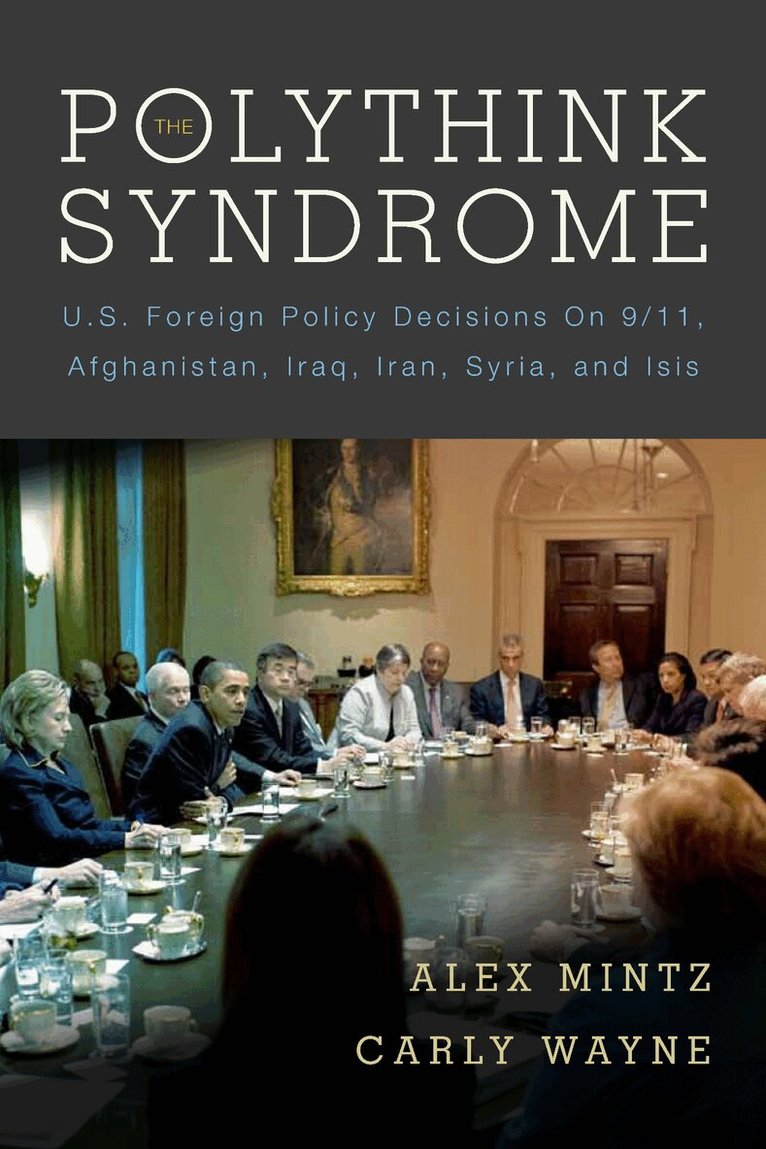
    Polythink Syndrome

    U.S. Foreign Policy Decisions on 9/11, Afghanistan, Iraq, Iran, Syria, and ISIS

    AvAlex Mintz,Carly Wayne

    Inbunden, Engelska, 2016

    1 099 kr

    Beställningsvara. Skickas inom 5-8 vardagar. Fri frakt över 249 kr.

    Fler format och utgåvor

    Häftad

    270 kr

    E-bok

    319 kr

    Beskrivning

    Why do presidents and their advisors often make sub-optimal decisions on military intervention, escalation, de-escalation, and termination of conflicts? The leading concept of group dynamics, groupthink, offers one explanation: policy-making groups make sub-optimal decisions due to their desire for conformity and uniformity over dissent, leading to a failure to consider other relevant possibilities. But presidential advisory groups are often fragmented and divisive. This book therefore scrutinizes polythink, a group decision-making dynamic whereby different members in a decision-making unit espouse a plurality of opinions and divergent policy prescriptions, resulting in a disjointed decision-making process or even decision paralysis.The book analyzes eleven national security decisions, including the national security policy designed prior to the terrorist attacks of 9/11, the decisions to enter into and withdraw from Afghanistan and Iraq, the 2007 "surge" decision, the crisis over the Iranian nuclear program, the UN Security Council decision on the Syrian Civil War, the faltering Kerry Peace Process in the Middle East, and the U.S. decision on military operations against ISIS.Based on the analysis of these case studies, the authors address implications of the polythink phenomenon, including prescriptions for avoiding and/or overcoming it, and develop strategies and tools for what they call Productive Polythink. The authors also show the applicability of polythink to business, industry, and everyday decisions.


    Produktinformation

    • Utgivningsdatum:2016-01-20
    • Mått:152 x 229 x 20 mm
    • Vikt:431 g
    • Format:Inbunden
    • Språk:Engelska
    • Antal sidor:200
    • Förlag:Stanford University Press
    • ISBN:9780804795159

    Utforska kategorier

    • Militär strategi inom Samhälle och politik
    • Internationella relationer inom Samhälle och politik

    Mer om författaren

    Alex Mintz is Director of the Institute for Policy & Strategy (IPS) and Agam Professor at the Lauder School of Government, Interdisciplinary Center, Herzliya (IDC). Carly Wayne is a Ph.D. candidate at the University of Michigan.

    Recensioner i media

    "Much attention has been paid to the consequences of groupthink; however, very little has been paid to this other end of the decision making spectrum: polythink. This book elaborates on the antecedent conditions, processes and consequences of polythink in decision making, and concludes with a discussion of the conditions that mitigate it and leverage it for effective decision making. In doing so, it adds an important element to the discourse on decision-making and policy making at all levels."—Peter T. Coleman, Director, Morton Deutsch International Center for Cooperation and Conflict Resolution at Columbia University "This book offers impressive evidence in favor of polythink as a major factor impacting foreign policy decision-making. Case material from the wars in Afghanistan and Iraq, along with the Iranian nuclear dispute, is treated in an original and stimulating way. A major contribution to foreign policy analysis."—Patrick James, Dornsife Dean's Professor of International Relations, University of Southern California "Americans excel in most things, from technology to music. But they keep failing in foreign policy. It is desperately important to understand why. The Polythink Syndrome offers a novel explanation—and possible remedies. This book is a major contribution and it will be influential."—Edward N. Luttwak, Senior Associate, Center for Strategic and International Studies, Washington DC

    Innehållsförteckning

    • Contents and Abstracts1The Polythink Syndrome chapter abstractIn this chapter, we introduce the Polythink phenomenon, using the contrasting examples of Pearl Harbor and September 11 to demonstrate the critical effect that group dynamics can have on national security policy. We explain how Polythink is essentially the opposite of Groupthink on a continuum of decision making from "completely cohesive" (Groupthink) to "completely fragmented" (Polythink). We introduce the main symptoms and causes of Polythink and outline the organization of the book.2Causes, Symptoms, and Consequences of Polythink chapter abstractIn this chapter, we outline the main symptoms, causes, and consequences of the Polythink phenomenon. We also introduce key explanations and predictors of Polythink. We then show how analysts can assess whether Polythink or Groupthink exists in a group. Finally, we compare the Polythink dynamic with the Groupthink dynamic and with a dynamic we call Con-Div, the middle point between these two extremes.3Polythink in National Security: The 9/11 Attacks chapter abstractThis chapter provides an in-depth review of the events leading up to the 9/11 attacks, analyzing the decision-making processes of key diplomatic and security decision-making groups, including the CIA, the Presidential Cabinet or advisory team, the State Department, and more, to assess the key signs and symptoms of Polythink that were present in the decision-making processes of these groups and ultimately contributed to the failure to prevent this staggering attack.4Polythink and Afghanistan War Decisions: War Initiation and Termination chapter abstractIn this chapter, we analyze the group dynamics in the Bush and Obama Administrations that fundamentally shaped and guided their policy decisions regarding the entrance to and exit from the Afghanistan War. While the initial invasion period was characterized by a deeply ingrained Groupthink mentality that had been shaped by the traumatic and devastating September 11 attacks, the decision to withdraw from the war was fraught with internal divisions and discordant worldviews of the national security policy-making complex—a Polythink process that deeply inhibited the development of a cohesive strategy for the successful conclusion of the war.5Decision Making in the Iraq War: From Groupthink to Polythink chapter abstractIn this chapter we continue our analysis of the detrimental effects of flawed group decision-making processes surrounding decisions of war and peace. Specifically, using the Iraq War as a case study, we analyze the implications of Groupthink and Polythink on decisions made by the U.S. government in this controversial theater. Breaking down the group dynamics in the Bush and Obama Administrations, we demonstrate the effects of the decision-unit group dynamic on the decisions to initiate the war, adopt the Surge, and ultimately, withdraw from Iraq.6Polythink in the Iranian Nuclear Dispute: Decisions of the U.S. and Israel chapter abstractThis chapter expands the range of national security decisions that can be affected by Polythink, examining the impact of Polythink on diplomacy, strategy, and negotiations. Specifically, we will assess the Obama Administration's 2009 Iran Policy Review concerning the Iranian nuclear program, and Israel's 2012 decision not to attack Iran's nuclear facilities. The chapter begins with the U.S. Administration's decision-making dynamic in addressing the Iranian threat during President Obama's first two years in office, specifically focusing on Obama's 2009 Iran Policy Review. In the second section, we analyze the decision-making processes that occurred in the Israeli government regarding the Iranian nuclear program in early 2012 as the government weighed a military strike on Iran's nuclear facilities. Interestingly, we find that in the Israeli case, the Polythink dynamic was mainly triggered by disagreement among three sub-decision-making groups: Israeli political leaders, the Israeli military establishment, and the U.S. Administration.7Recent Challenges: The Syria Debate, the Renewed Israeli-Palestinian Peace Negotiations, and the ISIS Decision chapter abstractThis chapter provides three examples of the application of Polythink to recent decisions and events in the international arena. Specifically, we analyze three recent developments in the Middle East: the tragedy in Syria and the UN and U.S. 2012 debate over sanctions against the Assad regime, the 2013<->14 peace negotiations between Israelis and Palestinians known as the "Kerry Process," and the summer 2014 U.S. decision to attack ISIS targets in Iraq and Syria. These three cases demonstrate the global nature of Polythink and its relevance and applicability to U.S. and UN decisions (i.e., with multiple players), to negotiation processes (decisions in strategic interaction) and to tactical versus strategic decisions (as in the ISIS decision). We discuss the deliberate decision-unit architecture of Obama's second-term advisory team, establishing the critical importance a leader plays in influencing whether the unit will have a Groupthink, Con-Div, or Polythink group dynamic.8The Global Nature of Polythink and Its Productive Potential chapter abstractIn this chapter, we discuss the implications of Polythink, Con-Div, and Groupthink beyond the realm of foreign policy, extending it to business decisions, research and development (R&D) decisions, marketing and sales decisions, production chain decisions, finance and budgeting decisions, domestic policymaking, voluntary and not-for-profit decisions, and small-group decisions in individuals' daily lives. We also detail strategies for transforming Destructive Polythink into Productive Polythink, such as engineering the decision unit to ensure a more balanced evaluation of policy alternatives en route to "good" decisions. Understanding these dynamics is crucial to explaining, predicting, and improving national security and foreign policy decisions, business and corporate decisions, and individual decisions.
    Hoppa över listan

    Mer från samma författare

    Alex Mintz, Dmitry (Dima) Adamsky - How Do Leaders Make Decisions?, Inbunden

    How Do Leaders Make Decisions?

    Alex Mintz, Dmitry (Dima) Adamsky

    Inbunden, 2019

    1 031 kr

    Alex Mintz, Lesley G. Terris - The Oxford Handbook of Behavioral Political Science, Inbunden

    The Oxford Handbook of Behavioral Political Science

    Alex Mintz, Lesley G. Terris

    Inbunden, 2024

    1 703 kr

    Lesley G. Terris, Alex Mintz - Oxford Handbook of Behavioral Political Science, E-bok

    Oxford Handbook of Behavioral Political Science

    Lesley G. Terris, Alex Mintz

    E-bok
    2024

    1 590 kr

    Lesley G. Terris, Alex Mintz - Oxford Handbook of Behavioral Political Science, E-bok

    Oxford Handbook of Behavioral Political Science

    Lesley G. Terris, Alex Mintz

    E-bok
    2024

    1 590 kr

    Alex Mintz, Tyson Chatagnier, Yair Samban - Terrorist Decision-Making, Inbunden

    Terrorist Decision-Making

    Alex Mintz, Tyson Chatagnier, Yair Samban

    Inbunden, 2019

    2 348 kr

    Alex Mintz - Politics Of Resource Allocation In The U.s. Department Of Defense, Häftad

    Politics Of Resource Allocation In The U.s. Department Of Defense

    Alex Mintz

    Häftad, 2021

    483 kr

    Steve Chan, Alex Mintz - Defense, Welfare and Growth, Inbunden

    Defense, Welfare and Growth

    Steve Chan, Alex Mintz

    Inbunden, 1992

    2 416 kr

    Yair Samban, Tyson Chatagnier, Alex Mintz - Terrorist Decision-Making, E-bok

    Terrorist Decision-Making

    Yair Samban, Tyson Chatagnier, Alex Mintz

    E-bok
    2019

    768 kr

    Yair Samban, Tyson Chatagnier, Alex Mintz - Terrorist Decision-Making, E-bok

    Terrorist Decision-Making

    Yair Samban, Tyson Chatagnier, Alex Mintz

    E-bok
    2019

    766 kr

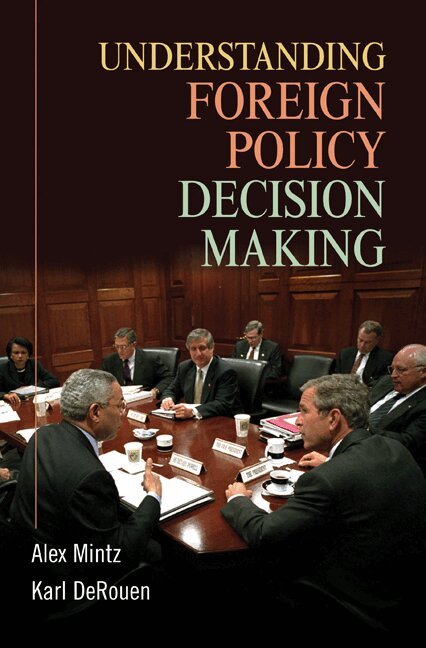
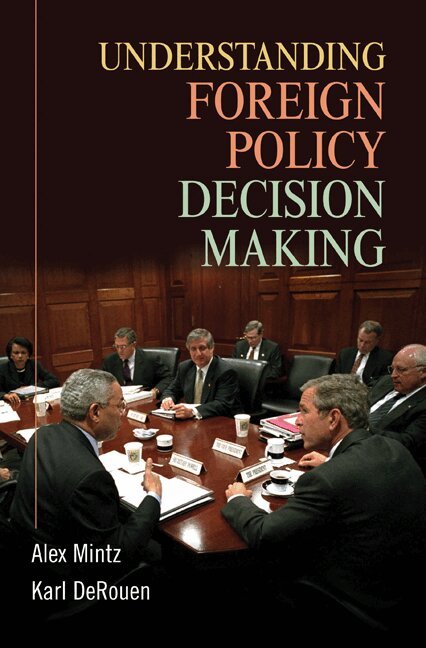
    Alex Mintz, Karl DeRouen Jr - Understanding Foreign Policy Decision Making, Häftad

    Understanding Foreign Policy Decision Making

    Alex Mintz, Karl DeRouen Jr

    Häftad, 2010

    443 kr

    Hoppa över listan

    Du kanske också är intresserad av

    Alex Mintz, Carly Wayne - Polythink Syndrome, Häftad

    Polythink Syndrome

    Alex Mintz, Carly Wayne

    Häftad, 2016

    270 kr

    Alex Mintz, Carly Wayne - Polythink Syndrome, E-bok

    Polythink Syndrome

    Alex Mintz, Carly Wayne

    E-bok
    2016

    319 kr

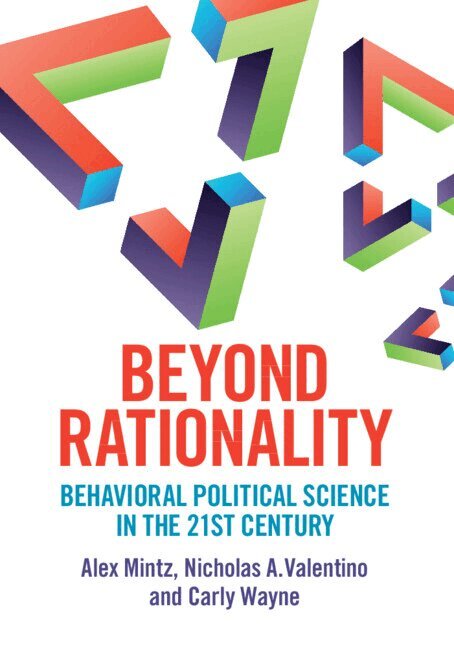
    Alex Mintz, Nicholas A. Valentino, Carly Wayne - Beyond Rationality, Häftad

    Beyond Rationality

    Alex Mintz, Nicholas A. Valentino, Carly Wayne

    Häftad, 2021

    615 kr

    Carly Wayne, Nicholas A. Valentino, Alex Mintz - Beyond Rationality, E-bok

    Beyond Rationality

    Carly Wayne, Nicholas A. Valentino, Alex Mintz

    E-bok
    2021

    728 kr

    Carly Wayne, Nicholas A. Valentino, Alex Mintz - Beyond Rationality, E-bok

    Beyond Rationality

    Carly Wayne, Nicholas A. Valentino, Alex Mintz

    E-bok
    2021

    726 kr

    Alex Mintz, Nicholas A. Valentino, Carly Wayne - Beyond Rationality, Inbunden

    Beyond Rationality

    Alex Mintz, Nicholas A. Valentino, Carly Wayne

    Inbunden, 2021

    1 447 kr

    Steve Chan, Alex Mintz - Defense, Welfare and Growth, Inbunden

    Defense, Welfare and Growth

    Steve Chan, Alex Mintz

    Inbunden, 1992

    2 416 kr

    Alex Mintz, Bruce Russett - New Directions for International Relations, Häftad

    New Directions for International Relations

    Alex Mintz, Bruce Russett

    Häftad, 2005

    602 kr

    Alex Mintz, Karl DeRouen Jr - Understanding Foreign Policy Decision Making, Inbunden

    Understanding Foreign Policy Decision Making

    Alex Mintz, Karl DeRouen Jr

    Inbunden, 2010

    721 kr

    Dmitry (Dima) Adamsky, Alex Mintz - How Do Leaders Make Decisions?, E-bok

    How Do Leaders Make Decisions?

    Dmitry (Dima) Adamsky, Alex Mintz

    E-bok
    2019

    1 228 kr