• Fri frakt över 249 kr
  • •
  • Snabba leveranser
  • •
  • Billiga böcker
Kundservice

Du är på sajten för privatpersoner.

Företag, bibliotek eller offentlig verksamhet?

Du handlar på classic.bokus.com, där alla dina funktioner finns intakta.
Till classic.bokus.com
Bokus logotyp. Gå till startsidan.
  • Erbjudanden
  • Student
  • Topplistor
  • Barn & ungdom
  • Bokus Play
  • E-böcker
  • Ljudböcker
  • Pocketböcker
  • Spel och pussel

Pocketfynda! Hundratals böcker för 49 kr/st →

Sidfot

Mina sidor

    Hjälp

    • Kundservice
    • Vanliga frågor och svar
    • Frakt och leverans
    • Retur vid ångerrätt
    • Reklamera vara
    • Betalning
    • Köpvillkor
    • Allmänna villkor
    • Information om webbplatsens tillgänglighet

    Om Bokus

    • Om oss
    • Pressrum
    • För studenter
    • För företag
    • För bibliotek och offentlig verksamhet
    • För leverantörer
    • Hållbarhet

    Populärt

    • Aktuella erbjudanden
    • Presentkort
    • Studentlitteratur
    • Nya böcker
    • Topplistor
    • Signerade böcker
    • Engelska böcker

    Inspiration

    • Boktips
    • BookTok
    • Barnbokskaraktärer
    • Populära författare
    Logotyp för Bokus
    Följ oss på Facebook (extern länk)Följ oss på Instagram (extern länk)Följ oss på YouTube (extern länk)Följ oss på TikTok (extern länk)
    bokus @ CookiesAnpassa cookiesIntegritetspolicyKöpvillkor
    Till Citymail hemsida (extern länk)Till Budbee hemsida (extern länk)Till Postnord hemsida (extern länk)Till Schenker hemsida (extern länk)Till Early Bird hemsida (extern länk)Till Walleys hemsida (extern länk)
    1. Psykologi och pedagogik
    2. Pedagogik
    3. Skolan och förskolan

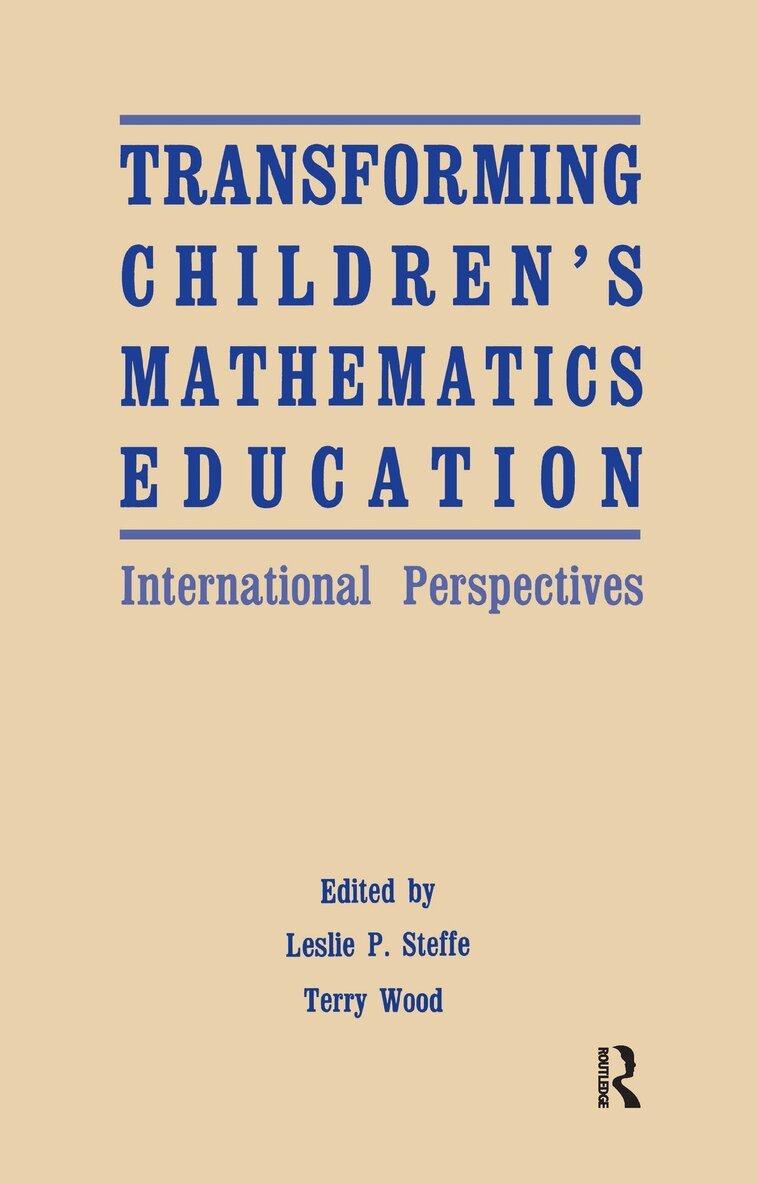
    Transforming Children's Mathematics Education

    International Perspectives

    AvLeslie P. Steffe,Terry Wood

    Inbunden, Engelska, 1990

    713 kr

    Beställningsvara. Skickas inom 10-15 vardagar. Fri frakt över 249 kr.

    Beskrivning

    Eminent scholars from around the globe gathered to discuss how educational systems would change if the prevailing principles of constructivism were applied to three major aspects of those systems -- knowledge and learning, communication, and environment. This volume provides documentation of the proceedings of this important meeting - - the Early Childhood Action Group of the Sixth International Congress on Mathematics Education.This international assembly, representing such diverse disciplines as mathematics and math education, epistemology, philosophy, cognitive science, psycholinguistics, and science education, is the first to examine early childhood mathematics education from constructivist and international perspectives in addition to formulating recommendations for future work in the field.

    Produktinformation

    • Utgivningsdatum:1990-05-01
    • Mått:152 x 229 x 36 mm
    • Vikt:1 110 g
    • Format:Inbunden
    • Språk:Engelska
    • Antal sidor:510
    • Förlag:Taylor & Francis Inc
    • ISBN:9780805806045

    Utforska kategorier

    • Skolan och förskolan inom Psykologi och pedagogik
    • Undervisning i specifika ämnen inom Psykologi och pedagogik

    Recensioner i media

    "...a necessary resource for researchers and graduate students in mathematics education and cognitive science."—CHOICE"...interesting and thought provoking."—Science Books and Films

    Innehållsförteckning

    • Contents: Part I:Overview.L.P. Steffe, Action Group A1: Early Childhood Years. Part II:Epistemological Chapters.H. Sinclair, Learning the Interactive Recreation of Knowledge. E. von Glasersfeld, Environment and Communication. Part III:Knowledge and Learning Elaboration Chapters.J. Leino, Knowledge and Learning in Mathematics. R.W. Lawler, Constructing Knowledge from Interactions. F. Marton, D. Neuman, Constructivism, Phenomenology and the Origin of Arithmetic Skills. Discussion Chapters--Learning. B. Denvir, Children Learning Mathematics. J. Ainley, Playing Games and Learning Mathematics. P.F. Campbell, Young Children's Concept of Measure. K. Yokochi, Some Aspects of Learning Geometry. Discussion Chapters-Knowledge. G. Wheatley, H. Bebout, Mathematical Knowledge of Young Learners. C.T. Fosnot, Possibility, Necessity, Contradiction, and Probability: Implications for Mathematics Education. J.C. Bergeron, N. Herscovics, Kindergartners' Knowledge of the Preconcepts of Number. T.N. Carraher, A.D. Schliemann, Knowledge of the Numeration System Among Pre-Schoolers. J. Ishida, An Analysis of First-Grade Children's Writing Number Sentences in Solving Word Problems. G. Boulton-Lewis, Young Children's Thinking Strategies and Levels of Capacity to Process Mathematical Information. G. Wheatley, P. Cobb, Analysis of Young Children's Spatial Constructions. L. English, Children's Competence in Forming Combinations. M.A. Clements, G. Del Campo, How Natural is Fraction Knowledge? Part IV:Communication-Elaboration Chapters.F. Lowenthal, Communication in Early Childhood. P. Cobb, Multiple Perspectives. J. Easley, H. Taylor, Conceptual Splatter in Peer Dialogues in Selected Japanese and U.S. First Grade Mathematics Classes. Discussion Chapters - Actual Communication. M. Stephens, Communication in the Mathematics Classroom. B. Wright, Interactive Communication: Constraints and Possibilities. T. Wood, E. Yackel, The Development of Collaborative Dialogue Within Small Group Interactions. M. Lampert, Connecting Inventions with Conventions. N. Nohda, Actual Communication in the Mathematical Classroom. J. Weissglass, J. Mumme, B. Cranin, Fostering Mathematical Communication: Helping Teachers Help Students. Discussion Chapters -- Possible Communication. G. Stanic, Reconstructing Constructivism. J. Bliss, The Nature of Communication in Early Childhood in the Contexts of Home and School. M.B. Bussi, Learning Situations and Experiential Domains Relevant to Early Childhood Mathematics Education. Part V:Environment Elaboration Chapters.R.O. Ohuche, Early Childhood Mathematics and the Environment. T.E. Kieren, Children's Mathematics/Mathematics for Children. L. Burton, What Could Teacher Education Be Like for Prospective Teachers of Early Childhood Mathematics -- With Particular References to the Environment. Discussion Chapters -- Mathematics Curriculum. N. Pateman, D.C. Johnson, Curriculum and Constructivism in Early Childhood Mathematics: Source of Tension and Possible Resolutions. H. Pengelly, Mathematical Learning Beyond the Activity. M. Sumio, Notes on Early Mathematical Experiences. H. Mansfield, The Role of the Teacher in Early Childhood Mathematics. L.P. Steffe, Mathematics Curriculum Design: A Constructivist's Perspective. Discussion Chapters -- Teacher Education. N. James, R. Underhill, Constructivism and Teacher Education for Teachers of Early Childhood Mathematics. L. Hatfield, Preparing Early Childhood Teachers for Construc- tive Mathematical Environments. D. Tirosh, Improving Prospective Early Childhood Teachers Content Knowledge and Attitudes Toward Mathematics. B. D'Ambrosio, Some Problems with Problem Solving: A Brazilian Teacher-Perspective. S. Yoshikawa, Construction of Mathematics Using Comparison and Examination of Children's Mathematical Thinking. N. Reeves, Action Research for Professional Development: Informing Teachers and Researchers. Part VI:Conclusion Survey Chapter.B. Perry, Cultural Perspectives on Success in Early Childhood Mathematics.