• Fri frakt över 249 kr
  • •
  • Snabba leveranser
  • •
  • Billiga böcker
Kundservice

Du är på sajten för privatpersoner.

Företag, bibliotek eller offentlig verksamhet?

Du handlar på classic.bokus.com, där alla dina funktioner finns intakta.
Till classic.bokus.com
Bokus logotyp. Gå till startsidan.
  • Erbjudanden
  • Nyheter
  • Student
  • Topplistor
  • Barn & ungdom
  • Bokus Play
  • E-böcker
  • Pocketböcker
  • Spel & pussel

10% rabatt på allt med kod: NYSTART10 →

Sidfot

Mina sidor

    Hjälp

    • Kundservice
    • Vanliga frågor och svar
    • Frakt och leverans
    • Retur vid ångerrätt
    • Reklamera vara
    • Betalning
    • Köpvillkor
    • Allmänna villkor
    • Information om webbplatsens tillgänglighet

    Om Bokus

    • Om oss
    • Pressrum
    • För studenter
    • För företag
    • För bibliotek och offentlig verksamhet
    • För leverantörer
    • Hållbarhet

    Populärt

    • Aktuella erbjudanden
    • Presentkort
    • Studentlitteratur
    • Nya böcker
    • Topplistor
    • Signerade böcker
    • Engelska böcker

    Inspiration

    • Boktips
    • BookTok
    • Populära bokserier
    • Barnbokskaraktärer
    • Populära författare
    Logotyp för Bokus
    Följ oss på Facebook (extern länk)Följ oss på Instagram (extern länk)Följ oss på YouTube (extern länk)Följ oss på TikTok (extern länk)
    bokus @ CookiesAnpassa cookiesIntegritetspolicyKöpvillkor
    Till Citymail hemsida (extern länk)Till Budbee hemsida (extern länk)Till Postnord hemsida (extern länk)Till Schenker hemsida (extern länk)Till Early Bird hemsida (extern länk)Till Walleys hemsida (extern länk)
    1. Psykologi och pedagogik
    2. Pedagogik

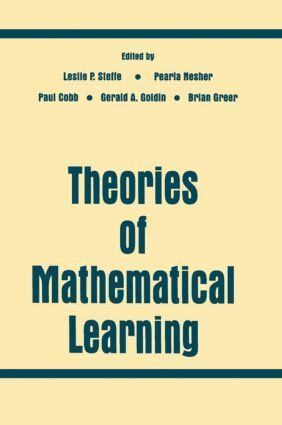
    Theories of Mathematical Learning

    AvLeslie P. Steffe,Pearla Nesher

    Häftad, Engelska, 1996

    1 398 kr

    Beställningsvara. Skickas inom 10-15 vardagar. Fri frakt över 249 kr.

    Beskrivning

    Chemists, working with only mortars and pestles, could not get very far unless they had mathematical models to explain what was happening "inside" of their elements of experience -- an example of what could be termed mathematical learning.This volume contains the proceedings of Work Group 4: Theories of Mathematics, a subgroup of the Seventh International Congress on Mathematical Education held at Université Laval in Québec. Bringing together multiple perspectives on mathematical thinking, this volume presents elaborations on principles reflecting the progress made in the field over the past 20 years and represents starting points for understanding mathematical learning today. This volume will be of importance to educational researchers, math educators, graduate students of mathematical learning, and anyone interested in the enterprise of improving mathematical learning worldwide.

    Produktinformation

    • Utgivningsdatum:1996-08-01
    • Mått:152 x 229 x 29 mm
    • Vikt:1 010 g
    • Format:Häftad
    • Språk:Engelska
    • Antal sidor:544
    • Förlag:Taylor & Francis Inc
    • ISBN:9780805816624

    Utforska kategorier

    • Pedagogik inom Psykologi och pedagogik
    • Matematikens filosofi inom Naturvetenskap och teknik

    Mer om författaren

    Leslie P. Steffe, Pearla Nesher, Paul Cobb, Bharath Sriraman, Brian Greer

    Innehållsförteckning

    • Contents: Preface. Part I: P. Cobb,Sociological and Anthropological Perspectives on Mathematics Learning.P. Cobb, B. Jaworski, N. Presmeg, Emergent and Sociocultural Views of Mathematical Activity. J. Voigt, Negotiation of Mathematical Meaning in Classroom Processes: Social Interaction and Learning Mathematics. G.B. Saxe, T. Bermudez, Emergent Mathematical Environments in Children's Games. J. Richards, Negotiating the Negotiation of Meaning: Comments on Voigt (1992) and Saxe and Bermudez (1992). A.D. Schliemann, D.W. Carraher, Negotiationg Mathematical Meanings In and Out of School. E. Yackel, Social Interaction and Individual Cognition. B. van Oers, Learning Mathematics as a Meaningful Activity. E.A. Forman, Learning Mathematics as Participation in Classroom Practice: Implications of Sociocultural Theory for Educational Reform. K. Crawford, Cultural Processes and Learning: Expectations, Actions, and Outcomes. J.W. Stigler, C. Fernandez, M. Yoshida, Traditions of School Mathematics in Japanese and American Elementary Classrooms. Part II: B. Greer,Cognitive Science Theories and Their Contributions to the Learning of Mathematics.B. Greer, Theories of Mathematics Education: The Role of Cognitive Analyses. G. Hatano, A Conception of Knowledge Acquisition and Its Implications for Mathematics Education. G. Vergnaud, The Theory of Conceptual Fields. D.W. Carraher, Learning About Fractions. P.W. Thompson, Imagery and the Development of Mathematical Reasoning. R.B. Davis, Cognition, Mathematics, and Education. Part III: G.A. Goldin,The Contribution of Constructivism to the Learning of Mathematics.G.A. Goldin, Theory of Mathematics Education: The Contributions of Constructivism. E. von Glasersfeld, Aspects of Radical Constructivism and Its Educational Recommendations. F. Marton, D. Neuman, Phenomenography and Children's Experience of Division. P. Ernest, Varieties of Constructivism: A Framework for Comparison. N. Herscovics, The Construction of Conceptual Schemes in Mathematics. G. Booker, Constructing Mathematical Conventions Formed by the Abstraction and Generalization of Earlier Ideas: The Development of Initial Fraction Ideas. G.A. Goldin, J.J. Kaput, A Joint Perspective on the Idea of Representation in Learning and Doing Mathematics. C.A. Maher, A.M. Martino, Young Children Invent Methods of Proof: The Gang of Four. C. Janvier, Constructivism and Its Consequences for Training Teachers. Part IV: Perspectives on the Nature of Mathematical Learning.W. Dörfler, Is the Metaphor of Mental Object Appropriate for a Theory of Learning Mathematics? L.P. Steffe, H.G. Wiegel, On the Nature of a Model of Mathematical Learning.