• Fri frakt över 249 kr
  • •
  • Snabba leveranser
  • •
  • Billiga böcker
Kundservice

Du är på sajten för privatpersoner.

Företag, bibliotek eller offentlig verksamhet?

Du handlar på classic.bokus.com, där alla dina funktioner finns intakta.
Till classic.bokus.com
Bokus logotyp. Gå till startsidan.
  • Erbjudanden
  • Nyheter
  • Student
  • Topplistor
  • Barn & ungdom
  • Bokus Play
  • E-böcker
  • Pocketböcker
  • Spel & pussel

10% rabatt på allt med kod: NYSTART10 →

Sidfot

Mina sidor

    Hjälp

    • Kundservice
    • Vanliga frågor och svar
    • Frakt och leverans
    • Retur vid ångerrätt
    • Reklamera vara
    • Betalning
    • Köpvillkor
    • Allmänna villkor
    • Information om webbplatsens tillgänglighet

    Om Bokus

    • Om oss
    • Pressrum
    • För studenter
    • För företag
    • För bibliotek och offentlig verksamhet
    • För leverantörer
    • Hållbarhet

    Populärt

    • Aktuella erbjudanden
    • Presentkort
    • Studentlitteratur
    • Nya böcker
    • Topplistor
    • Signerade böcker
    • Engelska böcker

    Inspiration

    • Boktips
    • BookTok
    • Populära bokserier
    • Barnbokskaraktärer
    • Populära författare
    Logotyp för Bokus
    Följ oss på Facebook (extern länk)Följ oss på Instagram (extern länk)Följ oss på YouTube (extern länk)Följ oss på TikTok (extern länk)
    bokus @ CookiesAnpassa cookiesIntegritetspolicyKöpvillkor
    Till Citymail hemsida (extern länk)Till Budbee hemsida (extern länk)Till Postnord hemsida (extern länk)Till Schenker hemsida (extern länk)Till Early Bird hemsida (extern länk)Till Walleys hemsida (extern länk)
    1. Psykologi och pedagogik
    2. Pedagogik
    3. Pedagogisk psykologi

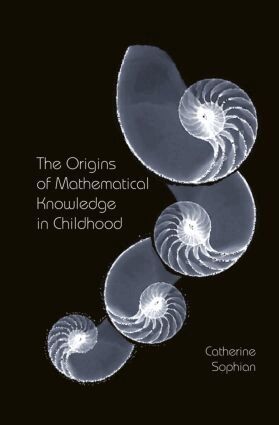
    Origins of Mathematical Knowledge in Childhood

    AvCatherine Sophian

    Inbunden, Engelska, 2007

    Del i serien Studies in Mathematical Thinking and Learning Series

    2 421 kr

    Beställningsvara. Skickas inom 10-15 vardagar. Fri frakt över 249 kr.

    Fler format och utgåvor

    Häftad

    948 kr

    E-bok

    1 124 kr

    E-bok

    1 128 kr

    Beskrivning

    This book examines the origins and development of children's mathematical knowledge. It contrasts the widely held view that counting is the starting point for mathematical development with an alternative comparison-of-quantities position. According to the comparison-of-quantities position, the concept of number builds upon more basic concepts of equality, inequality, and less-than and greater-than relations, which derive from comparisons between unenumerated quantities such as lengths. The concept of number combines these basic comparative concepts with the concept of a unit of measure, which allows one quantity to be described as a multiple of another.Sophian examines these alternative accounts of children's developing mathematical knowledge in the light of research:on children's counting;on their reasoning about continuous quantities such as length and area;on the development of the concept of unit;on additive and multiplicative reasoning; and on knowledge about fractions.In the closing chapters, Sophian draws out the developmental and the educational implications of the research and theory presented. Developmentally, the comparison-of-quantities position undermines the idea that numerical knowledge develops through domain-specific learning mechanisms in that it links numerical development both to physical knowledge about objects, which is the starting point for the concept of unit, and to the acquisition of linguistic number terms. Instructionally, the comparison-of-quantities perspective diverges from the counting-first perspective in that it underscores the continuity between whole-number arithmetic and fraction learning that stems from the importance of the concept of unit for both. Building on this idea, Sophian advances three instructional recommendations: First, instruction about numbers should always be grounded in thinking about quantities and how numbers represent the relations between them; second, instruction in the early years should always be guided by a long-term perspective in which current objectives are shaped by an understanding of their role in the overall course of mathematics learning; and third, instruction should be directly toward promoting the acquisition of the most general mathematical knowledge possible.The Origins of Mathematical Knowledge in Childhood is intended for researchers, professionals, and graduate students in developmental psychology, educational psychology, and mathematics education, and as a supplementary text for advanced undergraduate courses in cognitive development, educational psychology, and mathematics education.

    Produktinformation

    • Utgivningsdatum:2007-06-21
    • Mått:152 x 229 x 16 mm
    • Vikt:550 g
    • Format:Inbunden
    • Språk:Engelska
    • Serie:Studies in Mathematical Thinking and Learning Series
    • Antal sidor:212
    • Förlag:Taylor & Francis Inc
    • ISBN:9780805857580

    Utforska kategorier

    • Pedagogisk psykologi inom Psykologi och pedagogik
    • Matematik inom Naturvetenskap och teknik
    • Kognitiv psykologi inom Psykologi och pedagogik

    Recensioner i media

    "Sophian presents a tautly reasoned and compelling challenge to schooling-as-usual, that is, to instruction that takes counting as the basis for teaching children arithmetic... She argues for highlighting the unit as the foundation of mathematics instruction [and] goes on to trace the implications of unit not only for instruction on conventional topics, such as rational number, multiplication, and division, but also for a wider mathematics education that knits number, measure, data, and geometry."—Richard LehrerVanderbilt University"Sophian does a masterful job of organizing and presenting one of the major success stories of developmental and educational research – understanding the developmental roots of mathematical competence.... This book will interest and benefit both those interested in understanding children's cognitive development and those interested in developing ways of promoting mathematical competence. Sophian's research has contributed greatly to our understanding of both aspects of mathematical development; her book provides a timely and accessible introduction to the state of the art in research on children's mathematical development."—Kevin MillerUniversity of Michigan

    Innehållsförteckning

    • Contents: Preface. Cognitive Development and Mathematics Learning. Children's Counting. Quantitative Comparison Without Numbers. Understanding Units. Relations Among Quantities in Arithmetic: Additive and Multiplicative Reasoning. Understanding Fractions. Implications for Developmental Psychology. Implications for Mathematics Education.