• Fri frakt över 249 kr
  • •
  • Snabba leveranser
  • •
  • Billiga böcker
Kundservice

Du är på sajten för privatpersoner.

Företag, bibliotek eller offentlig verksamhet?

Du handlar på classic.bokus.com, där alla dina funktioner finns intakta.
Till classic.bokus.com
Bokus logotyp. Gå till startsidan.
  • Erbjudanden
  • Nyheter
  • Student
  • Topplistor
  • Barn & ungdom
  • Bokus Play
  • E-böcker
  • Pocketböcker
  • Spel & pussel

10% rabatt på allt med kod: NYSTART10 →

Sidfot

Mina sidor

    Hjälp

    • Kundservice
    • Vanliga frågor och svar
    • Frakt och leverans
    • Retur vid ångerrätt
    • Reklamera vara
    • Betalning
    • Köpvillkor
    • Allmänna villkor
    • Information om webbplatsens tillgänglighet

    Om Bokus

    • Om oss
    • Pressrum
    • För studenter
    • För företag
    • För bibliotek och offentlig verksamhet
    • För leverantörer
    • Hållbarhet

    Populärt

    • Aktuella erbjudanden
    • Presentkort
    • Studentlitteratur
    • Nya böcker
    • Topplistor
    • Signerade böcker
    • Engelska böcker

    Inspiration

    • Boktips
    • BookTok
    • Populära bokserier
    • Barnbokskaraktärer
    • Populära författare
    Logotyp för Bokus
    Följ oss på Facebook (extern länk)Följ oss på Instagram (extern länk)Följ oss på YouTube (extern länk)Följ oss på TikTok (extern länk)
    bokus @ CookiesAnpassa cookiesIntegritetspolicyKöpvillkor
    Till Citymail hemsida (extern länk)Till Budbee hemsida (extern länk)Till Postnord hemsida (extern länk)Till Schenker hemsida (extern länk)Till Early Bird hemsida (extern länk)Till Walleys hemsida (extern länk)
    1. Psykologi och pedagogik
    2. Pedagogik
    3. Pedagogisk metodik

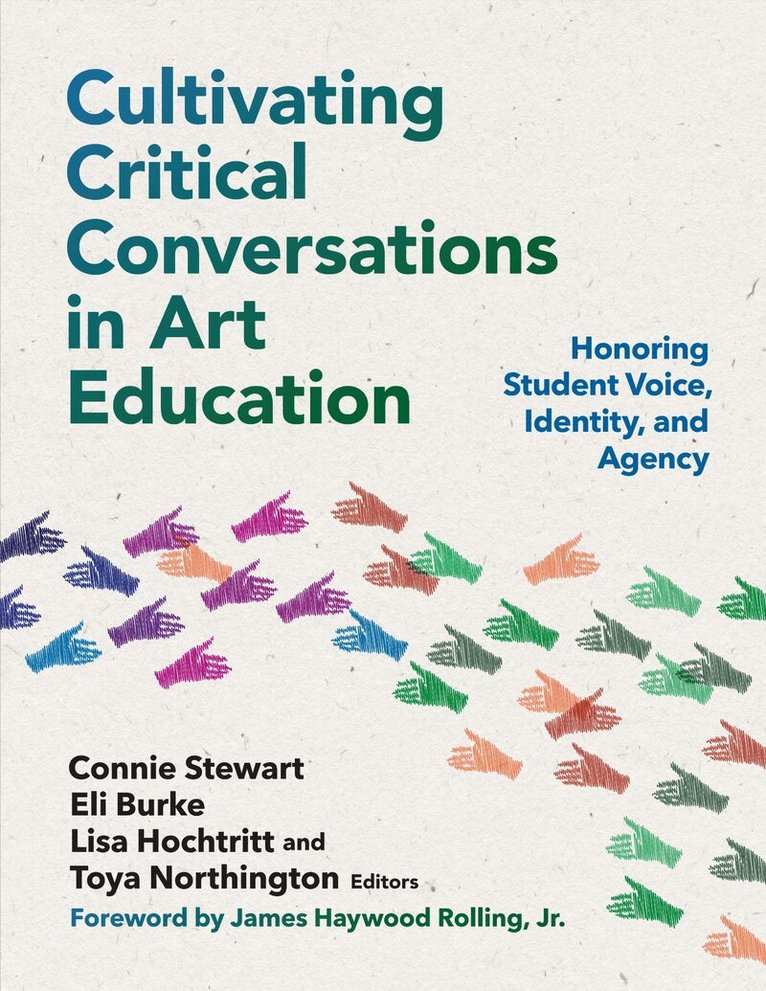
    Cultivating Critical Conversations in Art Education

    Honoring Student Voice, Identity, and Agency

    AvConnie Stewart,Eli Burke

    Häftad, Engelska, 2023

    379 kr

    Beställningsvara. Skickas inom 5-8 vardagar. Fri frakt över 249 kr.

    Beskrivning

    These stories from art educators highlight how art and visual culture can bridge learning with lived experience. Written by and for art educators from all backgrounds and contexts, this volume offers guidance for expanding students' opportunities to critically examine current events, histories, and cultural assumptions in ways that are relevant and inclusive of all identities. Readers will learn how to use contemporary art and dialogue as tools to acknowledge and value the unique perspectives of each person. Authors from diverse settings offer topics, insights, resources, and research for centering voices and critical conversations in K–12, higher education, museums, and nontraditional classrooms. The book addresses such questions as:How can a teacher reflect on their own assumptions and biases before crafting lessons and discussion prompts?In what ways can contemporary art encourage dialogue in art learning spaces?What happens when current national issues intersect with the personal lives of students?How can teachers democratize the classroom so all students are represented?How can teachers demonstrate ways to critically examine information?Book Features:Offers insights from art educators in public, independent, museum, and community settings.Addresses the role of art teachers in responding to the current highly politicized educational climate.Critically examines concepts of practice, power, and vulnerability in teaching.Discusses issues of race, LGBTQ+ rights, family structures, current events, democratic values, and social change as they concern students.Provides examples of dialogue in various art learning spaces and contexts.Contributors include JaeHan Bae, Kathy J. Brown, Lauren Cross, William Estrada, Pamela Harris Lawton, Amy Pfeiler-Wunder, Natasha S. Reid, Kryssi Staikidis, and Injeong Yoon-Ramirez.

    Produktinformation

    • Utgivningsdatum:2023-12-22
    • Mått:216 x 279 x 12 mm
    • Vikt:272 g
    • Format:Häftad
    • Språk:Engelska
    • Antal sidor:176
    • Förlag:Teachers' College Press
    • Medarbetare:James HaywoodRollingJr.
    • ISBN:9780807768983

    Utforska kategorier

    • Pedagogisk metodik inom Psykologi och pedagogik
    • Undervisning i specifika ämnen inom Psykologi och pedagogik

    Mer om författaren

    Connie Stewart is a professor and area head of art education at the University of Northern Colorado and coauthor of Teaching Contemporary Art With Young People: Themes in Art for K–12 Classrooms. Eli Burke is an interdisciplinary artist and PhD candidate in art and visual culture education at the University of Arizona and former education director at the Museum of Contemporary Art Tucson. Lisa Hochtritt is director of the Master of Arts in Teaching (MAT) program at Maryland Institute College of Art. Toya Northington is a multidisciplinary artist and director of equity, inclusion, and belonging at the Speed Art Museum in Louisville, Kentucky.

    Innehållsförteckning

    • Contents (Tentative)Foreword  James Haywood Rolling, Jr.Preface  Connie StewartIntroductionConnie Stewart, Eli Burke, Toya Northington, and Lisa HochtrittSection I: Conversations in Art Educational SettingsThis section presents educational practices where students engage in deeper conversations in a complex world.1.1. Exploring Divergent Topics with Divergent Thinking Strategies: A Visual NarrativeRebecca Shipe1.2. Let's Talk: Engaging in Critical Conversations in the Art RoomAmy Pfeiler-Wunder and Mary Kate Bergh1.3. Children Can Talk About Hard ThingsKimberly Lane1.4. Investigating Contemporary Art in the Elementary ClassroomAmy Felder1.5. Challenging Content and Critical Conversations in the ClassroomKryssi Staikidis1.6. "Yes, and…" Extending Conversations in Art ClassroomsNikki Sandschaper1.7. Challenging Implicit Bias: Using contemporary art to understand the power of personal autonomyKristin A. Ponden1.8. Approaching a Liberatory Future of Museum Education: Reflections on Practice and PedagogyAriana Robles, Amara Higuera, Gladys Preciado, and Alice Bebbington1.9. Addressing Facilitator Power in Youth Museum ProgramsSimona Zappas1.10. Rethinking Feelings in Anti-Racist Art PedagogyInjeong Yoon-Ramirez1.11. Shifting the Conversation: Scaffolding Sociocultural Dialogue in the Elementary Art ClassroomBeth Link1.12. Artistic Responses to RaceNaomi Lifschitz-Grant, Robb Epps, and Taylor Styles1.13. Using Group Reflection and Dialogue as tools for Antiracist TeachingAmanda Tobin Ripley, Hannah Heller, and Michelle Antonisse1.14. Shaming Queerness in Art Spaces: Would You Change That If You Could?Libya Doman1.15. Rethinking Disability in Art ClassroomsKelly M. GrossSection II: Structuring the Learning Environment for Open DiscussionThis section describes learning climates where vulnerability and opinions are honored.2.1. Creating Spaces to Support Difficult DialoguesLisa Hochtritt2.2. Centering Culture Through Critical ConversationsKatie Coogan and Margaret Walker2.3. Conversations over Wi-Fi: Reorienting Student-Centered Art Discussions OnlineAshley Mask2.4. Building Community by Using Opening and Closing CirclesValeska Maria Populoh2.5. Gallery Art Hive as Dialogic SpaceNatasha S. Reid2.6. Artists as Activists: Engaging Middle School Artists in Creating Art That MattersJulie Toole2.7. Finding the Hidden QuestionsAlice C. Pennisi2.8. Talking about Art: When Questions Are the AnswerErica Richard2.9. Critical Conversations in Conservative CommunitiesKelly Beach, Diana Montano, and Connie Stewart2.10. Facilitating Dialogue about Loss and Grief in the GalleryHarrison Orr and Carissa DiCindio2.11. How Superficial Themes in the Art Classroom Can Erase the Narrative of Marginalized Students and CommunitiesKetal Patel2.12. Problematizing Conversations: Creating Art to Engage in Difficult DiscussionsWilliam Estrada2.13. Two Colleagues Talk about Care: Responding to the Emotional State of Our StudentsChris Cain, John Humphrey, with Connie StewartSection III: Inviting Reflective StoriesThis section demonstrates the importance of personal narratives and the role of story in affecting change. 3.1. A Not-So-Queer EducationEli Burke3.2. Story as Pedagogy: Narrative Co-Inquiry with Teachers, Students, and CommunitiesPamela Harris Lawton3.3. Generating LGBTQ+ Community Through DialogueAdam J. Greteman, Nic M. Weststrate, and Karen Morris3.4 Power Play in the Art Critique – Kerry Downey and Aparna Sarkar3.5. Negotiating White Privilege in a Visual Culture InterventionLisa Novak and Breckon Chastain3.6. Critical Conversations in Art History: The State of the Field from Students' PerspectiveBecky Black, Aiyana Cady-Alviar, Damaria Moye, and Denise Zubizarreta3.7. Opening a Conversation About Adoption Through the Artwork of JooYoung ChoiBorim Song3.8. Art and Compassionate Dialogue: Finding and Giving Voice Through Intuitive Knowing and Artistic ResearchRébecca Bourgault and Catherine Rosamond3.9. Questioning White Privilege Through Contemporary ArtDonalyn Heise and Alisse Guerra3.10. Investigations of Racism through a Hexagon Project in an Online College Art Methods CourseJaeHan Bae3.11. Giving Voice to the Story of MigrationNaomi Lifschitz-Grant, Allison Ellis, and Catherine Holmes3.12. Fifth Dimension Discourse: Afrofuturism and the Creation of Brave Spaces in Art TeachingKathy J. Brown and Lauren Cross3.13. Start Where You AreToya NorthingtonSection IV: Resources That InspireThis section includes recommended resources provided by the contributors when asked, "What are your 2–3 go-to resources to inform critical conversations?"