• Fri frakt över 249 kr
  • •
  • Snabba leveranser
  • •
  • Billiga böcker
Kundservice

Du är på sajten för privatpersoner.

Företag, bibliotek eller offentlig verksamhet?

Du handlar på classic.bokus.com, där alla dina funktioner finns intakta.
Till classic.bokus.com
Bokus logotyp. Gå till startsidan.
  • Erbjudanden
  • Nyheter
  • Student
  • Topplistor
  • Barn & ungdom
  • Bokus Play
  • E-böcker
  • Pocketböcker
  • Spel & pussel

10% studentrabatt med kod TERM26

Sidfot

Mina sidor

    Hjälp

    • Kundservice
    • Vanliga frågor och svar
    • Frakt och leverans
    • Retur vid ångerrätt
    • Reklamera vara
    • Betalning
    • Köpvillkor
    • Allmänna villkor
    • Information om webbplatsens tillgänglighet

    Om Bokus

    • Om oss
    • Pressrum
    • För studenter
    • För företag
    • För bibliotek och offentlig verksamhet
    • För leverantörer
    • Hållbarhet

    Populärt

    • Aktuella erbjudanden
    • Presentkort
    • Studentlitteratur
    • Nya böcker
    • Topplistor
    • Signerade böcker
    • Engelska böcker

    Inspiration

    • Boktips
    • BookTok
    • Populära bokserier
    • Barnbokskaraktärer
    • Populära författare
    Logotyp för Bokus
    Följ oss på Facebook (extern länk)Följ oss på Instagram (extern länk)Följ oss på YouTube (extern länk)Följ oss på TikTok (extern länk)
    bokus @ CookiesAnpassa cookiesIntegritetspolicyKöpvillkor
    Till Citymail hemsida (extern länk)Till Budbee hemsida (extern länk)Till Postnord hemsida (extern länk)Till Schenker hemsida (extern länk)Till Early Bird hemsida (extern länk)Till Walleys hemsida (extern länk)
    1. Samhälle och politik
    2. Samhälle och kultur
    3. Sociala grupper och identitet
    4. Etnicitet

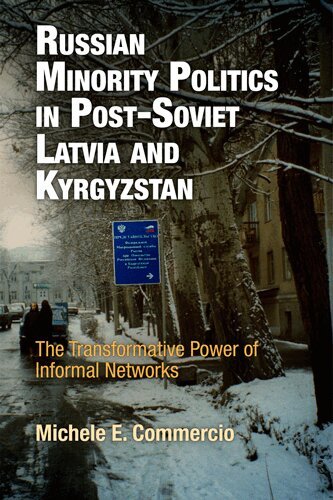
    Russian Minority Politics in Post-Soviet Latvia and Kyrgyzstan

    The Transformative Power of Informal Networks

    AvMichele E. Commercio

    E-bok
    Engelska, 2011

    Del i serien National and Ethnic Conflict in the 21st Century

    1 183 kr

    Läs direkt i Bokus Reader – eller ladda ned till din enhet

    Fler format och utgåvor

    Inbunden

    840 kr

    Beskrivning

    The collapse of the Soviet Union suddenly rendered ethnic Russians living in non-Russian successor states like Latvia and Kyrgyzstan new minorities subject to dramatic political, economic, and social upheaval. As elites in these new states implemented formal policies and condoned informal practices that privileged non-Russians, ethnic Russians had to react. In Russian Minority Politics in Post-Soviet Latvia and Kyrgyzstan, Michele E. Commercio draws on extensive field research, including hundreds of personal interviews, to analyze the responses of minority Russians to such policies and practices. In particular, she focuses on the role played by formal and informal institutions in the crystallization of Russian attitudes, preferences, and behaviors in these states.Commercio asks why there is more out-migration and less political mobilization among Russians in Kyrgyzstan, a state that adopts policies that placate both Kyrgyz and Russians, and less out-migration and more political mobilization among Russians in Latvia, a state that adopts policies that favor Latvians at the expense of Russians. Challenging current thinking, she suggests that the answer to this question lies in the power of informal networks.After the fall of the Soviet Union, the Communist party, Komsomol youth organization, and KGB networks were transformed into informal networks. Russians in Kyrgyzstan were for various reasons isolated from such networks, and this isolation restricted their access to the country's private sector, making it difficult for them to create effective associations capable of representing their interests. This resulted in a high level of Russian exit and the silencing of Russian voices. In contrast, Russians in Latvia were well connected to such networks, which provided them with access to the country's private sector and facilitated the establishment of political parties and nongovernmental organizations that represented their interests. This led to a low level of Russian exit and high level of Russian voice. Commercio concludes that informal networks have a stronger influence on minority politics than formal institutions.

    Produktinformation

    • Utgivningsdatum:2011-06-06
    • Språk:Engelska
    • Antal sidor:248
    • Filformat:EPUB
    • Kopieringsskydd:LCP
    • ISBN:9780812204704
    • Förlag:University of Pennsylvania Press
    • Serie:National and Ethnic Conflict in the 21st Century

    Utforska kategorier

    • Etnicitet inom Samhälle och politik

    Mer om författaren

    Michele E. Commercio teaches political science at the University of Vermont.

    Recensioner i media

    "The fate of Russian minorities in former Soviet republics has attracted considerable attention since the demise of the Soviet Union. In this book Michele Commercio offers an original contribution to the literature by focusing on the little-researched sphere of informal policies to argue that the degree to which official policies exclude ethnic minorities is in fact inversely related to their propensity to mobilize and seek redress."-Dominique Arel, University of Ottawa "Commercio is motivated by a genuine intellectual puzzle: why do ethnic Russians in Latvia (where the state pursues discriminatory policies against them) generally remain in the country, while their counterparts in Kyrgyzstan (where the state pursues less discrimination), generally emigrate to Russia? Her answer is at once elegant and well conceived; the difference lies in the stronger interpersonal networks among Russians in Latvia, compared to weaker ones among Russians in Kyrgyzstan."-Edward Schatz, University of Toronto

    Innehållsförteckning

    • A Note on TransliterationPART IChapter 1. "What the Hell Kind of 'Non-Native' Am I"?Chapter 2. Informal Networks, Exit, and VoiceChapter 3. Soviet Socialist Legacies and Post-Soviet NationalizationChapter 4. Opportunity Structures and the Role of Informal Networks in Their ReconfigurationPART IIChapter 5. Native Versus Non-Native: Russian Perceptions of Post-Soviet NationalizationChapter 6. Russian Responses to Perceptions of Socioeconomic ProspectsChapter 7. Ethnic Systems in TransitionAppendix: MethodsNotesBibliographyIndexAcknowledgments