• Fri frakt över 249 kr
  • •
  • Snabba leveranser
  • •
  • Billiga böcker
Kundservice

Du är på sajten för privatpersoner.

Företag, bibliotek eller offentlig verksamhet?

Du handlar på classic.bokus.com, där alla dina funktioner finns intakta.
Till classic.bokus.com
Bokus logotyp. Gå till startsidan.
  • Erbjudanden
  • Student
  • Topplistor
  • Barn & ungdom
  • Bokus Play
  • E-böcker
  • Ljudböcker
  • Pocketböcker
  • Spel och pussel

Pocketfynda! Hundratals böcker för 49 kr/st →

Sidfot

Mina sidor

    Hjälp

    • Kundservice
    • Vanliga frågor och svar
    • Frakt och leverans
    • Retur vid ångerrätt
    • Reklamera vara
    • Betalning
    • Köpvillkor
    • Allmänna villkor
    • Information om webbplatsens tillgänglighet

    Om Bokus

    • Om oss
    • Pressrum
    • För studenter
    • För företag
    • För bibliotek och offentlig verksamhet
    • För leverantörer
    • Hållbarhet

    Populärt

    • Aktuella erbjudanden
    • Presentkort
    • Studentlitteratur
    • Nya böcker
    • Topplistor
    • Signerade böcker
    • Engelska böcker

    Inspiration

    • Boktips
    • BookTok
    • Barnbokskaraktärer
    • Populära författare
    Logotyp för Bokus
    Följ oss på Facebook (extern länk)Följ oss på Instagram (extern länk)Följ oss på YouTube (extern länk)Följ oss på TikTok (extern länk)
    bokus @ CookiesAnpassa cookiesIntegritetspolicyKöpvillkor
    Till Citymail hemsida (extern länk)Till Budbee hemsida (extern länk)Till Postnord hemsida (extern länk)Till Schenker hemsida (extern länk)Till Early Bird hemsida (extern länk)Till Walleys hemsida (extern länk)
    1. Historia och arkeologi
    2. Historia
    3. Europas historia

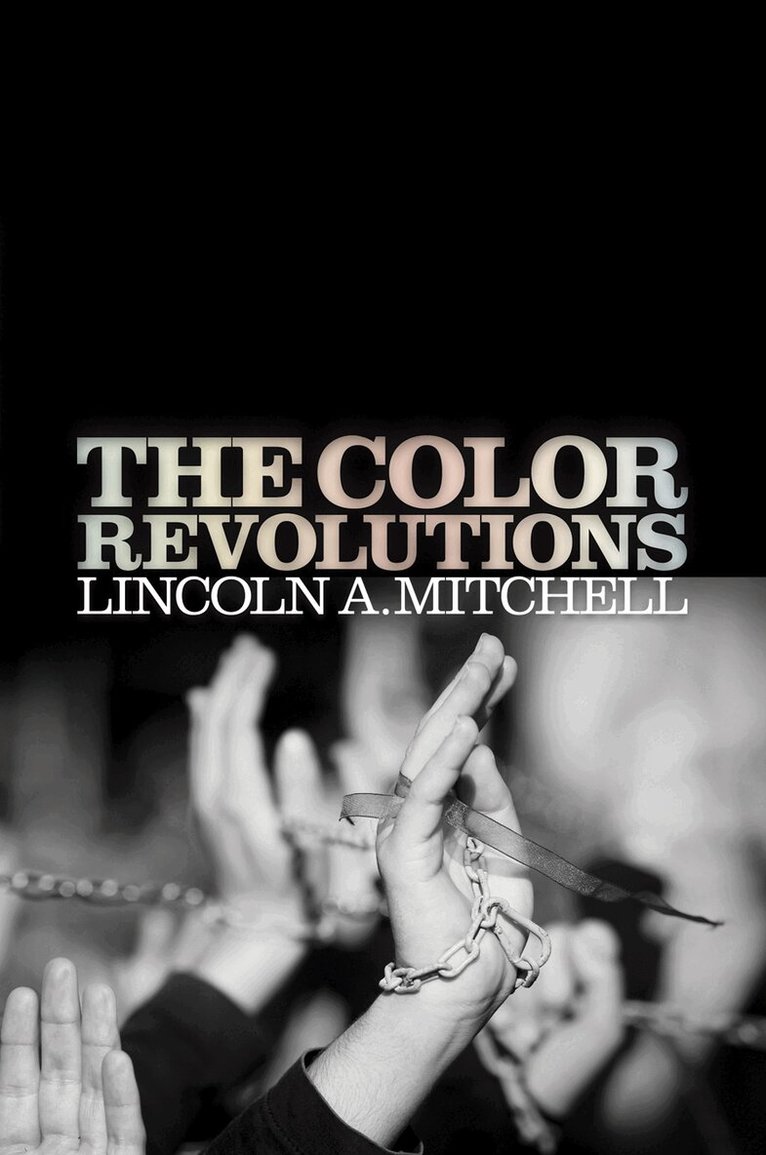
    Color Revolutions

    AvLincoln A. Mitchell

    E-bok
    Engelska, 2012

    1 300 kr

    Läs direkt i Bokus Reader – eller ladda ned till din enhet

    Fler format och utgåvor

    Inbunden

    918 kr

    Beskrivning

    From late 2003 through mid-2005, a series of peaceful street protests toppled corrupt and undemocratic regimes in Georgia, Ukraine, and Kyrgyzstan and ushered in the election of new presidents in all three nations. These movements-collectively known as the Color Revolutions-were greeted in the West as democratic breakthroughs that might thoroughly reshape the political terrain of the former Soviet Union.But as Lincoln A. Mitchell explains in The Color Revolutions, it has since become clear that these protests were as much reflections of continuity as they were moments of radical change. Not only did these movements do little to spur democratic change in other post-Soviet states, but their impact on Georgia, Ukraine, and Kyrgyzstan themselves was quite different from what was initially expected. In fact, Mitchell suggests, the Color Revolutions are best understood as phases in each nation's long post-Communist transition: significant events, to be sure, but far short of true revolutions.The Color Revolutions explores the causes and consequences of all three Color Revolutions-the Rose Revolution in Georgia, the Orange Revolution in Ukraine, and the Tulip Revolution in Kyrgyzstan-identifying both common themes and national variations. Mitchell's analysis also addresses the role of American democracy promotion programs, the responses of nondemocratic regimes to the Color Revolutions, the impact of these events on U.S.-Russian relations, and the failed "revolutions" in Azerbaijan and Belarus in 2005 and 2006.At a time when the Arab Spring has raised hopes for democratic development in the Middle East, Mitchell's account of the Color Revolutions serves as a valuable reminder of the dangers of confusing dramatic moments with lasting democratic breakthroughs.

    Produktinformation

    • Utgivningsdatum:2012-06-22
    • Språk:Engelska
    • Antal sidor:256
    • Filformat:EPUB
    • Kopieringsskydd:LCP
    • ISBN:9780812207095
    • Förlag:University of Pennsylvania Press

    Utforska kategorier

    • Europas historia inom Historia och arkeologi
    • Asiens historia inom Historia och arkeologi
    • Revolutioner och uppror inom Historia och arkeologi

    Mer om författaren

    Lincoln A. Mitchell is Associate Research Scholar at the Harriman Institute, Columbia University and author of Uncertain Democracy: U.S. Foreign Policy and Georgia's Rose Revolution, also available from the University of Pennsylvania Press.

    Recensioner i media

    "Although analytic reflections on the Color Revolutions are accumulating, nothing available matches this book's scope and depth. Mitchell's account, consistently searching and thorough, balanced and judicious, leads to some surprising and weighty conclusions that challenge the existing conventional wisdom on the Color Revolutions. It will likely stand for many years as the definitive work on the subject."-Thomas Carothers, Carnegie Endowment for International Peace "The Color Revolutions represents an important contribution to our understanding of what actually happened at the time and provides extremely useful insight about what the future might-or might not-hold for other countries where the desire for democracy is great but the roots of democracy are weak."-Richard Miles, former U.S. ambassador to Georgia, Azerbaijan, and Bulgaria "Lincoln Mitchell has written a sober, concise, and thought-provoking analysis of the color revolutions in the former Soviet Union. As both a scholar and practitioner, he offers a unique and nuanced perspective on issues central to those revolutions and to regime change more broadly. His book is a must-read for anyone who wants a clear-eyed vision of the opportunities and pitfalls of democracy promotion in the twenty-first century."-Lucan Way, Associate Professor of Political Science, University of Toronto

    Innehållsförteckning

    • Chapter 1. IntroductionChapter 2. Pre-Color Revolution RegimesChapter 3 . Electoral BreakthroughsChapter 4. The U.S. RoleChapter 5. RussiaChapter 6. Democracy After the Color RevolutionsChapter 7. Exporting Color RevolutionsChapter 8. Misreading Democratic Breakthroughs: U.S. Policy After the Color RevolutionsChapter 9. The End of an EraAppendix. Studying Color RevolutionsNotesBibliographyIndexAcknowledgments