• Fri frakt över 249 kr
  • •
  • Snabba leveranser
  • •
  • Billiga böcker
Kundservice

Du är på sajten för privatpersoner.

Företag, bibliotek eller offentlig verksamhet?

Du handlar på classic.bokus.com, där alla dina funktioner finns intakta.
Till classic.bokus.com
Bokus logotyp. Gå till startsidan.
  • Erbjudanden
  • Nyheter
  • Student
  • Topplistor
  • Barn & ungdom
  • Bokus Play
  • E-böcker
  • Pocketböcker
  • Spel & pussel

10% rabatt på allt med kod NYSTART10 →

Sidfot

Mina sidor

    Hjälp

    • Kundservice
    • Vanliga frågor och svar
    • Frakt och leverans
    • Retur vid ångerrätt
    • Reklamera vara
    • Betalning
    • Köpvillkor
    • Allmänna villkor
    • Information om webbplatsens tillgänglighet

    Om Bokus

    • Om oss
    • Pressrum
    • För studenter
    • För företag
    • För bibliotek och offentlig verksamhet
    • För leverantörer
    • Hållbarhet

    Populärt

    • Aktuella erbjudanden
    • Presentkort
    • Studentlitteratur
    • Nya böcker
    • Topplistor
    • Signerade böcker
    • Engelska böcker

    Inspiration

    • Boktips
    • BookTok
    • Populära bokserier
    • Barnbokskaraktärer
    • Populära författare
    Logotyp för Bokus
    Följ oss på Facebook (extern länk)Följ oss på Instagram (extern länk)Följ oss på YouTube (extern länk)Följ oss på TikTok (extern länk)
    bokus @ CookiesAnpassa cookiesIntegritetspolicyKöpvillkor
    Till Citymail hemsida (extern länk)Till Budbee hemsida (extern länk)Till Postnord hemsida (extern länk)Till Schenker hemsida (extern länk)Till Early Bird hemsida (extern länk)Till Walleys hemsida (extern länk)
    1. Skönlitteratur
    2. Litteraturvetenskap
    3. Litteraturvetenskap

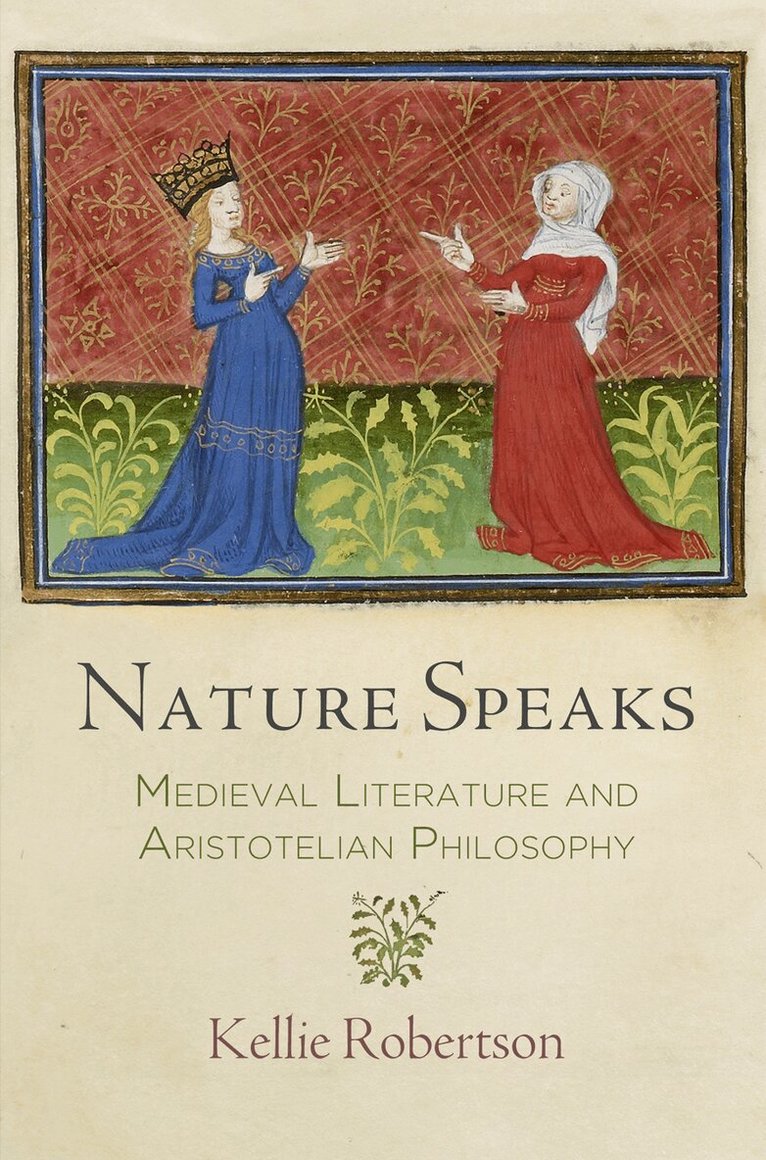
    Nature Speaks

    Medieval Literature and Aristotelian Philosophy

    AvKellie Robertson

    E-bok
    Engelska, 2017

    Del i serien Middle Ages Series

    1 542 kr

    Läs direkt i Bokus Reader – eller ladda ned till din enhet

    Fler format och utgåvor

    Inbunden

    1 094 kr

    Beskrivning

    What does it mean to speak for nature? Contemporary environmental critics warn that giving a voice to nonhuman nature reduces it to a mere echo of our own needs and desires; they caution that it is a perverse form of anthropocentrism. And yet nature's voice proved a powerful and durable ethical tool for premodern writers, many of whom used it to explore what it meant to be an embodied creature or to ask whether human experience is independent of the natural world in which it is forged.The history of the late medieval period can be retold as the story of how nature gained an authoritative voice only to lose it again at the onset of modernity. This distinctive voice, Kellie Robertson argues, emerged from a novel historical confluence of physics and fiction-writing. Natural philosophers and poets shared a language for talking about physical inclination, the inherent desire to pursue the good that was found in all things living and nonliving. Moreover, both natural philosophers and poets believed that representing the visible world was a problem of morality rather than mere description. Based on readings of academic commentaries and scientific treatises as well as popular allegorical poetry, Nature Speaks contends that controversy over Aristotle's natural philosophy gave birth to a philosophical poetics that sought to understand the extent to which the human will was necessarily determined by the same forces that shaped the rest of the material world.Modern disciplinary divisions have largely discouraged shared imaginative responses to this problem among the contemporary sciences and humanities. Robertson demonstrates that this earlier worldview can offer an alternative model of human-nonhuman complementarity, one premised neither on compulsory human exceptionalism nor on the simple reduction of one category to the other. Most important, Nature Speaks assesses what is gained and what is lost when nature's voice goes silent.

    Produktinformation

    • Utgivningsdatum:2017-01-25
    • Språk:Engelska
    • Antal sidor:456
    • Filformat:EPUB
    • Kopieringsskydd:LCP
    • ISBN:9780812293678
    • Förlag:University of Pennsylvania Press
    • Serie:Middle Ages Series

    Utforska kategorier

    • Litteraturvetenskap inom Skönlitteratur
    • Filosofiska discipliner inom Filosofi och religion

    Mer om författaren

    Kellie Robertson is Professor of English at the University of Maryland, College Park.

    Recensioner i media

    "Nature Speaks is inspirational, since it offers new insights for the field of medieval literature, and the ambition and scope of the work are to be applauded." (Isis) "At a moment when the human relationship to the natural world is deeply in need of attention and rearticulation, Kellie Robertson has given us a book that closely studies representations of the 'naturalness' of human beings in late medieval French and English literature. Robertson seeks to restore to view a pre-modern version of the human as internal to the natural world, a concept that creates a terrain for wideranging debate about the desires, compulsions, limits, and freedoms of human beings." (Review of English Studies) "Kellie Robertson's book is an indispensable study of the idea of nature in the writings of Jean de Meun, Guillaume de Deguileville, Geoffrey Chaucer, and John Lydgate. Revising the foundational work on nature and Platonism undertaken several generations ago, it offers an entirely new way of understanding the significance of nature in vernacular writing." (D. Vance Smith, Princeton University)

    Innehållsförteckning

    • A Note on Citations and AbbreviationsIntroduction: Medieval Poetry and Natural PhilosophyPART I. FRAMING MEDIEVAL NATUREChapter 1. Figuring PhysisChapter 2. Aristotle's Nature and Its DiscontentsPART II. ALLEGORIZING NATURE IN THE VERNACULARChapter 3. Jean de Meun and the Rule of NecessityChapter 4. Allegory Without Nature: Guillaume de Deguileville's PÈlerinage de vie humainePART III. LOVE AND TH ELIMITS OF NATURAL REASONChapter 5. Chaucer's NaturesChapter 6. "Kyndely Reson" on Trial: Translating Nature After ChaucerEpilogue: Nature's Silence: Humanism, Posthumanism, and the Legacy of Medieval NatureNotesWorks CitedIndexAcknowledgments