• Fri frakt över 249 kr
  • •
  • Snabba leveranser
  • •
  • Billiga böcker
Kundservice

Du är på sajten för privatpersoner.

Företag, bibliotek eller offentlig verksamhet?

Du handlar på classic.bokus.com, där alla dina funktioner finns intakta.
Till classic.bokus.com
Bokus logotyp. Gå till startsidan.
  • Erbjudanden
  • Student
  • Topplistor
  • Barn & ungdom
  • Bokus Play
  • E-böcker
  • Ljudböcker
  • Pocketböcker
  • Spel och pussel

5% studentrabatt – använd koden KURSBOK27 →

Sidfot

Mina sidor

    Hjälp

    • Kundservice
    • Vanliga frågor och svar
    • Frakt och leverans
    • Retur vid ångerrätt
    • Reklamera vara
    • Betalning
    • Köpvillkor
    • Allmänna villkor
    • Information om webbplatsens tillgänglighet

    Om Bokus

    • Om oss
    • Pressrum
    • För studenter
    • För företag
    • För bibliotek och offentlig verksamhet
    • För leverantörer
    • Hållbarhet

    Populärt

    • Aktuella erbjudanden
    • Presentkort
    • Studentlitteratur
    • Nya böcker
    • Topplistor
    • Signerade böcker
    • Engelska böcker

    Inspiration

    • Boktips
    • BookTok
    • Barnbokskaraktärer
    • Populära författare
    Logotyp för Bokus
    Följ oss på Facebook (extern länk)Följ oss på Instagram (extern länk)Följ oss på YouTube (extern länk)Följ oss på TikTok (extern länk)
    bokus @ CookiesAnpassa cookiesIntegritetspolicyKöpvillkor
    Till Citymail hemsida (extern länk)Till Budbee hemsida (extern länk)Till Postnord hemsida (extern länk)Till Schenker hemsida (extern länk)Till Early Bird hemsida (extern länk)Till Walleys hemsida (extern länk)
    1. Filosofi och religion
    2. Filosofi
    3. Filosofiska discipliner

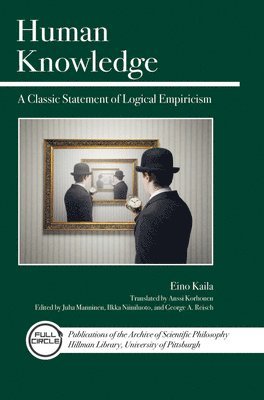
    Human Knowledge

    A Classic Statement of Logical Empiricism

    AvEino Kaila,George A. Reisch

    Häftad, Engelska, 2014

    Del i serien Full Circle Series

    506 kr

    Beställningsvara. Skickas inom 3-6 vardagar. Fri frakt över 249 kr.

    Beskrivning

    Finnish philosopher Eino Kaila wrote a classic statement of logical empiricism. Having experienced the foundational debates of the Vienna Circle in 1929, Kaila was a keen follower of the further developments of the Circle. His synoptic presentation and analysis of the basic themes, or "theses," of the movement was based on his lectures as professor of theoretical philosophy at the University of Helsinki. The work appeared as a book in Finnish in 1939 and a Swedish translation by Georg Henrik von Wright followed immediately. Earlier, a translation of his philosophical essays from the original German, entitled Reality and Experience, appeared in 1979. However, this is the first translation of Kaila's major epistemological work, which remains a source for re-evaluations of Logical Empiricism.

    Produktinformation

    • Utgivningsdatum:2014-06-26
    • Mått:152 x 228 x 20 mm
    • Vikt:354 g
    • Format:Häftad
    • Språk:Engelska
    • Serie:Full Circle Series
    • Antal sidor:288
    • Förlag:Open Court Publishing Co ,U.S.
    • ISBN:9780812698480
    • Översättare:Anssi Korhonen

    Utforska kategorier

    • Filosofiska discipliner inom Filosofi och religion

    Mer om författaren

    Finnish philosopher, critic, and teacher Eino Kaila (1890--1958) worked in numerous fields, including psychology, physics, and theater, and attempted to find unifying principles behind various branches of human and natural sciences. George A. Reisch is the author of How the Cold War Transformed Philosophy of Science: To the Icy Slopes of Logic. He lives in Chicago.Anssi Korhonen is the author of Logic as Universal Science: Russell's Early Logicism and its Philosophical Context. Juha Manninen is the editor of The Vienna Circle in the Nordic Countries: Networks and Transformations of Logical Empiricism. Ilkka Niiniluoto is the author of Truthlikeness. Korhonen, Manninen, and Niiniluoto live in Helsinki, Finland.

    Innehållsförteckning

    • Table of Contents Introduction Preface by Eino Kaila Part I. Theory Formation 1. Search for Invariances 2. How the Search for Invariances Created Greek Science 3. The Aristotelian Conception of Knowledge 4. The Galilean Conception of Knowledge 5. Induction Part II. Formal Theory of Truth 6. Logical Truth 7. Mathematical Truth Part III. Empirical Theory of Truth 8. The Principle of Testability 9. The Logic of Physical Theories 10. Logical Behaviorism