Juha Manninen – författare
Visar alla böcker från författaren Juha Manninen. Handla med fri frakt och snabb leverans.
8 produkter
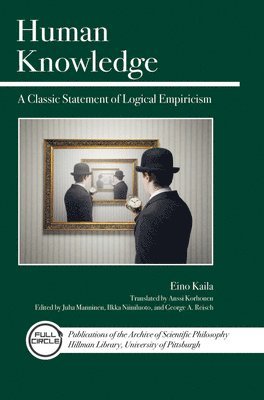
Human Knowledge
A Classic Statement of Logical Empiricism
Av Eino Kaila, George A. Reisch m. fl.
Häftad, 2014
507 kr
Lägg i varukorg
Finnish philosopher Eino Kaila wrote a classic statement of logical empiricism. Having experienced the foundational debates of the Vienna Circle in 1929, Kaila was a keen follower of the further developments of the Circle. His synoptic presentation and analysis of the basic themes, or "theses," of …
University of Strasbourg and the Foundation of Continental English Studies- L’Université de Strasbourg et la fondation des études anglaises continentales- Die Universitaet Straßburg und die Etablierung der Anglistik auf dem Kontinent
A Contribution to a European History of English Studies- Contribution à une histoire européenne des études anglaises- Ein Beitrag zu einer europaeischen Geschichte der Anglistik
Av Renate Haas, Albert Hamm m. fl.
Inbunden, 2009
1537 kr
Lägg i varukorg
The first regular chair of English Studies on the Continent was established in 1872 at the University of Strasbourg, re-founded by Germany after its victory of 1870-71. This institutionalisation, which decisively influenced the development of the discipline in Europe and beyond, can be explained by …
Vienna Circle in the Nordic Countries.
Networks and Transformations of Logical Empiricism
Av Juha Manninen, Friedrich Stadler
Inbunden, 2009
1094 kr
Lägg i varukorg
The rise of scientific (analytic) philosophy since the turn of the twentieth century is linked to the philosophical interaction between, on the one hand, Ernst Mach, the Vienna Circle around Moritz Schlick and Otto Neurath, the Berlin Group (Hans Reichenbach, Carl G. Hempel), and the Prague Group …
Vienna Circle in the Nordic Countries.
Networks and Transformations of Logical Empiricism
Av Friedrich Stadler, Juha Manninen
E-bok, 2009
1459 kr
Lägg i varukorg
The rise of scientific (analytic) philosophy since the turn of the twentieth century is linked to the philosophical interaction between, on the one hand, Ernst Mach, the Vienna Circle around Moritz Schlick and Otto Neurath, the Berlin Group (Hans Reichenbach, Carl G. Hempel), and the Prague Group …
Vienna Circle in the Nordic Countries.
Networks and Transformations of Logical Empiricism
Av Juha Manninen, Friedrich Stadler
Häftad, 2012
1094 kr
Lägg i varukorg
The rise of scientific (analytic) philosophy since the turn of the twentieth century is linked to the philosophical interaction between, on the one hand, Ernst Mach, the Vienna Circle around Moritz Schlick and Otto Neurath, the Berlin Group (Hans Reichenbach, Carl G. Hempel), and the Prague Group …
Essays on Explanation and Understanding
Studies in the Foundations of Humanities and Social Sciences
E-bok, 2012
734 kr
Lägg i varukorg
Essays on Explanation and Understanding
Studies in the Foundations of Humanities and Social Sciences
Häftad, 2011
550 kr
Lägg i varukorg
The present anthology consists of contributions to the philosophy of the humanities and the social sciences by European and American scholars. These writers represent not only the analytical tradition but also hermen- eutic philosophy and Marxism. Of the papers included in this volume those by …
Ajattelun välineet ja maailmat
Av Risto Vilkko, Juha Manninen
E-bok, 2019
267 kr
Lägg i varukorg
Jaakko Hintikka on aikamme johtavia tutkijoita logiikan alalla. Hänen tuotantonsa ulottuu myös tieto-oppiin, tieteenfilosofiaan, estetiikkaan, kielifilosofiaan, filosofian historiaan ja filosofian nykysuuntauksiin. Tämä kirja johdattaa lukijan Hintikan ajatteluun. Se tarjoaa edustavan valikoiman …