• Fri frakt över 249 kr
  • •
  • Snabba leveranser
  • •
  • Billiga böcker
Kundservice

Du är på sajten för privatpersoner.

Företag, bibliotek eller offentlig verksamhet?

Du handlar på classic.bokus.com, där alla dina funktioner finns intakta.
Till classic.bokus.com
Bokus logotyp. Gå till startsidan.
  • Erbjudanden
  • Nyheter
  • Student
  • Topplistor
  • Barn & ungdom
  • Bokus Play
  • E-böcker
  • Pocketböcker
  • Spel & pussel

10% studentrabatt med kod TERM26

Sidfot

Mina sidor

    Hjälp

    • Kundservice
    • Vanliga frågor och svar
    • Frakt och leverans
    • Retur vid ångerrätt
    • Reklamera vara
    • Betalning
    • Köpvillkor
    • Allmänna villkor
    • Information om webbplatsens tillgänglighet

    Om Bokus

    • Om oss
    • Pressrum
    • För studenter
    • För företag
    • För bibliotek och offentlig verksamhet
    • För leverantörer
    • Hållbarhet

    Populärt

    • Aktuella erbjudanden
    • Presentkort
    • Studentlitteratur
    • Nya böcker
    • Topplistor
    • Signerade böcker
    • Engelska böcker

    Inspiration

    • Boktips
    • BookTok
    • Populära bokserier
    • Barnbokskaraktärer
    • Populära författare
    Logotyp för Bokus
    Följ oss på Facebook (extern länk)Följ oss på Instagram (extern länk)Följ oss på YouTube (extern länk)Följ oss på TikTok (extern länk)
    bokus @ CookiesAnpassa cookiesIntegritetspolicyKöpvillkor
    Till Citymail hemsida (extern länk)Till Budbee hemsida (extern länk)Till Postnord hemsida (extern länk)Till Schenker hemsida (extern länk)Till Early Bird hemsida (extern länk)Till Walleys hemsida (extern länk)
    1. Samhälle och politik
    2. Politik och statsskick
    3. Statsskick och politiska processer

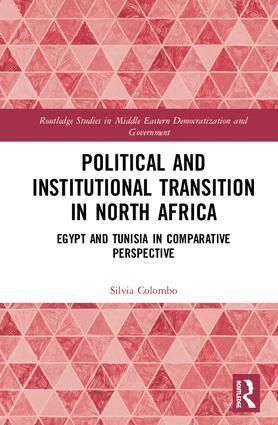
    Political and Institutional Transition in North Africa

    Egypt and Tunisia in Comparative Perspective

    AvSilvia Colombo

    Inbunden, Engelska, 2018

    Del i serien Routledge Studies in Middle Eastern Democratization and Government

    2 434 kr

    Beställningsvara. Skickas inom 10-15 vardagar. Fri frakt över 249 kr.

    Fler format och utgåvor

    Häftad

    698 kr

    E-bok

    822 kr

    E-bok

    824 kr

    Beskrivning

    The year 2011 will go down in history as a turning point for the Arab world. The popular unrest that swept across the region and led to the toppling of the Ben Ali, Mubarak, and Qaddhafi regimes in Tunisia, Egypt, and Libya has fundamentally altered the social, economic, and political outlooks of these countries and the region as a whole.This book assesses the transition processes unleashed by the uprisings that took place in Egypt and Tunisia in 2011. The wave of unrest and popular mobilisation that swept through these countries is treated as the point of departure of long and complex processes of change, manipulation, restructuring, and entrenchment of the institutional structures and logics that defined politics. The book explores the constitutive elements of institutional development, namely processes of constitution making, electoral politics, the changing status and power of the judiciary, and the interplay between the civilian and the military apparatuses in Egypt and Tunisia. It also considers the extent to which these two countries have become more democratic, as a result of their institutions being more legitimate, accountable, and responsive, at the beginning of 2014 and from a comparative perspective. The impact of temporal factors in shaping transition paths is highlighted throughout the book. The book provides a comprehensive assessment of political and institutional transition processes in two key countries in North Africa and its conclusions shed light on similar processes that have taken place throughout the region since 2011. It will be a valuable resource for anyone studying Middle Eastern and North African politics, area studies, comparative institutional development and democratisation.

    Produktinformation

    • Utgivningsdatum:2018-06-18
    • Mått:156 x 234 x 16 mm
    • Vikt:430 g
    • Format:Inbunden
    • Språk:Engelska
    • Serie:Routledge Studies in Middle Eastern Democratization and Government
    • Antal sidor:194
    • Förlag:Taylor & Francis Inc
    • ISBN:9780815347095

    Utforska kategorier

    • Statsskick och politiska processer inom Samhälle och politik
    • Politisk aktivism inom Samhälle och politik
    • Statsvetenskap och politisk teori inom Samhälle och politik

    Mer om författaren

    Silvia Colombo is Head of the Mediterranean and Middle East Programme at the International Affairs Institute (IAI) in Rome. She works on Euro-Mediterranean cooperation and domestic and regional politics in the Arab world.

    Recensioner i media

    "Years after the Arab Spring the reasons of failure and success of different attempts of transition are still largely undetermined. Through an enlightening binary comparison of Egypt and Tunisia and thorough, first-hand field research, Colombo presents the most advanced analysis of the phenomenon to date. This is a compulsory reading for anyone interested in the Middle East and North Africa as a scholar, student or practitioner." - Leonardo Morlino, Professor of Political Science at Luiss University, Italy and former President of the International Political Science Association (IPSA)"Tunisia and Egypt: so close and yet so far apart. Both countries were bent on unsustainable paths, both succeeded in overthrowing entrenched dictators. Yet after a brief moment of general euphoria, Tunisia and Egypt took dramatically divergent paths. Why? Silvia Colombo meticulously dissects the institutional dynamics underpinning and explaining changes and continuities in Tunisia and Egypt. A must read for anyone wishing to understand the contrasting and contested trajectories of North Africa and the Middle East."- Nathalie Tocci, Director of the International Affairs Institute (IAI), Italy and Special Advisor to the EU High Representative Federica Mogherini

    Innehållsförteckning

    • Introduction1. Debating transition, explaining institutional development2. Looking back3. Writing constitutions in time4. It all comes down to electoral politics5. The deep state fights back6. Forward lookingConclusionsBibliographyAppendix: List of interviews