• Fri frakt över 249 kr
  • •
  • Snabba leveranser
  • •
  • Billiga böcker
Kundservice

Du är på sajten för privatpersoner.

Företag, bibliotek eller offentlig verksamhet?

Du handlar på classic.bokus.com, där alla dina funktioner finns intakta.
Till classic.bokus.com
Bokus logotyp. Gå till startsidan.
  • Erbjudanden
  • Student
  • Topplistor
  • Barn & ungdom
  • Bokus Play
  • E-böcker
  • Ljudböcker
  • Pocketböcker
  • Spel och pussel

Pocketfynda! Hundratals böcker för 49 kr/st →

Sidfot

Mina sidor

    Hjälp

    • Kundservice
    • Vanliga frågor och svar
    • Frakt och leverans
    • Retur vid ångerrätt
    • Reklamera vara
    • Betalning
    • Köpvillkor
    • Allmänna villkor
    • Information om webbplatsens tillgänglighet

    Om Bokus

    • Om oss
    • Pressrum
    • För studenter
    • För företag
    • För bibliotek och offentlig verksamhet
    • För leverantörer
    • Hållbarhet

    Populärt

    • Aktuella erbjudanden
    • Presentkort
    • Studentlitteratur
    • Nya böcker
    • Topplistor
    • Signerade böcker
    • Engelska böcker

    Inspiration

    • Boktips
    • BookTok
    • Barnbokskaraktärer
    • Populära författare
    Logotyp för Bokus
    Följ oss på Facebook (extern länk)Följ oss på Instagram (extern länk)Följ oss på YouTube (extern länk)Följ oss på TikTok (extern länk)
    bokus @ CookiesAnpassa cookiesIntegritetspolicyKöpvillkor
    Till Citymail hemsida (extern länk)Till Budbee hemsida (extern länk)Till Postnord hemsida (extern länk)Till Schenker hemsida (extern länk)Till Early Bird hemsida (extern länk)Till Walleys hemsida (extern länk)
    1. Naturvetenskap och teknik
    2. Matematik och naturvetenskap
    3. Naturvetenskap:allmänt

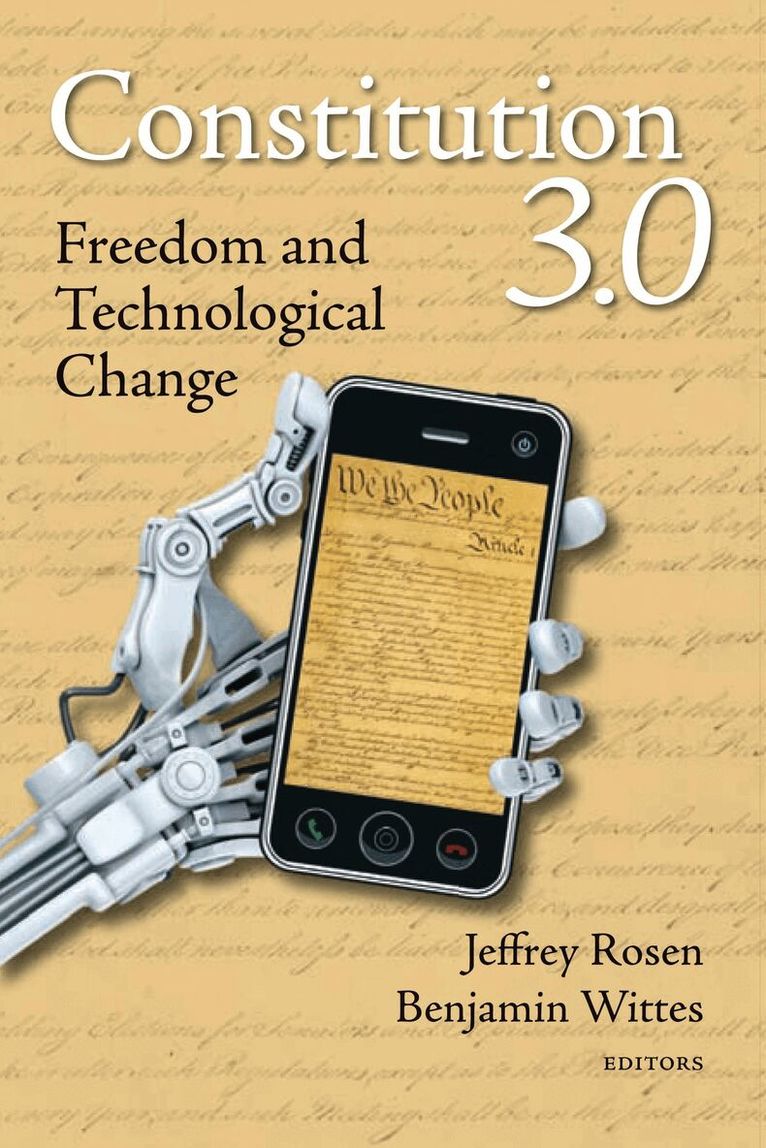
    Constitution 3.0

    Freedom and Technological Change

    AvJeffrey Rosen,Benjamin Wittes

    Häftad, Engelska, 2013

    286 kr

    Beställningsvara. Skickas inom 10-15 vardagar. Fri frakt över 249 kr.

    Beskrivning

    At the beginning of the twenty-first century, breathtaking changes in technology are posing stark challenges to our constitutional values. From free speech to privacy, from liberty and personal autonomy to the right against self-incrimination, basic constitutional principles are under stress from technological advances unimaginable even a few decades ago, let alone during the founding era. In this provocative collection, America's leading scholars of technology, law, and ethics imagine how to translate and preserve constitutional and legal values at a time of dizzying technological change.Constitution 3.0 explores some of the most urgent constitutional questions of the near future. Will privacy become obsolete, for example, in a world where ubiquitous surveillance is becoming the norm? Imagine that Facebook and Google post live feeds from public and private surveillance cameras, allowing 24/7 tracking of any citizen in the world. How can we protect free speech now that Facebook and Google have more power than any king, president, or Supreme Court justice to decide who can speak and who can be heard? How will advanced brain-scan technology affect the constitutional right against self-incrimination? And on a more elemental level, should people have the right to manipulate their genes and design their own babies? Should we be allowed to patent new forms of life that seem virtually human? The constitutional challenges posed by technological progress are wide-ranging, with potential impacts on nearly every aspect of life in America and around the world.The authors include Jamie Boyle, Duke Law School; Eric Cohen and Robert George, Princeton University; Jack Goldsmith, Harvard Law School; Orin Kerr, George Washington University Law School; Lawrence Lessig, Harvard Law School; Stephen Morse, University of Pennsylvania Law School; John Robertson, University of Texas Law School; Christopher Slobogin, Vanderbilt Law School; O. Carter Snead, Notre

    Produktinformation

    • Utgivningsdatum:2013-03-21
    • Mått:153 x 229 x 17 mm
    • Vikt:413 g
    • Format:Häftad
    • Språk:Engelska
    • Antal sidor:284
    • Förlag:Bloomsbury Publishing Plc
    • ISBN:9780815724506

    Utforska kategorier

    • Naturvetenskap:allmänt inom Naturvetenskap och teknik
    • Författningsrätt och förvaltningsrätt inom Juridik

    Mer om författaren

    "Jeffrey Rosen is a professor of law at the George Washington University Law School, the legal affairs editor of The New Republic, and a nonresident senior fellow at Brookings. His books include The Unwanted Gaze, The Naked Crowd, and The Supreme Court.Benjamin Wittes is a senior fellow in Governance Studies at the Brookings Institution. He is the author of Law and the Long War and Detention and Denial."

    Recensioner i media

    "In this terrific new anthology, some of the country's most original constitutionalthinkers set themselves to imagining a brave new world of 24 hour surveillance, Facebook snooping, neurological sentencing, biothreats, robots, and more. Each author tries to map these emerging technologies onto existing constitutional doctrine and reflect on how the current doctrine must stretch to accommodate, or risk failing us. This is a thrilling, terrifying account of technology that has come to define us, and a challenge to think in new ways about our most fundamental values." —Dahlia Lithwick, Slate senior editor|"In this thought-provoking collection of essays by a distinguished group of scholars,Jeffrey Rosen and Ben Wittes take us on a magical journey to the Constitution's future,posing hard questions about how to translate our commitments to freedom and equalityto a technologically advanced world. This is a fascinating book that anyone interested inthe problems of technological change should read." —Jack M. Balkin, Knight Professor of ConstitutionalLaw and the First Amendment, Yale Law School|" Constitution 3.0 is a remarkable and provocative book that tackles one of law —andsociety's —most important questions: How will new technologies intersecting all aspectsof our lives affect our constitutional rights and our approach to a document written morethan two centuries ago? In this invaluable contribution, Jeffrey Rosen and BenjaminWittes, two of the nation's sharpest legal thinkers, ask some of the nation's preeminentscholars to look to the future and predict how cutting-edge technologies will coexist withone of the world's oldest constitutions." —Jan Crawford, CBS News Chief Legal and PoliticalCorrespondent, author, Supreme Conflict|""An invaluable roadmap for responding to the challenge of adapting our constitutional values to future technological developments."" — POLITICO