• Fri frakt över 249 kr
  • •
  • Snabba leveranser
  • •
  • Billiga böcker
Kundservice

Du är på sajten för privatpersoner.

Företag, bibliotek eller offentlig verksamhet?

Du handlar på classic.bokus.com, där alla dina funktioner finns intakta.
Till classic.bokus.com
Bokus logotyp. Gå till startsidan.
  • Erbjudanden
  • Nyheter
  • Student
  • Topplistor
  • Barn & ungdom
  • Bokus Play
  • E-böcker
  • Pocketböcker
  • Spel & pussel

10% rabatt på allt med kod: NYSTART10 →

Sidfot

Mina sidor

    Hjälp

    • Kundservice
    • Vanliga frågor och svar
    • Frakt och leverans
    • Retur vid ångerrätt
    • Reklamera vara
    • Betalning
    • Köpvillkor
    • Allmänna villkor
    • Information om webbplatsens tillgänglighet

    Om Bokus

    • Om oss
    • Pressrum
    • För studenter
    • För företag
    • För bibliotek och offentlig verksamhet
    • För leverantörer
    • Hållbarhet

    Populärt

    • Aktuella erbjudanden
    • Presentkort
    • Studentlitteratur
    • Nya böcker
    • Topplistor
    • Signerade böcker
    • Engelska böcker

    Inspiration

    • Boktips
    • BookTok
    • Populära bokserier
    • Barnbokskaraktärer
    • Populära författare
    Logotyp för Bokus
    Följ oss på Facebook (extern länk)Följ oss på Instagram (extern länk)Följ oss på YouTube (extern länk)Följ oss på TikTok (extern länk)
    bokus @ CookiesAnpassa cookiesIntegritetspolicyKöpvillkor
    Till Citymail hemsida (extern länk)Till Budbee hemsida (extern länk)Till Postnord hemsida (extern länk)Till Schenker hemsida (extern länk)Till Early Bird hemsida (extern länk)Till Walleys hemsida (extern länk)
    1. Kultur
    2. Scenkonst och film
    3. Film

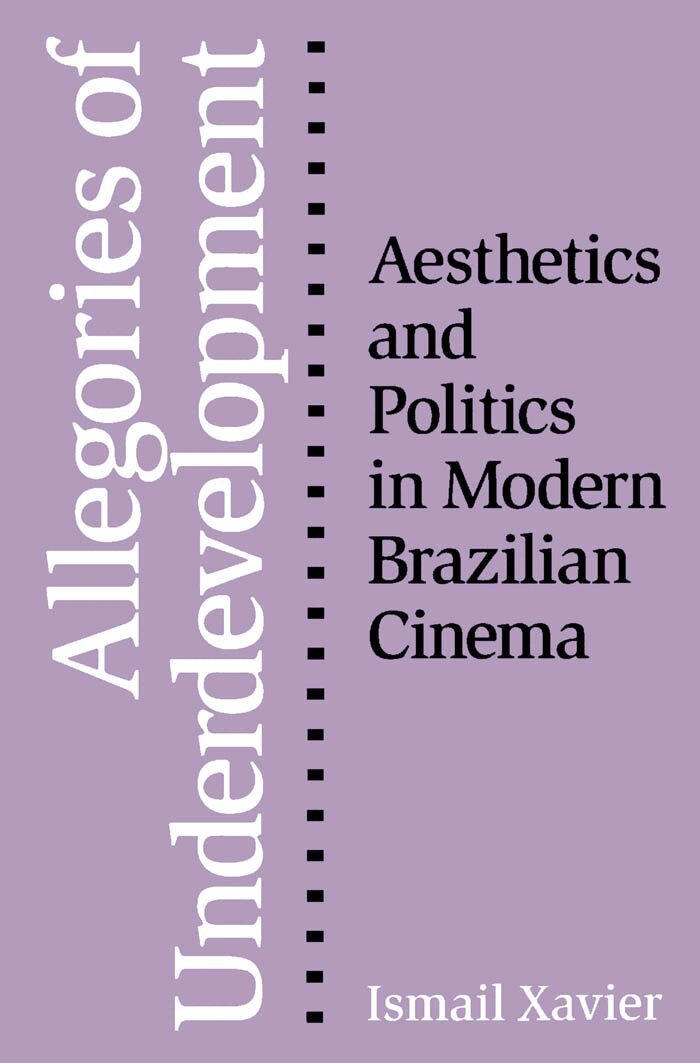
    Allegories of Underdevelopment

    Aesthetics and Politics in Modern Brazilian Cinema

    AvIsmail Xavier

    Häftad, Engelska, 1997

    294 kr

    Beställningsvara. Skickas inom 5-8 vardagar. Fri frakt över 249 kr.

    Beskrivning

    Examines the centrality of Cinema Novo to filmmaking in Brazil.“A camera in the hand and ideas in the head” was the primary axiom of the young originators of Brazil’s Cinema Novo. This movement of the 1960s and early 1970s overcame technical constraints and produced films on minimal budgets. In Allegories of Underdevelopment, Ismail Xavier examines a number of these films, arguing that they served to represent a nation undergoing a political and social transformation into modernity.Its best-known voice, filmmaker Glauber Rocha claimed that Cinema Novo was driven by an “aesthetics of hunger.” This scarcity of means demanded new cinematic approaches that eventually gave rise to a legitimate and unique Third World cinema. Xavier stands in the vanguard of scholars presenting and interpreting these revolutionary films-from the masterworks of Rocha to the groundbreaking experiments of Julio Bressane, RogÉrio Sganzerla, Andrea Tonacci and Arthur Omar-to an English-speaking audience. Focusing on each filmmaker’s use of narrative allegories for the “conservative modernization” Brazil and other nations underwent in the 1960s and 1970s, Xavier asks questions relating to the connection between film and history. He examines the way Cinema Novo transformed Brazil’s cultural memory and charts the controversial roles that Marginal Cinema and Tropicalism played in this process. Among the films he discusses are Black God, White Devil, Land in Anguish, Red Light Bandit, MacunaÍma, AntÔnio das Mortes, The Angel Is Born, and Killed the Family and Went to the Movies.A compelling chronicle of the history of modern Brazilian cinema, Allegories of Underdevelopment brings to light the work of many filmmakers who are virtually unknown in the English-speaking world.

    Produktinformation

    • Utgivningsdatum:1997-08-01
    • Mått:149 x 229 x 15 mm
    • Format:Häftad
    • Språk:Engelska
    • Antal sidor:296
    • Förlag:University of Minnesota Press
    • ISBN:9780816626779

    Utforska kategorier

    • Film inom Kultur
    • Kulturvetenskap inom Samhälle och politik

    Mer om författaren

    Ismail Xavier received his Ph.D. in film studies from New York University. He currently teaches at the University of SÃo Paulo, Brazil.

    Innehållsförteckning

    • Part I The teleology of history: "Black God White Devil" - allegory and prophecy. Part II The crisis of teleology land in anguish: allegory and agony; "Red Light Bandit" - allegory and irony; the levels of incoherence - or the mirage of the nation as a subject. Part III Allegory and melancholy: "Macunaima" - the delusions of eternal childhood; "Antonio das Mortes" - myth and simulacrum in the crisis of revolution. Part IV: Allegory and deconstruction: "The Angel is Born" - the song of exile; "Killed the Family and went to the Movies" - the ersatz carnival; bang bang - passage, not destination. Part V Further developments: trends of allegory in the 1970s.