• Fri frakt över 249 kr
  • •
  • Snabba leveranser
  • •
  • Billiga böcker
Kundservice

Du är på sajten för privatpersoner.

Företag, bibliotek eller offentlig verksamhet?

Du handlar på classic.bokus.com, där alla dina funktioner finns intakta.
Till classic.bokus.com
Bokus logotyp. Gå till startsidan.
  • Erbjudanden
  • Nyheter
  • Student
  • Topplistor
  • Barn & ungdom
  • Bokus Play
  • E-böcker
  • Pocketböcker
  • Spel & pussel

10% rabatt på allt med kod NYSTART10 →

Sidfot

Mina sidor

    Hjälp

    • Kundservice
    • Vanliga frågor och svar
    • Frakt och leverans
    • Retur vid ångerrätt
    • Reklamera vara
    • Betalning
    • Köpvillkor
    • Allmänna villkor
    • Information om webbplatsens tillgänglighet

    Om Bokus

    • Om oss
    • Pressrum
    • För studenter
    • För företag
    • För bibliotek och offentlig verksamhet
    • För leverantörer
    • Hållbarhet

    Populärt

    • Aktuella erbjudanden
    • Presentkort
    • Studentlitteratur
    • Nya böcker
    • Topplistor
    • Signerade böcker
    • Engelska böcker

    Inspiration

    • Boktips
    • BookTok
    • Populära bokserier
    • Barnbokskaraktärer
    • Populära författare
    Logotyp för Bokus
    Följ oss på Facebook (extern länk)Följ oss på Instagram (extern länk)Följ oss på YouTube (extern länk)Följ oss på TikTok (extern länk)
    bokus @ CookiesAnpassa cookiesIntegritetspolicyKöpvillkor
    Till Citymail hemsida (extern länk)Till Budbee hemsida (extern länk)Till Postnord hemsida (extern länk)Till Schenker hemsida (extern länk)Till Early Bird hemsida (extern länk)Till Walleys hemsida (extern länk)
    1. Data och IT
    2. Systemvetenskap och AI

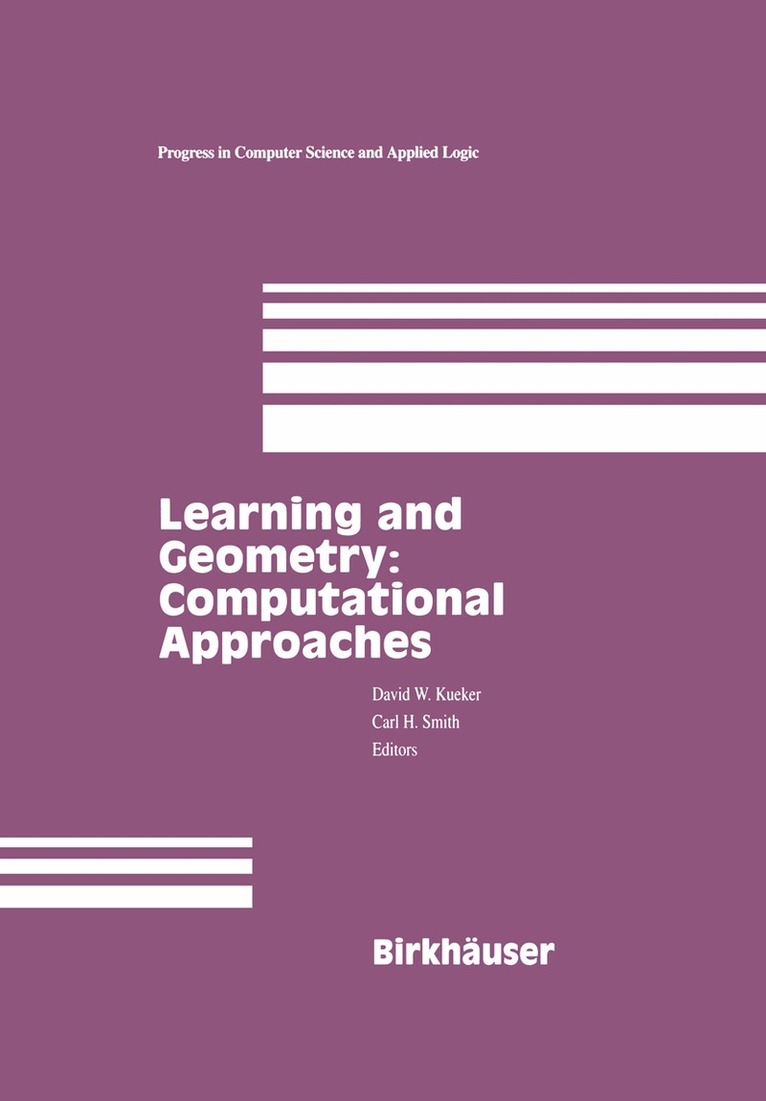
    Learning and Geometry: Computational Approaches

    AvDavid Kueker,Carl Smith

    Inbunden, Engelska, 1995

    Del i serien Progress in Computer Science and Applied Logic

    1 086 kr

    Beställningsvara. Skickas inom 10-15 vardagar. Fri frakt över 249 kr.

    Beskrivning

    The field of computational learning theory arose out of the desire to for­ mally understand the process of learning. As potential applications to artificial intelligence became apparent, the new field grew rapidly. The learning of geo­ metric objects became a natural area of study. The possibility of using learning techniques to compensate for unsolvability provided an attraction for individ­ uals with an immediate need to solve such difficult problems. Researchers at the Center for Night Vision were interested in solving the problem of interpreting data produced by a variety of sensors. Current vision techniques, which have a strong geometric component, can be used to extract features. However, these techniques fall short of useful recognition of the sensed objects. One potential solution is to incorporate learning techniques into the geometric manipulation of sensor data. As a first step toward realizing such a solution, the Systems Research Center at the University of Maryland, in conjunction with the Center for Night Vision, hosted a Workshop on Learning and Geometry in January of 1991. Scholars in both fields came together to learn about each others' field and to look for common ground, with the ultimate goal of providing a new model of learning from geometrical examples that would be useful in computer vision. The papers in the volume are a partial record of that meeting.

    Produktinformation

    • Utgivningsdatum:1995-12-01
    • Mått:178 x 254 x undefined mm
    • Vikt:694 g
    • Format:Inbunden
    • Språk:Engelska
    • Serie:Progress in Computer Science and Applied Logic
    • Antal sidor:212
    • Upplaga:1996
    • Förlag:Birkhauser Boston Inc
    • ISBN:9780817638252

    Utforska kategorier

    • Systemvetenskap och AI inom Data och IT
    • Matematik inom Naturvetenskap och teknik
    • Material och digital teknik i undervisningen inom Psykologi och pedagogik

    Innehållsförteckning

    • Learning.- MDL Learning.- PAC Learning, Noise and Geometry.- A Review of Some Extensions to the PAC Learning Model.- Geometry.- Finite Point Sets and Oriented Matroids: Combinatorics in Geometry.- A Survey of Geometric Reasoning Using Algebraic Methods.- Synthetic versus Analytic Geometry for Computers.- Representing Geometric Configurations.- Geometry Theorem Proving in Euclidean, Decartesian, Hilbertian and Computerwise Fashion.