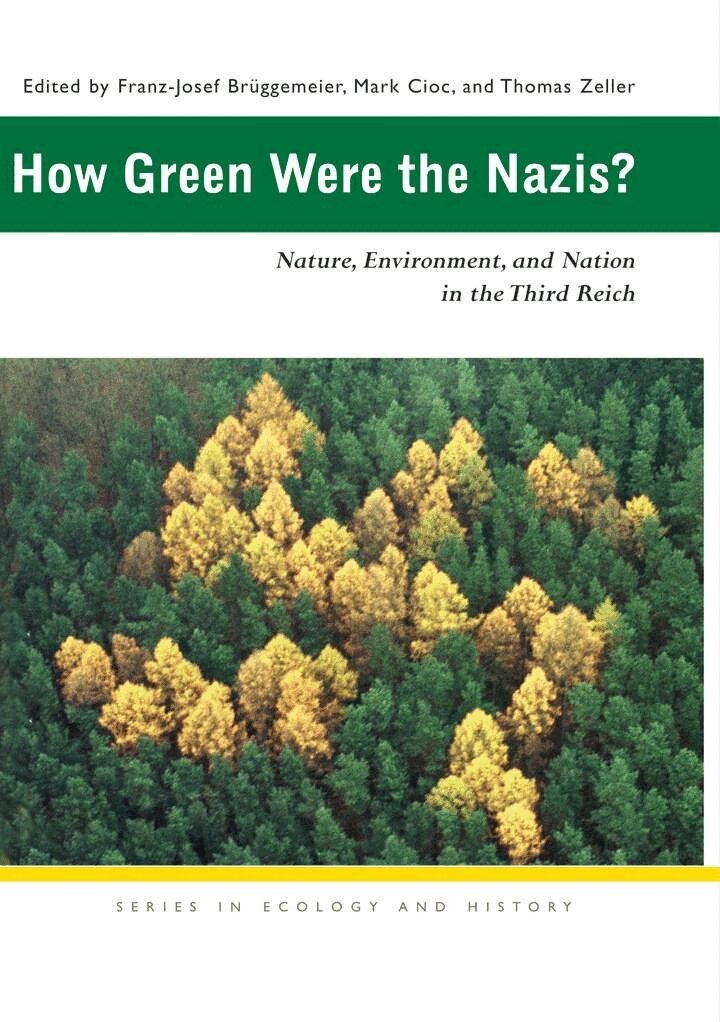
Häftad, Engelska, 2005
How Green Were the Nazis?
Nature, Environment, and Nation in the Third Reich
Av Franz-Josef Brüggemeier, Mark Cioc, Thomas Zeller
Del i serien Series in Ecology and History
378 kr
Skickas onsdag 18/11. Fri frakt över 249 kr.
Beskrivning
Produktinformation
- Utgivningsdatum: 2005-12-15
- Mått: 152 x 229 x 24 mm
- Vikt: 414 g
- Format: Häftad
- Språk: Engelska
- Serie: Series in Ecology and History
- Antal sidor: 288
- Förlag: Ohio University Press
- ISBN: 9780821416471
Utforska kategorier
Mer om författaren
Franz-Josef BrÜggemeier is a professor of history at the University of Freiburg, Germany. He has published extensively in the field of environmental history in nineteenth- and twentieth-century Europe.Mark Cioc is a professor of history at the University of California, Santa Cruz and the author of The Rhine: An Eco-Biography, 1815–2000. He is a coeditor of How Green Were the Nazis? Nature, Environment, and Nation in the Third Reich.Thomas Zeller is an associate professor at the University of Maryland, where he teaches the history of technology, environmental history, and science and technology studies. He is the author of Driving Germany: The Landscape of the German Autobahn, 1930–1970 and coeditor of How Green Were the Nazis? Nature, Environment, and Nation in the Third Reich and Rivers in History: Designing and Conceiving Waterways in Europe and North America.
Recensioner i media
"Perhaps one of the greatest values of this book is to underscore once again the fact that environmentalism as a political belief system has never been value-free and thus has been able to take vastly different political forms." (Technology and Culture) "Instead of courting controversy, How Green Were the Nazis? both draws on, and contributes to, recent trends in the historiography of the Third Reich. It treats the regime not as a 'historical aberration' but as a barbaric mutation of modernity that displayed 'a mixture of atavistic and avante-garde ideas' in environmental as in other policy areas." (Environment and History) "The environmental ideas, policies, and consequences of the Nazi regime pose controversial questions that have long begged for authoritative answers. At last, a team of highly qualified scholars has tackled these questions, with dispassionate judgment and deep research. Their assessment will stand for years to come as the fundamental work on the subject and provides a new angle of vision on 20th-century Europe's most disruptive force." "An invaluable English introduction to the history of conservation in the Third Reich." "The thesis brought forward by the editors regarding the 'modernity' of National Socialism is exciting.... The volume raises key questions and provides a very good basis for engaging with the history of conservation under Nazi rule." (Historische Zeitschrift) "The picture that emerges is of a regime that seemed intent early on to protect the environment yet abandoned conservation as soon as serious war preparation commenced in 1936.... In introducing us to conservationists who threw in their lot with the Nazi regime, the volume does remind us that the desire to protect nature must be accompanied by an equally strong commitment to social justice and human rights." (H-German)
Betyg & recensioner
0 recensioner
Inga recensioner tillgängliga.