• Fri frakt över 249 kr
  • •
  • Snabba leveranser
  • •
  • Billiga böcker
Kundservice

Du är på sajten för privatpersoner.

Företag, bibliotek eller offentlig verksamhet?

Du handlar på classic.bokus.com, där alla dina funktioner finns intakta.
Till classic.bokus.com
Bokus logotyp. Gå till startsidan.
  • Erbjudanden
  • Nyheter
  • Student
  • Topplistor
  • Barn & ungdom
  • Bokus Play
  • E-böcker
  • Pocketböcker
  • Spel & pussel

10% rabatt på allt med kod: NYSTART10 →

Sidfot

Mina sidor

    Hjälp

    • Kundservice
    • Vanliga frågor och svar
    • Frakt och leverans
    • Retur vid ångerrätt
    • Reklamera vara
    • Betalning
    • Köpvillkor
    • Allmänna villkor
    • Information om webbplatsens tillgänglighet

    Om Bokus

    • Om oss
    • Pressrum
    • För studenter
    • För företag
    • För bibliotek och offentlig verksamhet
    • För leverantörer
    • Hållbarhet

    Populärt

    • Aktuella erbjudanden
    • Presentkort
    • Studentlitteratur
    • Nya böcker
    • Topplistor
    • Signerade böcker
    • Engelska böcker

    Inspiration

    • Boktips
    • BookTok
    • Populära bokserier
    • Barnbokskaraktärer
    • Populära författare
    Logotyp för Bokus
    Följ oss på Facebook (extern länk)Följ oss på Instagram (extern länk)Följ oss på YouTube (extern länk)Följ oss på TikTok (extern länk)
    bokus @ CookiesAnpassa cookiesIntegritetspolicyKöpvillkor
    Till Citymail hemsida (extern länk)Till Budbee hemsida (extern länk)Till Postnord hemsida (extern länk)Till Schenker hemsida (extern länk)Till Early Bird hemsida (extern länk)Till Walleys hemsida (extern länk)
    1. Samhälle och politik
    2. Sociologi och antropologi
    3. Antropologi

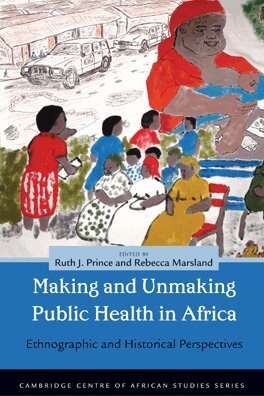
    Making and Unmaking Public Health in Africa

    Ethnographic and Historical Perspectives

    AvRuth J. Prince,Rebecca Marsland

    E-bok
    Engelska, 2013

    Del i serien Cambridge Centre of African Studies Series

    605 kr

    Läs direkt i Bokus Reader – eller ladda ned till din enhet

    Beskrivning

    Africa has emerged as a prime arena of global health interventions that focus on particular diseases and health emergencies. These are framed increasingly in terms of international concerns about security, human rights, and humanitarian crisis. This presents a stark contrast to the 1960s and '70s, when many newly independent African governments pursued the vision of public health "for all," of comprehensive health care services directed by the state with support from foreign donors. These initiatives often failed, undermined by international politics, structural adjustment, and neoliberal policies, and by African states themselves. Yet their traces remain in contemporary expectations of and yearnings for a more robust public health.This volume explores how medical professionals and patients, government officials, and ordinary citizens approach questions of public health as they navigate contemporary landscapes of NGOs and transnational projects, faltering state services, and expanding privatization. Its contributors analyze the relations between the public and the private providers of public health, from the state to new global biopolitical formations of political institutions, markets, human populations, and health. Tensions and ambiguities animate these complex relationships, suggesting that the question of what public health actually is in Africa cannot be taken for granted. Offering historical and ethnographic analyses, the volume develops an anthropology of public health in Africa.Contributors:Hannah Brown, P. Wenzel Geissler, Murray Last, Rebecca Marsland, Lotte Meinert, Benson A. Mulemi, Ruth J. Prince, Noémi Tousignant, and Susan Reynolds Whyte

    Produktinformation

    • Utgivningsdatum:2013-11-15
    • Språk:Engelska
    • Antal sidor:277
    • Filformat:EPUB
    • Kopieringsskydd:LCP
    • ISBN:9780821444665
    • Förlag:Ohio University Press
    • Serie:Cambridge Centre of African Studies Series

    Utforska kategorier

    • Antropologi inom Samhälle och politik
    • Hälso- och sjukvård inom Medicin
    • Rättsliga frågor i hälso- och sjukvården inom Medicin

    Mer om författaren

    Ruth Prince is a research fellow in the Department of Social Anthropology at theUniversity of Cambridgeand the Institute of Anthropology at theUniversity of Oslo.Rebecca Marsland is a lecturer in the Department of Social Anthropology at the University of Edinburgh.

    Recensioner i media

    "The essays are in the very best tradition of medical anthropology: they display intimate political engagement, are genuinely comparative, speak to each other, and…accessibly written. …The volume opens up new vistas on public health, and challenges what we take for granted." (African Affairs) "Public health in Africa—as elsewhere—is no longer strictly public. Public and private providers are involved in national and transnational partnerships that divide responsibility for health and welfare among a number of agencies and actors. These clear and powerful essays set out this new landscape, exploring how medical professionals and patients, government officials and citizens approach questions of health. This text is required reading for anyone interested in contemporary Africa." "[The chapters] provide a fascinating range of ethnographically rich and theoretically subtle accounts of and insights into the diverse and often ambiguous practices of 'public health' across Africa. …One of the most impressive things about this volume is its integration and coherence…The result is a landmark publication that I believe will become a key text of enduring value – particularly to scholars and practitioners in the fields of public health, global health, and medical anthropology – but also to a much wider audience within and beyond anthropology." (Journal of the Royal Anthropological Institute) "A powerful and complex picture of what 'public health' is in Africa today as commitments to national health systems are being reshaped through the dramatic rise of 'global health.' This set of ethnographically rich and historically sensitive essays illustrates the forms of inequality that structure efforts to building health care institutions and that configure debates over who is responsible for the health and care of particular individuals. It is a must read for both Africanists interested in medicine and public health professionals who care about Africa." "This volume contributes significantly to the rapidly developing scholarship of public health and global health in African contexts, considered either as a collection of excellent chapters or taken as the sum of its parts. … [It] is also book-ended with trenchant, provocative commentaries on the operative theories and current practices of public health in Africa.…Making and Unmaking Public Health in Africa is an ideal fit for teaching the history or anthropology of public health at the undergraduate or graduate level." (Social History of Medicine) "Though the historical and anthropological literature on public health in Africa has tended to focus on the 'health' part of the equation, the chapters in this volume interrogate the meaning of the 'public' aspect.…Prince and Marsland argue that in recent years 'widening global and national inequalities and the emptying out of the public as an inclusive terrain' has led to a shift in health care provision to 'the arena of the market and of nongovernmental and transnational organizations' in most African settings. Individual chapters examine how Africans across the continent interpret and negotiate this chaotic, fractured terrain in a variety of contexts… Recommended." (Choice) "Any medical anthropologist who works in Africa will want this book in a nearby library. Those of us who study African biomedicine and biomedical research, whether anthropologists or historians, will find it particularly valuable. …As a whole, this excellent collection enlarges the scope of public health and challenges readers to think deeply about who is responsible for African health—and for the many threats to it." (Medical Anthropology Quarterly) "This superb new edited volume is extraordinarily timely and important." (Journal of the Royal Anthropological Institute)