• Fri frakt över 249 kr
  • •
  • Snabba leveranser
  • •
  • Billiga böcker
Kundservice

Du är på sajten för privatpersoner.

Företag, bibliotek eller offentlig verksamhet?

Du handlar på classic.bokus.com, där alla dina funktioner finns intakta.
Till classic.bokus.com
Bokus logotyp. Gå till startsidan.
  • Erbjudanden
  • Nyheter
  • Student
  • Topplistor
  • Barn & ungdom
  • Bokus Play
  • E-böcker
  • Pocketböcker
  • Spel & pussel

10% rabatt på allt med kod NYSTART10 →

Sidfot

Mina sidor

    Hjälp

    • Kundservice
    • Vanliga frågor och svar
    • Frakt och leverans
    • Retur vid ångerrätt
    • Reklamera vara
    • Betalning
    • Köpvillkor
    • Allmänna villkor
    • Information om webbplatsens tillgänglighet

    Om Bokus

    • Om oss
    • Pressrum
    • För studenter
    • För företag
    • För bibliotek och offentlig verksamhet
    • För leverantörer
    • Hållbarhet

    Populärt

    • Aktuella erbjudanden
    • Presentkort
    • Studentlitteratur
    • Nya böcker
    • Topplistor
    • Signerade böcker
    • Engelska böcker

    Inspiration

    • Boktips
    • BookTok
    • Populära bokserier
    • Barnbokskaraktärer
    • Populära författare
    Logotyp för Bokus
    Följ oss på Facebook (extern länk)Följ oss på Instagram (extern länk)Följ oss på YouTube (extern länk)Följ oss på TikTok (extern länk)
    bokus @ CookiesAnpassa cookiesIntegritetspolicyKöpvillkor
    Till Citymail hemsida (extern länk)Till Budbee hemsida (extern länk)Till Postnord hemsida (extern länk)Till Schenker hemsida (extern länk)Till Early Bird hemsida (extern länk)Till Walleys hemsida (extern länk)
    1. Samhälle och politik
    2. Samhälle och kultur
    3. Kultur och medier
    4. Kulturvetenskap

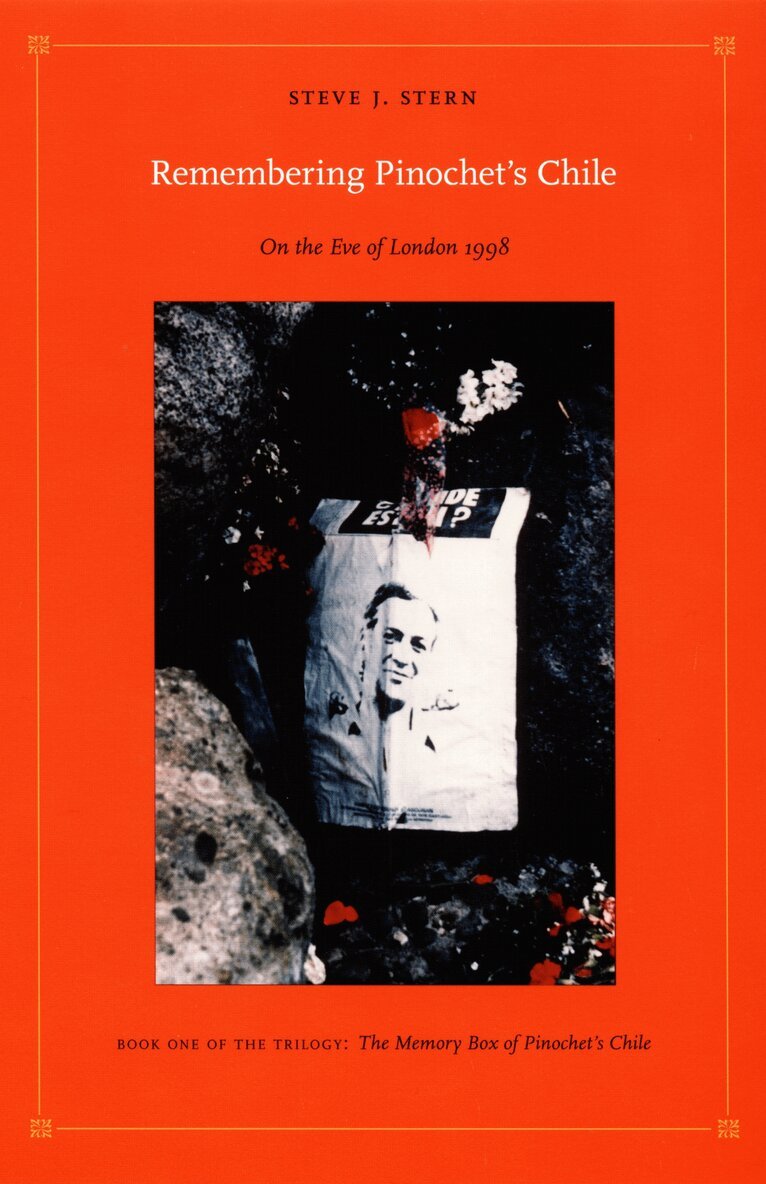
    Remembering Pinochet's Chile

    On the Eve of London 1998

    AvSteve J. Stern

    Häftad, Engelska, 2006

    Del i serien Latin America Otherwise

    377 kr

    Beställningsvara. Skickas inom 5-8 vardagar. Fri frakt över 249 kr.

    Fler format och utgåvor

    E-bok

    568 kr

    Beskrivning

    During the two years just before the 1998 arrest in London of General Augusto Pinochet, the historian Steve J. Stern had been in Chile collecting oral histories of life under Pinochet as part of an investigation into the form and meaning of memories of state-sponsored atrocities. In this compelling work, Stern shares the recollections of individual Chileans and draws on their stories to provide a framework for understanding memory struggles in history.“A thoughtful, nuanced study of how Chileans remember the traumatic 1973 coup by Augusto Pinochet against Salvador Allende and the nearly two decades of military government that followed. . . . In light of the recent revelations of American human rights abuses of Iraqi prisoners, [Stern’s] insights into the legacies of torture and abuse in the Chilean prisons of the 1970s certainly have contemporary significance for any society that undergoes a national trauma.”-Publishers Weekly“This outstanding work of scholarship sets a benchmark in the history of state terror, trauma, and memory in Latin America.”-Thomas Miller Klubock, American Historical Review“This is a book of uncommon depth and introspection. . . . Steve J. Stern has not only advanced the memory of the horrors of the military dictatorship; he has assured the place of Pinochet’s legacy of atrocity in our collective conscience.”-Peter Kornbluh, author of The Pinochet File: A Declassified Dossier on Atrocity and Accountability“Steve J. Stern’s book elegantly recounts the conflicted recent history of Chile. He has found a deft solution to the knotty problem of evenhandedness in representing points of view so divergent they defy even the most careful attempts to portray the facts of the Pinochet period. He weaves a tapestry of memory in which narratives of horror and rupture commingle with the sincere perceptions of Chileans who remember Pinochet’s rule as salvation. The facts are there, but more important is the understanding we gain by knowing how ordinary Chileans-Pinochet’s supporters and his victims-work through their unresolved past.”-John Dinges, author of The Condor Years: How Pinochet and His Allies Brought Terrorism to Three Continents

    Produktinformation

    • Utgivningsdatum:2006-09-04
    • Mått:156 x 234 x 17 mm
    • Vikt:431 g
    • Format:Häftad
    • Språk:Engelska
    • Serie:Latin America Otherwise
    • Antal sidor:280
    • Förlag:Duke University Press
    • ISBN:9780822338161

    Utforska kategorier

    • Kulturvetenskap inom Samhälle och politik
    • Statsvetenskap och politisk teori inom Samhälle och politik

    Mer om författaren

    Steve J. Stern is Alberto Flores Galindo Professor of History at the University of Wisconsin, Madison. Among his most recent books is Shining and Other Paths: War and Society in Peru, 1980–1995, also published by Duke University Press.

    Recensioner i media

    “Stern’s collection makes an important and original contribution to our understanding of how interpretations of the role played by the Chilean coup influenced subsequent political culture, and is a valuable exploration of personal histories through ethnographic research. Stern can only be praised for recording and disseminating stories that have rarely if ever been heard before, demonstrating a rare gift for eliciting testimony that is a tribute to his skill as a researcher and providing the reader with a potent and, indeed, moving sense of the full impact that the Pinochet dictatorship had on Chilean society.” - Gavin O'Toole (Latin American Review of Books) ‘Accessibly narrated and based on extensive archival research and ethnographic interviews, Stern's volume is certain to appear on many course syllabi in the near future. . . . [He] manages, quite adeptly, to add a dimension of complexity to concepts like censorship that are often discussed in rather unambiguous and generalized terms both in scholarly work on dictatorship and in university classrooms. . . . Stern brilliantly traces the evolution of memory as a critical category in Pinochet's Chile and helps us to see how the scripting of the past became a fierce political battle that would last long into the years of transition.”- Michael J. Lazzara (The Americas) “The work operates at a high level of theoretical sophistication of memory studies, but it applies that theory most concretely and insightfully to the events in Chile. . . . Recommended.” - J. A. Rhodes (Choice) “Stern successfully paints a broad picture of the dictatorship, its effects, and the struggle against it. Elegant and accessible, his book is likely to remain, for many years to come, a central reference text on the Pinochet regime and its ensuing battles to define historical memory.” - Michael J. Lazara (A Contracorriente) “[T]he theme of memory, a rigorous interdisciplinary methodology, and a creative narrative structure are the combined source of this work’s brilliance, one that sets a benchmark for future historical studies and challenges the conceptual boundaries for the study of Latin American dictatorships.” - Elizabeth Quay Hutchison (American Historical Review) “[T]his is an impressive synthesis based on prodigious research. . . . His focus on social memory, which allows him to consider the moral and subjective elements of human experience, together with his historian’s sensitivity to indeterminacy and human agency make this a compelling interpretation of how Chileans lived the Pinochet years.” - Alexander Wilde (Left History) “In a classic oral historian’s fashion, Stern shares stories and voices of the seldom heard. . . . Battling for Hearts and Minds also provides meticulous explanations of how Stern gathered and assessed distinct memory strands. In this 500-page work, almost 100 pages are notes, and Stern includes a thoughtful essay on primary sources as well as oral research as methodology. Combined with his lucid prose, this makes the volume quite valuable as a model for young researchers as well as for classroom use.” - Katherine Hite (Journal of Latin American Studies) “Stern has also provided scholars a window to understanding the logic and strategy of the Left. This book deserves wide reading and consideration by scholars both within and outside of the Latin America specialty. His forthcoming volume should be eagerly awaited." - Keith D. Dickson (Canadian Journal of History) “[A] brilliantly crafted, deeply layered narrative of the interaction between memory and history. . . . It is a ‘must read’ for anyone interested in understanding the dynamics of authoritarian rule and democratic resurgence in the Cold War period of Latin American history. Given its conceptual resonances and unique methodology it is sure to be of interest to students of historical memory anywhere in the world.” - James A. Wood (The Latin Americanist) “[A] remarkable tale of the inner contest between rival public memories-those of the regime’s backers and those of its detractors. Going well beyond some of the (now conventional) reliance upon testimonials, Stern follows the hopes and heartaches of civic activists, teachers, officers, and churchgoers as they organized themselves around real and symbolic struggles during the dictatorship’s most brutal years and its eventual demise.” - Jeremy Adelman (Journal of Interdisciplinary History) “As a superb study of contemporary Chilean history, Stern’s two volumes are certain to become classics for all those interested in the social, political, and economic evolution of Chile. Yet, Stern’s extraordinary accounts of how memory is built, signified, and reconstructed-as a dependent and independent variable, as methodologically rigorous jargon would have it-can also provide a useful and attractive framework for those interested in how memory is, ultimately and within constraints, created and re-created.” - Patricio Navia (Latin American Research Review)

    Innehållsförteckning

    • 6. An Ethics of Everyday Infinities and Powers: Flix Guattari on Affect and the Refrain / Lone Bertelsen and Andrew Murphie 138 An Inventory of Shimmers / Gregory J. Seigworth and Melissa Gregg 1 Acknowledgments xiMaps xviiiIntroduction to the Trilogy: The Memory Box of Pinochet’s Chile xxiIntroduction to Book One: Remembering Pinochet’s Chile 11. Heroic Memory: Ruin into Salvation 7AFTERWORD Childhood Holidays, Childhood Salvation 352. Dissident Memory: Rupture, Persecution, Awakening 39AFTERWORD The Lore of Goodness and Remorse 683. Indifferent Memory: Closing the Box on the Past 88AFTERWORD The Accident: Temptations of Silence 1024. From Loose Memory to Emblematic Memory: Knots on the Social Body 104AFTERWORD Memory Tomb of the Unknown Soldier 134Conclusion: Memories and Silences of the Heart 143Abbreviations Used in Notes and Essay on Sources 155Notes 157Essay on Sources 215Index 237