• Fri frakt över 249 kr
  • •
  • Snabba leveranser
  • •
  • Billiga böcker
Kundservice

Du är på sajten för privatpersoner.

Företag, bibliotek eller offentlig verksamhet?

Du handlar på classic.bokus.com, där alla dina funktioner finns intakta.
Till classic.bokus.com
Bokus logotyp. Gå till startsidan.
  • Erbjudanden
  • Nyheter
  • Student
  • Topplistor
  • Barn & ungdom
  • Bokus Play
  • E-böcker
  • Pocketböcker
  • Spel & pussel

10% rabatt på allt med kod: NYSTART10 →

Sidfot

Mina sidor

    Hjälp

    • Kundservice
    • Vanliga frågor och svar
    • Frakt och leverans
    • Retur vid ångerrätt
    • Reklamera vara
    • Betalning
    • Köpvillkor
    • Allmänna villkor
    • Information om webbplatsens tillgänglighet

    Om Bokus

    • Om oss
    • Pressrum
    • För studenter
    • För företag
    • För bibliotek och offentlig verksamhet
    • För leverantörer
    • Hållbarhet

    Populärt

    • Aktuella erbjudanden
    • Presentkort
    • Studentlitteratur
    • Nya böcker
    • Topplistor
    • Signerade böcker
    • Engelska böcker

    Inspiration

    • Boktips
    • BookTok
    • Populära bokserier
    • Barnbokskaraktärer
    • Populära författare
    Logotyp för Bokus
    Följ oss på Facebook (extern länk)Följ oss på Instagram (extern länk)Följ oss på YouTube (extern länk)Följ oss på TikTok (extern länk)
    bokus @ CookiesAnpassa cookiesIntegritetspolicyKöpvillkor
    Till Citymail hemsida (extern länk)Till Budbee hemsida (extern länk)Till Postnord hemsida (extern länk)Till Schenker hemsida (extern länk)Till Early Bird hemsida (extern länk)Till Walleys hemsida (extern länk)
    1. Kultur
    2. Konstböcker
    3. Konstformer
    4. Övriga konstformer

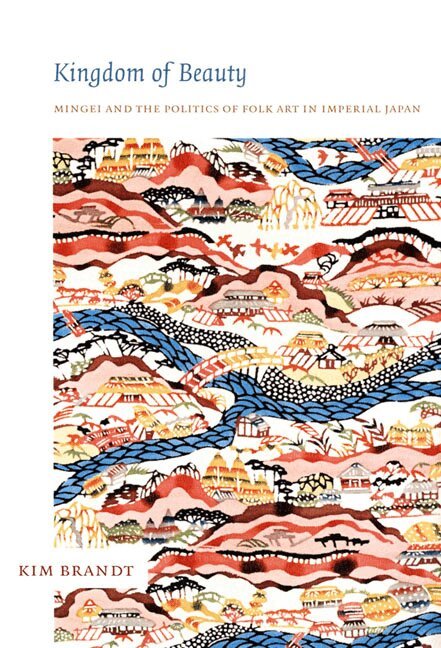
    Kingdom of Beauty

    Mingei and the Politics of Folk Art in Imperial Japan

    AvKim Brandt

    Häftad, Engelska, 2007

    Del i serien Asia-Pacific: Culture, Politics, and Society

    477 kr

    Beställningsvara. Skickas inom 3-6 vardagar. Fri frakt över 249 kr.

    Fler format och utgåvor

    E-bok

    471 kr

    Beskrivning

    A Study of the Weatherhead East Asian Institute, Columbia UniversityKingdom of Beauty shows that the discovery of mingei (folk art) by Japanese intellectuals in the 1920s and 1930s was central to the complex process by which Japan became both a modern nation and an imperial world power. Kim Brandt’s account of the mingei movement locates its origins in colonial Korea, where middle-class Japanese artists and collectors discovered that imperialism offered them special opportunities to amass art objects and gain social, cultural, and even political influence. Later, mingei enthusiasts worked with (and against) other groups-such as state officials, fascist ideologues, rival folk art organizations, local artisans, newspaper and magazine editors, and department store managers-to promote their own vision of beautiful prosperity for Japan, Asia, and indeed the world. In tracing the history of mingei activism, Brandt considers not only Yanagi Muneyoshi, Hamada Shōji, Kawai Kanjirō, and other well-known leaders of the folk art movement but also the often overlooked networks of provincial intellectuals, craftspeople, marketers, and shoppers who were just as important to its success. The result of their collective efforts, she makes clear, was the transformation of a once-obscure category of pre-industrial rural artifacts into an icon of modern national style.

    Produktinformation

    • Utgivningsdatum:2007-07-20
    • Mått:154 x 230 x 20 mm
    • Vikt:500 g
    • Format:Häftad
    • Språk:Engelska
    • Serie:Asia-Pacific: Culture, Politics, and Society
    • Antal sidor:277
    • Förlag:Duke University Press
    • ISBN:9780822340003

    Utforska kategorier

    • Övriga konstformer inom Kultur

    Mer om författaren

    Kim Brandt is Associate Professor of Japanese history at Columbia University.

    Recensioner i media

    “Kingdom of Beauty is first-rate. Kim Brandt’s analysis is sharp, her organization supple, her writing graceful. Moreover, her synthesis of the imperial with the domestic-and of the ideological with the material-makes the book a model of cultural history.”-KÄren Wigen, author of The Making of a Japanese Periphery, 1750–1920 “A richly textured, beautifully written, and provocatively argued analysis of the Japanese folk-craft movement, this study sheds light on empire, middle-class material culture, the aesthetics of fascism, and much else common to twentieth-century societies in the throes of dislocating change. A beguiling book on important themes.”-Carol Gluck, George Sansom Professor of History, Columbia University “Kingdom of Beauty is an important work that contributes a grounded account of knowledge production processes, dynamics of art evaluation, and achievements of art centered social activism in a colonial setting that will beuseful to scholars in many fields.”- Liora Sarfati (Museum Anthropology Review) “Kingdom of Beauty is truly the most compelling study of Mingei I have read: it not only answers questions hitherto unanswered, but also provides useful tools for the future study of Mingei, particularly in the context of today’s increasingly globalizing world. . . . I am deeply struck by the manner in which the author has approached often contentious topics with unabated tenacity, integrity, and sincerity.” (Asian Ethnology) “[A]n impressive narrative of mingei’s cultural history . . . . Kingdom of Beauty is a rigorous scholarly work, much of which is based on Brandt’s judicious use of Japanese primary resources. It is beautifully written, and benefits from the inclusion of numerous . . . plates of mingei wares. Brandt’s argument is tight, comprehensive and engaging and, most importantly, groundbreaking in its excavation of the complex social forces at work and the entities associated with mingei’s ascent in the first half of last century.” - Penny Bailey (Asian Studies Review)

    Innehållsförteckning

    • Acknowledgments ixIntroduction 11. The Beauty of Sorrow 72. The Discovery of Mingei 383. New Mingei in the 1930s 834. Mingei and the Wartime State, 1937-1945 1245. Renovating Greater East Asia 173Epilogue 223Notes 229Bibliography 277Index 293