• Fri frakt över 249 kr
  • •
  • Snabba leveranser
  • •
  • Billiga böcker
Kundservice

Du är på sajten för privatpersoner.

Företag, bibliotek eller offentlig verksamhet?

Du handlar på classic.bokus.com, där alla dina funktioner finns intakta.
Till classic.bokus.com
Bokus logotyp. Gå till startsidan.
  • Erbjudanden
  • Nyheter
  • Student
  • Topplistor
  • Barn & ungdom
  • Bokus Play
  • E-böcker
  • Pocketböcker
  • Spel & pussel

10% rabatt på allt med kod: NYSTART10 →

Sidfot

Mina sidor

    Hjälp

    • Kundservice
    • Vanliga frågor och svar
    • Frakt och leverans
    • Retur vid ångerrätt
    • Reklamera vara
    • Betalning
    • Köpvillkor
    • Allmänna villkor
    • Information om webbplatsens tillgänglighet

    Om Bokus

    • Om oss
    • Pressrum
    • För studenter
    • För företag
    • För bibliotek och offentlig verksamhet
    • För leverantörer
    • Hållbarhet

    Populärt

    • Aktuella erbjudanden
    • Presentkort
    • Studentlitteratur
    • Nya böcker
    • Topplistor
    • Signerade böcker
    • Engelska böcker

    Inspiration

    • Boktips
    • BookTok
    • Populära bokserier
    • Barnbokskaraktärer
    • Populära författare
    Logotyp för Bokus
    Följ oss på Facebook (extern länk)Följ oss på Instagram (extern länk)Följ oss på YouTube (extern länk)Följ oss på TikTok (extern länk)
    bokus @ CookiesAnpassa cookiesIntegritetspolicyKöpvillkor
    Till Citymail hemsida (extern länk)Till Budbee hemsida (extern länk)Till Postnord hemsida (extern länk)Till Schenker hemsida (extern länk)Till Early Bird hemsida (extern länk)Till Walleys hemsida (extern länk)
    1. Kultur
    2. Konstböcker
    3. Konsthistoria

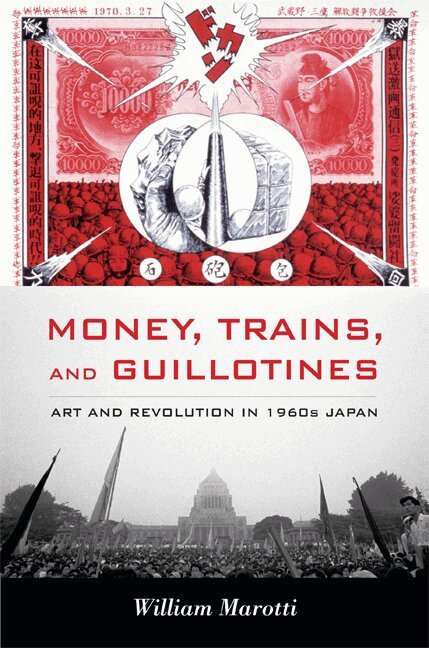
    Money, Trains, and Guillotines

    Art and Revolution in 1960s Japan

    AvWilliam Marotti

    Häftad, Engelska, 2013

    Del i serien Asia-Pacific: Culture, Politics, and Society

    500 kr

    Beställningsvara. Skickas inom 5-8 vardagar. Fri frakt över 249 kr.

    Fler format och utgåvor

    Inbunden

    1 472 kr

    E-bok

    732 kr

    Beskrivning

    During the 1960s a group of young artists in Japan challenged official forms of politics and daily life through interventionist art practices. William Marotti situates this phenomenon in the historical and political contexts of Japan after the Second World War and the international activism of the 1960s. The Japanese government renewed its Cold War partnership with the United States in 1960, defeating protests against a new security treaty through parliamentary action and the use of riot police. Afterward, the government promoted a depoliticized everyday world of high growth and consumption, creating a sanitized national image to present in the Tokyo Olympics of 1964. Artists were first to challenge this new political mythology. Marotti examines their political art, and the state's aggressive response to it. He reveals the challenge mounted in projects such as Akasegawa Genpei's 1,000-yen prints, a group performance on the busy Yamanote train line, and a plan for a giant guillotine in the Imperial Plaza. Focusing on the annual Yomiuri IndÉpendant exhibition, he demonstrates how artists came together in a playful but powerful critical art, triggering judicial and police response. Money, Trains, and Guillotines expands our understanding of the role of art in the international 1960s, and of the dynamics of art and policing in Japan.

    Produktinformation

    • Utgivningsdatum:2013-03-27
    • Mått:166 x 236 x 28 mm
    • Vikt:866 g
    • Format:Häftad
    • Språk:Engelska
    • Serie:Asia-Pacific: Culture, Politics, and Society
    • Antal sidor:464
    • Förlag:Duke University Press
    • ISBN:9780822349808

    Utforska kategorier

    • Konsthistoria inom Kultur
    • Allmän historia och världshistoria inom Historia och arkeologi

    Mer om författaren

    William Marotti is Associate Professor of History at the University of California, Los Angeles.

    Recensioner i media

    “Marotti's detailed analysis of the Japanese artists' evolution from surrealist sensibility to interventionist action contributes immensely to our understanding of how the political aesthetic so characteristic of the 1960s emerged simultaneously in numerous countries…. A vivid, highly informed and richly rewarding investigation of art and politics under post-1945 capitalism in Japan.” - Justin Jesty (Art in America) “William Marotti explicates the social and political context of the Yomiuri Independent avant-garde. . . . [A] remarkably detailed and vivid view of the activities of Akasegawa and his circle.” - Mark Schilling (Japan Times) “[An] innovative, carefully crafted interdisciplinary history of the cultural origins of Japan’s 1968. . . . Appropriate to its rich and diverse visual subject matter, it is also beautifully illustrated and produced. Its provocative interrogation of conventional scholarly boundaries of discipline, chronology, narrative, and ontology, at the level not only of theory but also of practice, suggests a kinship with the efforts of the artists whose story it so carefully and sympathetically excavates.” - Ethan Mark (American Historical Review) “None of these art interventions documented in Money, Trains and Guillotines are fully understandable without the background of the politics of the time, and the author skillfully presents both art and politics, focused and interwoven. Author William Marotti's twenty-year effort has produced a fine book.” - Mike Mosher (Leonardo Reviews) "Marotti’s subtle readings of these texts, underappreciated in Japanese scholarship, make a strong case for their importance within art history. Money, Trains, and Guillotines not only fills in a major gap within English-language understanding of postwar Japanese art. Once translated into Japanese-which it should be, promptly-it should sharpen the discourse within Akasegawa’s home country." - Kenji Kajiya (Pacific Affairs) “William Marotti’s book is a landmark study of political art and the politics of artistic expression in contemporary Japan. . . . Marotti uncovers a fascinating, provocative, and sometimes-shocking history of political art. . ..  Marotti’s attention to detail and to the emotional life of his subjects is truly engrossing in the best traditions of microhistory. . . .  [T]his is a richly documented, thoughtprovoking, and marvelously sculptured piece of scholarship that will be immensely enriching for anyone interested in issues of constitutional freedoms, artistic expression, and the intersection of politics and the everyday in postwar Japan.” - Simon Avenell (Journal of Japanese Studies) "This book will form a major addition to my teaching, providing an important counter-balance to the dominant narrative of a postwar Japan marching in drumbeat towards a capitalist future. In illuminating the ways in which culture and radical politics were enmeshed at this key juncture of postwar Japanese history, Marotti highlights the importance of the everyday as 'the central political arena for dissent and for policing.'" - Mark Pendleton (Journal of Asian Studies)

    Innehållsförteckning

    • Acknowledgments ixChronology of Select Events xiiiIntroduction 1Part I. Art against the Police: Akasegawa Genpei's 1,000-Yen Prints, the State, and the Borders of the Everyday 91. The Vision of the Police 152. The Occupation, the New Emperor System, and the Figure of Japan 373. The Process of Art 74Part II. Artistic Practice Finds Its Object: The Avant-Garde and the Yomiuri Indépendant 1114. The Yomiuri Indépendant: Making and Displacing History 1175. The Yomiuri Anpan 152Part III. Theorizing Art and Revolution 2016. Beyond the Guillotine: Speaking of Art / Art Speaking 2077. Naming the Real 2458. The Moment of the Avant-Garde 284Epilogue 317Notes 319Select Bibliography 393Index 405