• Fri frakt över 249 kr
  • •
  • Snabba leveranser
  • •
  • Billiga böcker
Kundservice

Du är på sajten för privatpersoner.

Företag, bibliotek eller offentlig verksamhet?

Du handlar på classic.bokus.com, där alla dina funktioner finns intakta.
Till classic.bokus.com
Bokus logotyp. Gå till startsidan.
  • Erbjudanden
  • Nyheter
  • Student
  • Topplistor
  • Barn & ungdom
  • Bokus Play
  • E-böcker
  • Pocketböcker
  • Spel & pussel

Må bättre, för mindre! Upp till 50% rabatt på hälsoböcker

Sidfot

Mina sidor

    Hjälp

    • Kundservice
    • Vanliga frågor och svar
    • Frakt och leverans
    • Retur vid ångerrätt
    • Reklamera vara
    • Betalning
    • Köpvillkor
    • Allmänna villkor
    • Information om webbplatsens tillgänglighet

    Om Bokus

    • Om oss
    • Pressrum
    • För studenter
    • För företag
    • För bibliotek och offentlig verksamhet
    • För leverantörer
    • Hållbarhet

    Populärt

    • Aktuella erbjudanden
    • Presentkort
    • Studentlitteratur
    • Nya böcker
    • Topplistor
    • Signerade böcker
    • Engelska böcker

    Inspiration

    • Boktips
    • BookTok
    • Populära bokserier
    • Barnbokskaraktärer
    • Populära författare
    Logotyp för Bokus
    Följ oss på Facebook (extern länk)Följ oss på Instagram (extern länk)Följ oss på YouTube (extern länk)Följ oss på TikTok (extern länk)
    bokus @ CookiesAnpassa cookiesIntegritetspolicyKöpvillkor
    Till Citymail hemsida (extern länk)Till Budbee hemsida (extern länk)Till Postnord hemsida (extern länk)Till Schenker hemsida (extern länk)Till Early Bird hemsida (extern länk)Till Walleys hemsida (extern länk)
    1. Samhälle och politik
    2. Sociologi och antropologi
    3. Antropologi

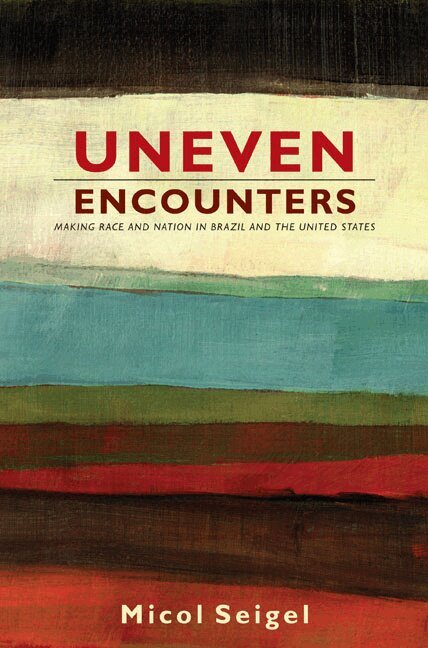
    Uneven Encounters

    Making Race and Nation in Brazil and the United States

    AvMicol Seigel

    Häftad, Engelska, 2009

    Del i serien American Encounters/Global Interactions

    609 kr

    Beställningsvara. Skickas inom 3-6 vardagar. Fri frakt över 249 kr.

    Beskrivning

    In Uneven Encounters, Micol Seigel chronicles the exchange of popular culture between Brazil and the United States in the years between the World Wars, and demonstrates how that exchange affected ideas of race and nation in both countries. From Americans interpreting advertisements for Brazilian coffee or dancing the Brazilian maxixe, to Rio musicians embracing the “foreign” qualities of jazz, Seigel traces a lively, cultural back and forth. Along the way, she shows how race and nation for both elites and non-elites are constructed together, and driven by global cultural and intellectual currents as well as local, regional, and national ones.Seigel explores the circulation of images of Brazilian coffee and of maxixe in the United States during the period just after the imperial expansions of the early twentieth century. Exoticist interpretations structured North Americans’ paradoxical sense of themselves as productive “consumer citizens.” Some people, however, could not simply assume the privileges of citizenship. In their struggles against racism, Afro-descended citizens living in Rio de Janeiro, SÃo Paulo, New York, and Chicago encountered images and notions of each other, and found them useful. Seigel introduces readers to cosmopolitan Afro-Brazilians and African Americans who rarely traveled far from home but who nonetheless absorbed ideas from abroad. She suggests that studies comparing U.S. and Brazilian racial identities as two distinct constructions are misconceived. Racial formation transcends national borders; attempts to understand it must do the same.

    Produktinformation

    • Utgivningsdatum:2009-03-18
    • Mått:156 x 235 x 25 mm
    • Vikt:535 g
    • Format:Häftad
    • Språk:Engelska
    • Serie:American Encounters/Global Interactions
    • Antal sidor:408
    • Förlag:Duke University Press
    • ISBN:9780822344407

    Utforska kategorier

    • Antropologi inom Samhälle och politik
    • Etnicitet inom Samhälle och politik

    Mer om författaren

    Micol Seigel is Assistant Professor in the Department of African American and African Diaspora Studies and the Program in American Studies at Indiana University, Bloomington.

    Recensioner i media

    “I can think of few works about Brazil that reveal so much about the United States, and no work about the United States that tells us so much about Brazil. . . . . [A]n important, thought-provoking book.” - Marc A. Hertzman, A Contracorriente “Uneven Encounters is an imaginative, thoughtful, and eloquently argued work of Atlantic history.” - George Reid Andrews, Journal of American History “Drawing widely from postmodern, postcolonial, feminist, diasporic, and queer studies, Seigel approaches this topic through a bold use of sources, archives, and theoretical approaches, arguing quite convincingly that Afro-Brazilians played an active role in the international circulation of ideas and cultural expressions in the tumultuous 1920s. . . . [An] outstanding study.” - James M. Green, American Historical Review “ . . . Micol Seigel offers a refreshing analysis of racial perceptions in the USA and Brazil. . . . The contributions of Seigel’s are many and to different fields, including history, American, Latin American, cultural and race and ethnic studies. Rather than a comparison of national traits and differences, Seigel’s sophisticated study explores the complexities in the encounters between Brazil and the U.S. in the transnational scenery of popular artifacts. It sheds new light on notions of race and nation in Brazil and the U.S. by maintaining that these were forged often in relation to on another.” - Cileine de Lourenco, Ethnic and Racial Studies “Seigel . . . displaces scholars who have argued that the myth of racial democracy was possible in Brazil due to an ignorant lack of black identity, showing instead how blacks helped create and shape racial democracy.” - Felipe Cruz, The Latin Americanist “I suspect everyone, depending on research interests, will find something here that illuminates previously held understandings of complex and sometimes misread histories of the United States and Brazil.” - Stanley R. Bailey, Bulletin of Latin American Research “Uneven Encounters is a very important contribution not only to the transnational study of racial formation but to the very definition of what transnational scholarship should be.”-MarÍa Josefina SaldaÑa-Portillo, author of The Revolutionary Imagination in the Americas and the Age of Development “In recent years, the comparative study of race in Brazil and the United States has reached an impasse. Uneven Encounters, rather than reviving the old debates, challenges their very premises. With style and substance, Micol Seigel offers us a searing critique of the comparative method and brilliantly demonstrates how a transnational and cultural approach to race and racial identities can open up genuinely new and productive lines of inquiry.”-Barbara Weinstein, author of For Social Peace in Brazil: Industrialists and the Remaking of the Working Class in SÃo Paulo, 1920–1964 “[M]icol Seigel offers a refreshing analysis of racial perceptions in the USA and Brazil. . . . The contributions of Seigel’s are many and to different fields, including history, American, Latin American, cultural and race and ethnic studies. Rather than a comparison of national traits and differences, Seigel’s sophisticated study explores the complexities in the encounters between Brazil and the U.S. in the transnational scenery of popular artifacts. It sheds new light on notions of race and nation in Brazil and the U.S. by maintaining that these were forged often in relation to on another.” - Cileine de Lourenco (Ethnic and Racial Studies) “Uneven Encounters is an imaginative, thoughtful, and eloquently argued work of Atlantic history.” - George Reid Andrews (Journal of American History) “Drawing widely from postmodern, postcolonial, feminist, diasporic, and queer studies, Seigel approaches this topic through a bold use of sources, archives, and theoretical approaches, arguing quite convincingly that Afro-Brazilians played an active role in the international circulation of ideas and cultural expressions in the tumultuous 1920s. . . . [An] outstanding study.” - James M. Green (American Historical Review) “I can think of few works about Brazil that reveal so much about the United States, and no work about the United States that tells us so much about Brazil. . . . [A]n important, thought-provoking book.” - Marc A. Hertzman (A Contracorriente) “I suspect everyone, depending on research interests, will find something here that illuminates previously held understandings of complex and sometimes misread histories of the United States and Brazil.” - Stanley R. Bailey (Bulletin of Latin American Research) “Seigel . . . displaces scholars who have argued that the myth of racial democracy was possible in Brazil due to an ignorant lack of black identity, showing instead how blacks helped create and shape racial democracy.” - Felipe Cruz (The Latin Americanist)

    Innehållsförteckning

    • Illustrations ixPreface xiNote on Language xviiAcknowledgments xixIntroduction 11. Producing Consumption: Coffee and Consumer Citizenship 132. Maxixe's Travels: Cultural Exchange and Erasure 673. Playing Politics: Making the Meanings of Jazz in Rio de Janeiro 954. Nation Drag: Uses of the Exotic 1365. Another "Global Vision": (Trans)Nationalism in the Sao Paulo Black Press 1796. Black Mothers, Citizen Sons 206Conclusion 235Abbreviations 241Notes 243Discography 321Bibliography 323Index 367