• Fri frakt över 249 kr
  • •
  • Snabba leveranser
  • •
  • Billiga böcker
Kundservice

Du är på sajten för privatpersoner.

Företag, bibliotek eller offentlig verksamhet?

Du handlar på classic.bokus.com, där alla dina funktioner finns intakta.
Till classic.bokus.com
Bokus logotyp. Gå till startsidan.
  • Erbjudanden
  • Student
  • Topplistor
  • Barn & ungdom
  • Bokus Play
  • E-böcker
  • Ljudböcker
  • Pocketböcker
  • Spel och pussel

Pocketfynda! Hundratals böcker för 49 kr/st →

Sidfot

Mina sidor

    Hjälp

    • Kundservice
    • Vanliga frågor och svar
    • Frakt och leverans
    • Retur vid ångerrätt
    • Reklamera vara
    • Betalning
    • Köpvillkor
    • Allmänna villkor
    • Information om webbplatsens tillgänglighet

    Om Bokus

    • Om oss
    • Pressrum
    • För studenter
    • För företag
    • För bibliotek och offentlig verksamhet
    • För leverantörer
    • Hållbarhet

    Populärt

    • Aktuella erbjudanden
    • Presentkort
    • Studentlitteratur
    • Nya böcker
    • Topplistor
    • Signerade böcker
    • Engelska böcker

    Inspiration

    • Boktips
    • BookTok
    • Barnbokskaraktärer
    • Populära författare
    Logotyp för Bokus
    Följ oss på Facebook (extern länk)Följ oss på Instagram (extern länk)Följ oss på YouTube (extern länk)Följ oss på TikTok (extern länk)
    bokus @ CookiesAnpassa cookiesIntegritetspolicyKöpvillkor
    Till Citymail hemsida (extern länk)Till Budbee hemsida (extern länk)Till Postnord hemsida (extern länk)Till Schenker hemsida (extern länk)Till Early Bird hemsida (extern länk)Till Walleys hemsida (extern länk)
    1. Samhälle och politik
    2. Politik och statsskick
    3. Politiska ideologier och rörelser
    4. Högerradikalism och högerextremism

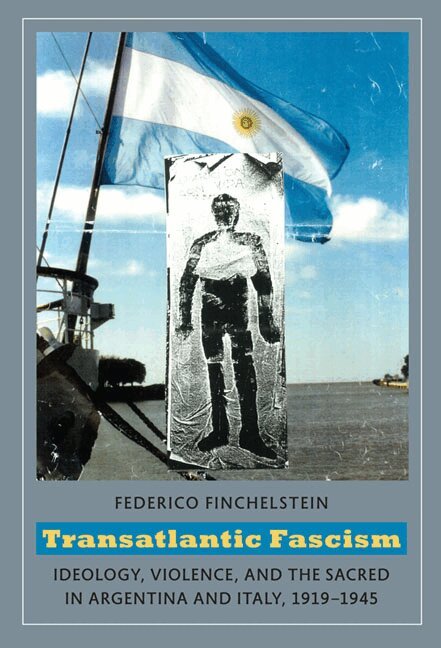
    Transatlantic Fascism

    Ideology, Violence, and the Sacred in Argentina and Italy, 1919-1945

    AvFederico Finchelstein

    Häftad, Engelska, 2010

    375 kr

    Beställningsvara. Skickas inom 5-8 vardagar. Fri frakt över 249 kr.

    Fler format och utgåvor

    Inbunden

    1 288 kr

    E-bok

    568 kr

    Beskrivning

    In Transatlantic Fascism, Federico Finchelstein traces the intellectual and cultural connections between Argentine and Italian fascisms, showing how fascism circulates transnationally. From the early 1920s well into the Second World War, Mussolini tried to export Italian fascism to Argentina, the “most Italian” country outside of Italy. (Nearly half the country’s population was of Italian descent.) Drawing on extensive archival research on both sides of the Atlantic, Finchelstein examines Italy’s efforts to promote fascism in Argentina by distributing bribes, sending emissaries, and disseminating propaganda through film, radio, and print. He investigates how Argentina’s political culture was in turn transformed as Italian fascism was appropriated, reinterpreted, and resisted by the state and the mainstream press, as well as by the Left, the Right, and the radical Right.As Finchelstein explains, nacionalismo, the right-wing ideology that developed in Argentina, was not the wholesale imitation of Italian fascism that Mussolini wished it to be. Argentine nacionalistas conflated Catholicism and fascism, making the bold claim that their movement had a central place in God’s designs for their country. Finchelstein explores the fraught efforts of nationalistas to develop a “sacred” ideological doctrine and political program, and he scrutinizes their debates about Nazism, the Spanish Civil War, imperialism, anti-Semitism, and anticommunism. Transatlantic Fascism shows how right-wing groups constructed a distinctive Argentine fascism by appropriating some elements of the Italian model and rejecting others. It reveals the specifically local ways that a global ideology such as fascism crossed national borders.

    Produktinformation

    • Utgivningsdatum:2010-01-11
    • Mått:156 x 232 x 23 mm
    • Vikt:499 g
    • Format:Häftad
    • Språk:Engelska
    • Antal sidor:344
    • Förlag:Duke University Press
    • ISBN:9780822346128

    Utforska kategorier

    • Högerradikalism och högerextremism inom Samhälle och politik

    Mer om författaren

    Federico Finchelstein is Assistant Professor of History at the New School for Social Research and the Eugene Lang College of the New School in New York City.

    Recensioner i media

    “[T]hought-provoking, intelligent, well-researched, and complex work of intellectual history. . . . Finchelstein has written a book that is an important contribution to the study of fascism in general and makes an even more crucial contribution to the study of the ideology of the far Right in Argentina.” - Joel Horowitz, American Historical Review “Federico Finchelstein’s extensive background in fascist and Holocaust studies and his work in Italian and French archives set this book apart. So, too, does his approach. Rather than simply discuss European influence on Nacionalismo, Finchelstein analyzes ideas and perceptions flowing in both directions across the Atlantic. . . . A short review such as this one cannot do justice to the originality, richness, and subtlety of this book. Even the detailed endnotes, which practically constitute another volume, merit close examination. Finchelstein’s fine work surely will stimulate debates about fascist transnationalism, Nacionalismo, and this movement’s legacy for years to come.” - Sandra McGee Deutsch, Hispanic American Historical Review “[I]t is obvious that this book is a splendid contribution. But it is also welcome,necessary, and timely as extreme right-wing politics, authoritarianism, and party-led totalitarian states in the world are reasserting themselves. . . . If Churchill or Roosevelt had allowed a partial peace to end World War II, instead of total surrender, the Argentine politics described in this book would have joined Brazilian integralism to further autonomous fascist traditions in Central America, the Southern Cone, and the Andes. Finchelstein’s wonderful work paints a haunting image.” - Friedrich E. Schuler, The Americas “Federico Finchelstein’s careful and ambitiously researched book which rests on archival work done in Rome, Buenos Aires, and the United States usefully reframes the literature on fascism by successfully challenging its overwhelming Eurocentrism....[It] is an invaluable contribution to reinvigorating scholarly discussion of fascism and is sure to be emulated, contested, and extended in years to come.” - Dylan Riley, Journal of Modern History “Transatlantic Fascism is a fresh examination of fascism in Argentina from the perspective of its transnational connections. Federico Finchelstein provides new insight into fascism and its impact in Argentina.”-Donna Guy, author of Women Build the Welfare State: Performing Charity and Creating Rights in Argentina, 1880-1955 “Federico Finchelstein displays an exceptional combination of talents in Transatlantic Fascism: imagination tempered by diligence and meticulousness, independence tempered by judiciousness. His theoretical clarity and deep empirical research have forged a rich, intellectually rewarding, and important study of fascism. The book’s transnational perspective sheds much-needed light on a conceptually elusive ideology and political phenomenon.”-Jose C. Moya, author of Cousins and Strangers: Spanish Immigrants in Buenos Aires, 1850-1930 “In this innovative, impressively researched work, Federico Finchelstein takes an ambitious comparative approach to the historical study of fascism. He shows both how fascism was a transnational ideology and how that ideology was inflected and joined with at times violent practices according to different national traditions. His close inquiry into the Italian-Argentine connection sheds new light on a complex set of problems, including dimensions of fascism related to religion and to the manner in which fascism was understood and experienced by its committed activists. This book is important not only for specialists in European and Latin American history but for all historians and social scientists interested in problems of comparative history and methodology.”-Dominick LaCapra, Professor of History and Bowmar Professor of Humanistic Studies, Cornell University “In this original and refreshing work on the history of fascism between Europe and Latin America, Federico Finchelstein elaborates a new concept-transatlantic fascism-that predictably will raise a large debate among historians. Written from the perspective of global history, this book rethinks the history of fascism in its international, not only European, dimension.”-Enzo Traverso, author of The Origins of Nazi Violence “[I]t is obvious that this book is a splendid contribution. But it is also welcome, necessary, and timely as extreme right-wing politics, authoritarianism, and party-led totalitarian states in the world are reasserting themselves. . . . If Churchill or Roosevelt had allowed a partial peace to end World War II, instead of total surrender, the Argentine politics described in this book would have joined Brazilian integralism to further autonomous fascist traditions in Central America, the Southern Cone, and the Andes. Finchelstein’s wonderful work paints a haunting image.” - Friedrich E. Schuler (The Americas) “[T]hought-provoking, intelligent, well-researched, and complex work of intellectual history. . . . Finchelstein has written a book that is an important contribution to the study of fascism in general and makes an even more crucial contribution to the study of the ideology of the far Right in Argentina.” - Joel Horowitz (American Historical Review) “Federico Finchelstein’s careful and ambitiously researched book which rests on archival work done in Rome, Buenos Aires, and the United States usefully reframes the literature on fascism by successfully challenging its overwhelming Eurocentrism....[It] is an invaluable contribution to reinvigorating scholarly discussion of fascism and is sure to be emulated, contested, and extended in years to come.” - Dylan Riley (Journal of Modern History) “Federico Finchelstein’s extensive background in fascist and Holocaust studies and his work in Italian and French archives set this book apart. So, too, does his approach. Rather than simply discuss European influence on Nacionalismo, Finchelstein analyzes ideas and perceptions flowing in both directions across the Atlantic. . . . A short review such as this one cannot do justice to the originality, richness, and subtlety of this book. Even the detailed endnotes, which practically constitute another volume, merit close examination. Finchelstein’s fine work surely will stimulate debates about fascist transnationalism, Nacionalismo, and this movement’s legacy for years to come.” - Sandra McGee Deutsch (Hispanic American Historical Review)

    Innehållsförteckning

    • Acknowledgments ixIntroduction 11. Transnational Fascism 152. The Argentine Road to Fascism 423. Fascism Discovers the Americas 794. A "Christianized Fascism" 1185. Debating Global Totalitarianism 138Epilogue 163Bibliography 179Notes 285Index 321