• Fri frakt över 249 kr
  • •
  • Snabba leveranser
  • •
  • Billiga böcker
Kundservice

Du är på sajten för privatpersoner.

Företag, bibliotek eller offentlig verksamhet?

Du handlar på classic.bokus.com, där alla dina funktioner finns intakta.
Till classic.bokus.com
Bokus logotyp. Gå till startsidan.
  • Erbjudanden
  • Nyheter
  • Student
  • Topplistor
  • Barn & ungdom
  • Bokus Play
  • E-böcker
  • Pocketböcker
  • Spel & pussel

10% rabatt på allt med kod: NYSTART10 →

Sidfot

Mina sidor

    Hjälp

    • Kundservice
    • Vanliga frågor och svar
    • Frakt och leverans
    • Retur vid ångerrätt
    • Reklamera vara
    • Betalning
    • Köpvillkor
    • Allmänna villkor
    • Information om webbplatsens tillgänglighet

    Om Bokus

    • Om oss
    • Pressrum
    • För studenter
    • För företag
    • För bibliotek och offentlig verksamhet
    • För leverantörer
    • Hållbarhet

    Populärt

    • Aktuella erbjudanden
    • Presentkort
    • Studentlitteratur
    • Nya böcker
    • Topplistor
    • Signerade böcker
    • Engelska böcker

    Inspiration

    • Boktips
    • BookTok
    • Populära bokserier
    • Barnbokskaraktärer
    • Populära författare
    Logotyp för Bokus
    Följ oss på Facebook (extern länk)Följ oss på Instagram (extern länk)Följ oss på YouTube (extern länk)Följ oss på TikTok (extern länk)
    bokus @ CookiesAnpassa cookiesIntegritetspolicyKöpvillkor
    Till Citymail hemsida (extern länk)Till Budbee hemsida (extern länk)Till Postnord hemsida (extern länk)Till Schenker hemsida (extern länk)Till Early Bird hemsida (extern länk)Till Walleys hemsida (extern länk)
    1. Samhälle och politik
    2. Samhälle och kultur
    3. Sociala och etiska frågor
    4. Våld och övergrepp

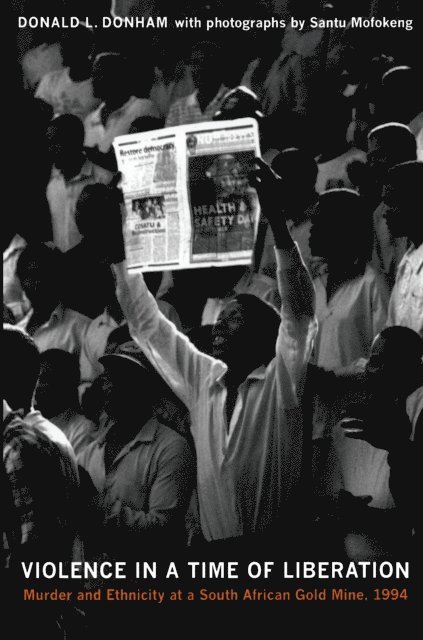
    Violence in a Time of Liberation

    Murder and Ethnicity at a South African Gold Mine, 1994

    AvDonald L. Donham

    Häftad, Engelska, 2011

    376 kr

    Beställningsvara. Skickas inom 5-8 vardagar. Fri frakt över 249 kr.

    Fler format och utgåvor

    E-bok

    568 kr

    Beskrivning

    How can we account for the apparent increase in ethnic violence across the globe? Donald L. Donham develops a methodology for understanding violence that shows why this question needs to be recast. He examines an incident that occurred at a South African gold mine at the moment of the 1994 elections that brought apartheid to a close. Black workers ganged up on the Zulus among them, killing two and injuring many more. While nearly everyone came to characterize the conflict as “ethnic,” Donham argues that heightened ethnic identity was more an outcome of the violence than its cause. Based on his careful reconstruction of events, he contends that the violence was not motivated by hatred of an ethnic other. It emerged, rather, in ironic ways, as capitalist managers gave up apartheid tactics and as black union activists took up strategies that departed from their stated values. National liberation, as it actually occurred, was gritty, contradictory, and incomplete. Given unusual access to the mine, Donham comes to this conclusion based on participant observation, review of extensive records, and interviews conducted over the course of a decade. Violence in a Time of Liberation is a kind of murder mystery that reveals not only who did it but also the ways that narratives of violence, taken up by various media, create ethnic violence after the fact.

    Produktinformation

    • Utgivningsdatum:2011-07-21
    • Mått:156 x 235 x 17 mm
    • Vikt:503 g
    • Format:Häftad
    • Språk:Engelska
    • Antal sidor:256
    • Förlag:Duke University Press
    • ISBN:9780822348535

    Utforska kategorier

    • Våld och övergrepp inom Samhälle och politik
    • Etnicitet inom Samhälle och politik

    Mer om författaren

    Donald L. Donham is Professor of Anthropology at the University of California, Davis. He is the author of Marxist Modern: An Ethnographic History of the Ethiopian Revolution; History, Power, Ideology: Central Issues in Marxism and Anthropology; and Work and Power in Maale, Ethiopia.

    Recensioner i media

    “Violence in a Time of Liberation is an absorbing and exceptionally clear-sighted analysis of violence and ethnic consciousness in South Africa. Focused on a specific set of events that occurred at a gold mine in the mid-1990s, Donald L. Donham brings vivid ethnographic description and analysis to bear on some of the thorniest questions faced by social analysts of violence. His book is lucidly written and cunningly constructed, with a substantial narrative pull. It is a very significant contribution both to scholarly understandings of contemporary South African society and to theoretical debates around ethnic violence.”-James Ferguson, author of Global Shadows: Africa in the Neoliberal World Order “Taking off from a single episode, Donald L. Donham provides readers with a rich account that makes an important point: ethnic identification is often more the consequence of violence than the cause. Since people involved may, in retrospect, interpret an event using ethnic categories, understanding the complexity of the processes leading up to violence requires peeling away layers of backward projection and reconstructing the flow of events, tasks Donham performs here with sensitivity and insight.”-Frederick Cooper, author of Colonialism in Question: Theory, Knowledge, History “A prescient narrative of mine violence. Based on a study of a mine called Cinderella, it provides a piercing and lucid exposition of the path to this violence in a post-1994 moment. . . . Violence in a Time of Liberation offers an exemplary example of how historical ethnography can be used to study violence. It probes us to give time and labour to understand better what has happened, even if its meanings remain elusive. For violence, too, is a way of remembering our disappointed hope.“ - Matthew Willhelm-Solomon (Mail & Guardian) “This is a beautifully produced book…. It is also beautifully written, thoughtful, intelligent, meticulous in making arguments, and humble in making its case and in acknowledgement of others’ work. For those who are interested in debates about the often violent ambiguities of “liberation” (in South Africa and elsewhere), this is a must read. It is also a masterpiece of anthropological narrative in its own right. Like any engaging detective story, it will be widely read.” - T. Dunbar Moodie (Anthropos) “This is a carefully analyzed, clearly written, and beautifully produced book. Donham’s careful attention to detail is nicely enhanced by South African photographer Santu Mofokeng’s work ....[It] is an important book with implications for analysis of many conflicts in the world that are all too easily dismissed as ethnic or religious. Donham leads us to see that these labels are not completely wrong but that they fail to incorporate the multiple dimensions in which the conflicts are embedded.” - Thomas V. McClendon (International Journal of African Historical Studies) “What is particularly enjoyable about this book is the way in which Donham brings together multiple scales of analysis and discourses to demonstrate how ethnicity came to legitimate violence in the moment and explain the murders in retrospect…In sum, Donham’s monograph is an excellent example of ethnographic work on ethnicity that would provide excellent fodder for courses on nationalism, ethnicity, ethnic violence, and South Africa.” - David M. Hoffman (Journal of Anthropological Research) “Working with an award-winning photographer Santu Mofokeng, Donham was able to capture in both word and image the grittiness and hardships of compound life. In truth, the use of image and text is powerful. . . . This book represents a kind of “reckoning” with a world in transition, with violence, with capitalism that surely extends far beyond South African studies to entice readers concerned with such questions almost anywhere.” - Anne Maria Makhulu (American Ethnologist)

    Innehållsförteckning

    • Preface ixGroups at Cinderella in 1994 xiLocal Timeline in Relation to National Liberation xiiiIntroduction 11. Picturing a South African Gold Mine 11Photo gallery by Santu Mofokeng 252. White Stories 453. Ways of Dying 694. Good Friday at Cinderella 885. Freeing Workers and Erasing History 1106. Unionization from Above 1257. Motives for Murder 1518. The Aftermath. "They Were Enjoying Our Freedom" 174Conclusion 186Postscript. Doing Fieldwork at the End of Apartheid 189Notes 197Bibliography 217Index 231