• Fri frakt över 249 kr
  • •
  • Snabba leveranser
  • •
  • Billiga böcker
Kundservice

Du är på sajten för privatpersoner.

Företag, bibliotek eller offentlig verksamhet?

Du handlar på classic.bokus.com, där alla dina funktioner finns intakta.
Till classic.bokus.com
Bokus logotyp. Gå till startsidan.
  • Erbjudanden
  • Nyheter
  • Student
  • Topplistor
  • Barn & ungdom
  • Bokus Play
  • E-böcker
  • Pocketböcker
  • Spel & pussel

10% rabatt på allt med kod NYSTART10 →

Sidfot

Mina sidor

    Hjälp

    • Kundservice
    • Vanliga frågor och svar
    • Frakt och leverans
    • Retur vid ångerrätt
    • Reklamera vara
    • Betalning
    • Köpvillkor
    • Allmänna villkor
    • Information om webbplatsens tillgänglighet

    Om Bokus

    • Om oss
    • Pressrum
    • För studenter
    • För företag
    • För bibliotek och offentlig verksamhet
    • För leverantörer
    • Hållbarhet

    Populärt

    • Aktuella erbjudanden
    • Presentkort
    • Studentlitteratur
    • Nya böcker
    • Topplistor
    • Signerade böcker
    • Engelska böcker

    Inspiration

    • Boktips
    • BookTok
    • Populära bokserier
    • Barnbokskaraktärer
    • Populära författare
    Logotyp för Bokus
    Följ oss på Facebook (extern länk)Följ oss på Instagram (extern länk)Följ oss på YouTube (extern länk)Följ oss på TikTok (extern länk)
    bokus @ CookiesAnpassa cookiesIntegritetspolicyKöpvillkor
    Till Citymail hemsida (extern länk)Till Budbee hemsida (extern länk)Till Postnord hemsida (extern länk)Till Schenker hemsida (extern länk)Till Early Bird hemsida (extern länk)Till Walleys hemsida (extern länk)
    1. Kultur
    2. Scenkonst och film
    3. Film

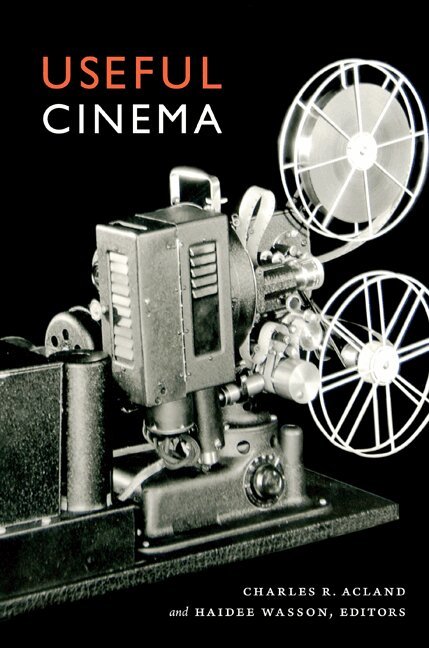
    Useful Cinema

    AvCharles R. Acland,Haidee Wasson

    Häftad, Engelska, 2011

    459 kr

    Beställningsvara. Skickas inom 5-8 vardagar. Fri frakt över 249 kr.

    Beskrivning

    By exploring the use of film in mid-twentieth-century institutions, including libraries, museums, classrooms, and professional organizations, the essays in Useful Cinema show how moving images became an ordinary feature of American life. In venues such as factories and community halls, people encountered industrial, educational, training, advertising, and other types of “useful cinema.” Screening these films transformed unlikely spaces, conveyed ideas, and produced subjects in the service of public and private aims. Such functional motion pictures helped to shape common sense about cinema’s place in contemporary life. Whether measured in terms of the number of films shown, the size of audiences, or the economic activity generated, the “non-theatrical sector” was a substantial and enduring parallel to the more spectacular realm of commercial film. In Useful Cinema, scholars examine organizations such as UNESCO, the YMCA, the Amateur Cinema League, and the Metropolitan Museum of Art. They also consider film exhibition sites in schools, businesses, and industries. As they expand understanding of this other American cinema, the contributors challenge preconceived notions about what cinema is. Contributors. Charles R. Acland, Joseph Clark, ZoË Druick, Ronald Walter Greene, Alison Griffiths, Stephen Groening, Jennifer Horne, Kirsten Ostherr, Eric Smoodin, Charles Tepperman, Gregory A. Waller, Haidee Wasson. Michael Zryd

    Produktinformation

    • Utgivningsdatum:2011-10-14
    • Mått:156 x 235 x 26 mm
    • Vikt:630 g
    • Format:Häftad
    • Språk:Engelska
    • Antal sidor:400
    • Förlag:Duke University Press
    • ISBN:9780822350095

    Utforska kategorier

    • Film inom Kultur

    Mer om författaren

    Charles R. Acland is Professor and Concordia University Research Chair in Communication Studies at Concordia University in Montreal. He is the author of Screen Traffic: Movies, Multiplexes, and Global Culture, also published by Duke University Press, and the editor of Residual Media.Haidee Wasson is Associate Professor in the Mel Hoppenheim School of Cinema at Concordia University. She is the author of Museum Movies: The Museum of Modern Art and the Birth of Art Cinema and a co-editor of Inventing Film Studies, also published by Duke University Press.

    Recensioner i media

    “[T]he 13 case studies nicely illustrate the variety of institutional settings in the US that exploited the cinematic medium to shape thinking, tastes, and behaviors throughout the 20th century. . . . The overall results are engaging, provocative, and useful. Highly recommended. Lower-division undergraduates through faculty/professionals; general readers.“ - J. I. Deutsch, Choice “Charles Acland offers here a complementary (and alternative) history of media engagement…. provides significant food for thought…. [E]xperimental film serves perhaps an unusual, but still a legitimate, purpose.” - Liz Giuffre, Media International Australia “A wholly solid collection of new research in a blossoming area of study. Each of Useful Cinema’s articles offers unique, substantial, and interesting work that will engage and benefit any scholar even peripherally interested in the socio-cultural and socio-political dimensions of educational or industrial film. . . . As broad as its subject matter may be, the volume is unified by a rigorous standard of archival scholarship, a remarkable tendency to build interest and delight in unexpected topics, and a consistency of accessible writing that clearly illuminates how film and media are used to write and rewrite social histories.” - Andrew James Myers, Mediascape “Education is commonly understood as opposed to entertainment. But this rich and fascinating volume puts the lie to such an assumption. It shows how, across the decades, ‘useful cinema’ was measured in relation to Hollywood entertainment and indeed interacted with it in a complex fashion. Useful Cinema does so through essays that are themselves compelling and captivating, eloquent and enjoyable. The book is itself, in other words, a masterful blend of the entertaining and the useful.”-Dana Polan, New York University “This valuable book reveals how moving images proliferated beyond the spectacular confines of theaters to become deeply embedded in everyday life, cultures, and institutions. The publication of this fascinating anthology is a welcome sign that film historians are starting to forgo their longtime fascination with mass-produced glamour and make peace with cinema’s most utilitarian, and numerically dominant, genres.”-Rick Prelinger, founder of Prelinger Archives “[T]he 13 case studies nicely illustrate the variety of institutional settings in the US that exploited the cinematic medium to shape thinking, tastes, and behaviors throughout the 20th century. . . . The overall results are engaging, provocative, and useful. Highly recommended. Lower-division undergraduates through faculty/professionals; general readers.“ - J. I. Deutsch (Choice) “A wholly solid collection of new research in a blossoming area of study. Each of Useful Cinema’s articles offers unique, substantial, and interesting work that will engage and benefit any scholar even peripherally interested in the socio-cultural and socio-political dimensions of educational or industrial film. . . . As broad as its subject matter may be, the volume is unified by a rigorous standard of archival scholarship, a remarkable tendency to build interest and delight in unexpected topics, and a consistency of accessible writing that clearly illuminates how film and media are used to write and rewrite social histories.” - Andrew James Myers (Mediascape) “Charles Acland offers here a complementary (and alternative) history of media engagement…. provides significant food for thought…. [E]xperimental film serves perhaps an unusual, but still a legitimate, purpose.” - Liz Giuffre (Media International Australia)

    Innehållsförteckning

    • Acknowledgments ixIntroduction: Utility and Cinema / Haidee Wasson and Charles R. Acland 11. Celluloid Classrooms "What a Power for Education!": The Cinema and Sites of Learning in the 1930s / Eric Smoodin 17"We Can See Ourselves as Others See Us": Women Workers and Western Union's Training Films in the 1920s / Stephen Groening 34Hollywood's Educators: Mark May and Teaching Film Custodians / Charles R. Acland 59UNESCO, Film, and Education: Mediating Postwar Paradigms of Communications / Zoë Druick 81Health Films, Cold War, and the Production of Patriotic Audiences: The Body Fights Bacteria (1948) / Kirsten Ostherr 1032. Civic Circuits Projecting the Promise of 16mm, 1935–45 / Gregory A. Waller 125A History Long Overdue: The Public Library and Motion Pictures / Jennifer Horne 149Big, Fast Museums / Small, Slow Movies: Film, Scale, and the Art Musuem / Haidee Wasson 178Pastoral Exhibition: The YMCA Motion Picture Bureau and the Transition to 16mm, 1928–39 / Ronald Walter Greene 205"A Moving Picture of the Heavens": The Planetarium Space Show as Useful Cinema / Alison Griffiths 2303. Making Useful Films Double Vision: World War II, Racial Uplift, and the All-American Newsreel's Pedagogical Address / Joseph Clark 263Mechanical Craftsmanship: Amateurs Making Practical Films / Charles Tepperman 289Experimental Film as Useless Cinema / Michael Zyrd 315Filmography 337Bibliography 343About the Contributors 365Index 369