• Fri frakt över 249 kr
  • •
  • Snabba leveranser
  • •
  • Billiga böcker
Kundservice

Du är på sajten för privatpersoner.

Företag, bibliotek eller offentlig verksamhet?

Du handlar på classic.bokus.com, där alla dina funktioner finns intakta.
Till classic.bokus.com
Bokus logotyp. Gå till startsidan.
  • Erbjudanden
  • Nyheter
  • Student
  • Topplistor
  • Barn & ungdom
  • Bokus Play
  • E-böcker
  • Pocketböcker
  • Spel & pussel

10% rabatt på allt med kod: NYSTART10 →

Sidfot

Mina sidor

    Hjälp

    • Kundservice
    • Vanliga frågor och svar
    • Frakt och leverans
    • Retur vid ångerrätt
    • Reklamera vara
    • Betalning
    • Köpvillkor
    • Allmänna villkor
    • Information om webbplatsens tillgänglighet

    Om Bokus

    • Om oss
    • Pressrum
    • För studenter
    • För företag
    • För bibliotek och offentlig verksamhet
    • För leverantörer
    • Hållbarhet

    Populärt

    • Aktuella erbjudanden
    • Presentkort
    • Studentlitteratur
    • Nya böcker
    • Topplistor
    • Signerade böcker
    • Engelska böcker

    Inspiration

    • Boktips
    • BookTok
    • Populära bokserier
    • Barnbokskaraktärer
    • Populära författare
    Logotyp för Bokus
    Följ oss på Facebook (extern länk)Följ oss på Instagram (extern länk)Följ oss på YouTube (extern länk)Följ oss på TikTok (extern länk)
    bokus @ CookiesAnpassa cookiesIntegritetspolicyKöpvillkor
    Till Citymail hemsida (extern länk)Till Budbee hemsida (extern länk)Till Postnord hemsida (extern länk)Till Schenker hemsida (extern länk)Till Early Bird hemsida (extern länk)Till Walleys hemsida (extern länk)
    1. Samhälle och politik
    2. Sociologi och antropologi
    3. Antropologi

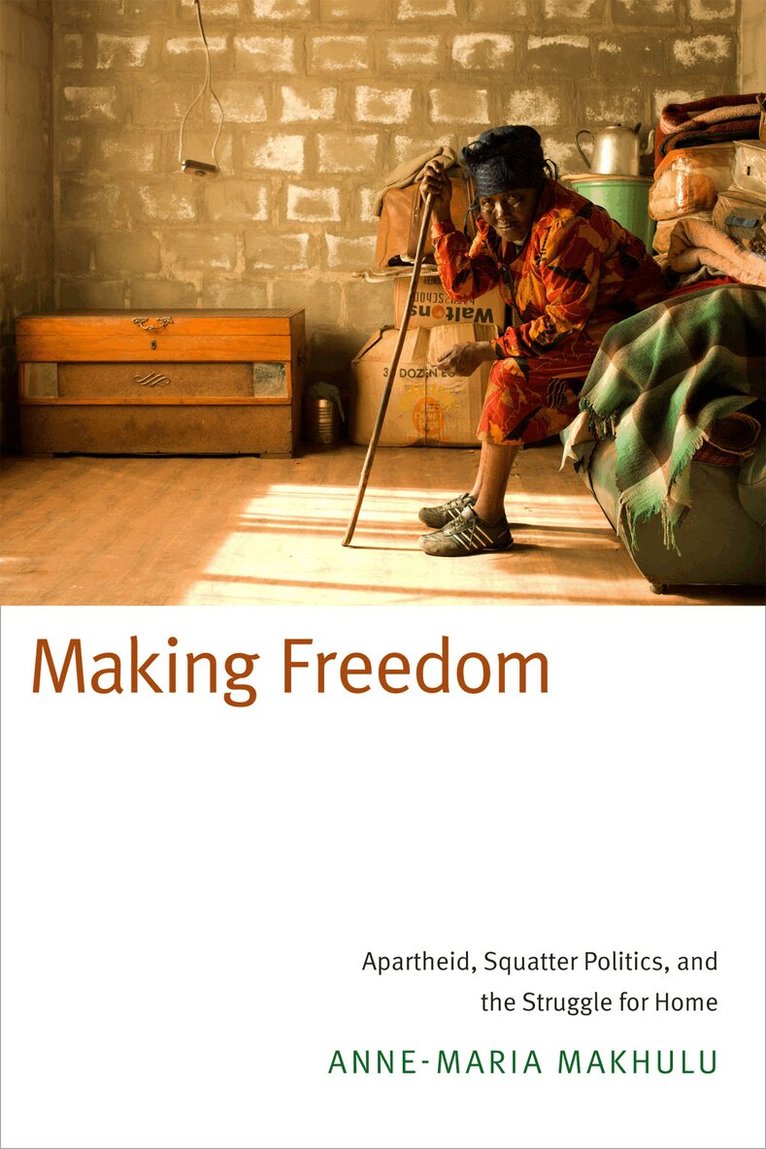
    Making Freedom

    Apartheid, Squatter Politics, and the Struggle for Home

    AvAnne-Maria Makhulu

    Inbunden, Engelska, 2015

    1 276 kr

    Beställningsvara. Skickas inom 5-8 vardagar. Fri frakt över 249 kr.

    Fler format och utgåvor

    Häftad

    388 kr

    E-bok

    568 kr

    Beskrivning

    In Making Freedom Anne-Maria Makhulu explores practices of squatting and illegal settlement on the outskirts of Cape Town during and immediately following the end of apartheid. Apartheid's paradoxical policies of prohibiting migrant Africans who worked in Cape Town from living permanently within the city led some black families to seek safe haven on the city's perimeters. Beginning in the 1970s families set up makeshift tents and shacks and built whole communities, defying the state through what Makhulu calls a "politics of presence." In the simple act of building homes, squatters, who Makhulu characterizes as urban militants, actively engaged in a politics of "the right to the city" that became vital in the broader struggles for liberation. Despite apartheid's end in 1994, Cape Town’s settlements have expanded, as new forms of dispossession associated with South African neoliberalism perpetuate relations of spatial exclusion, poverty, and racism. As Makhulu demonstrates, the efforts of black Capetonians to establish claims to a place in the city not only decisively reshaped Cape Town's geography but changed the course of history.

    Produktinformation

    • Utgivningsdatum:2015-10-23
    • Mått:152 x 229 x 20 mm
    • Vikt:499 g
    • Format:Inbunden
    • Språk:Engelska
    • Antal sidor:256
    • Förlag:Duke University Press
    • ISBN:9780822359470

    Utforska kategorier

    • Antropologi inom Samhälle och politik
    • Afrikas historia inom Historia och arkeologi

    Mer om författaren

    Anne-Maria Makhulu is Assistant Professor of Cultural Anthropology and African and African American Studies at Duke University. She is a coeditor of Hard Work, Hard Times: Global Volatility and African Subjectivities.

    Recensioner i media

    "Making Freedom, an exciting and provocative book about Cape Town’s informal settlements during and after apartheid, engages precisely with the spaces between those foregrounded by official categories." - Maxim Bolt (Anthropological Quarterly) "In so many ways, Making Freedom is a tour de force. Not only does it open up new ways to make sense of unauthorized squatting in struggling cities, it also challenges mainstream urban studies to look beyond negative stereotypes of so-called 'illegal' squatting. Makhulu weaves her analysis through all sorts of debates-informal work, selfbuilt housing, the “right to the city,” and many more. For this reason and more, Making Freedom is a book worth reading and engaging with." - Martin J. Murray (International Journal of African Historical Studies) "A thoughtful, sobering and provocative read for anyone interested in the recent history of South Africa’s urban development on a highly political landscape.... Reading Making Freedom is an intersectional literary experience in its careful consideration of not only economics and politics but gender, race and culture."- Lené Le Roux (Southeastern Geographer) "Makhulu’s recounts and comments with insight on the stories told by some squatters, mostly in respect of Crossroads.... There is much in this book that is of interest." - Richard Tomlinson (American Historical Review) "Making Freedom is a strongly argued and well executed book. It is a great addition to the literature offering a stimulating and insightful analysis of Cape Town’s informal settlements, exploring the problems and contradictions at play, while posing important questions regarding freedom in post-apartheid South Africa." - Matthew Graham (Social History) "Makhulu’s book is a major contribution to apartheid and post-apartheid housing studies. The book’s major strength comes from learning from the squatters themselves about how they made freedom and home in urban South Africa. . . . The book is a great contribution to the historiography of South African anthropology and history, among other disciplines, and it reminds us that making freedom and making home is what all societies struggle for irrespective of gender, class, race, religion and generation." - Joyce M. Chadya (Canadian Journal of History) "This book is a thoughtful and critical case study on the impact of apartheid in South Africa’s major cities. The book’s strengths lie in the personal testimonies of Makhulu’s respondents, who narrate their struggle to gain freedom and cement their domestic space of belonging. . . . this book can significantly assist students and scholars in researching the historiography and anthropology of South Africa’s oppressive housing and city influx policies. It is an exciting study that strikes a clear connection between the struggle for freedom and making a home in a country that disowned a section of its citizens and pushed them to the periphery." - Denis Waswa (African Studies Review)

    Innehållsförteckning

    • Acknowledgments  viiPrologue  xiIntroduction  11. Migrations  272. Counterinsurgency  633. Transitions  954. "Reckoning"  129Conclusion. Making Freedom  153Notes  169References 199Index  221