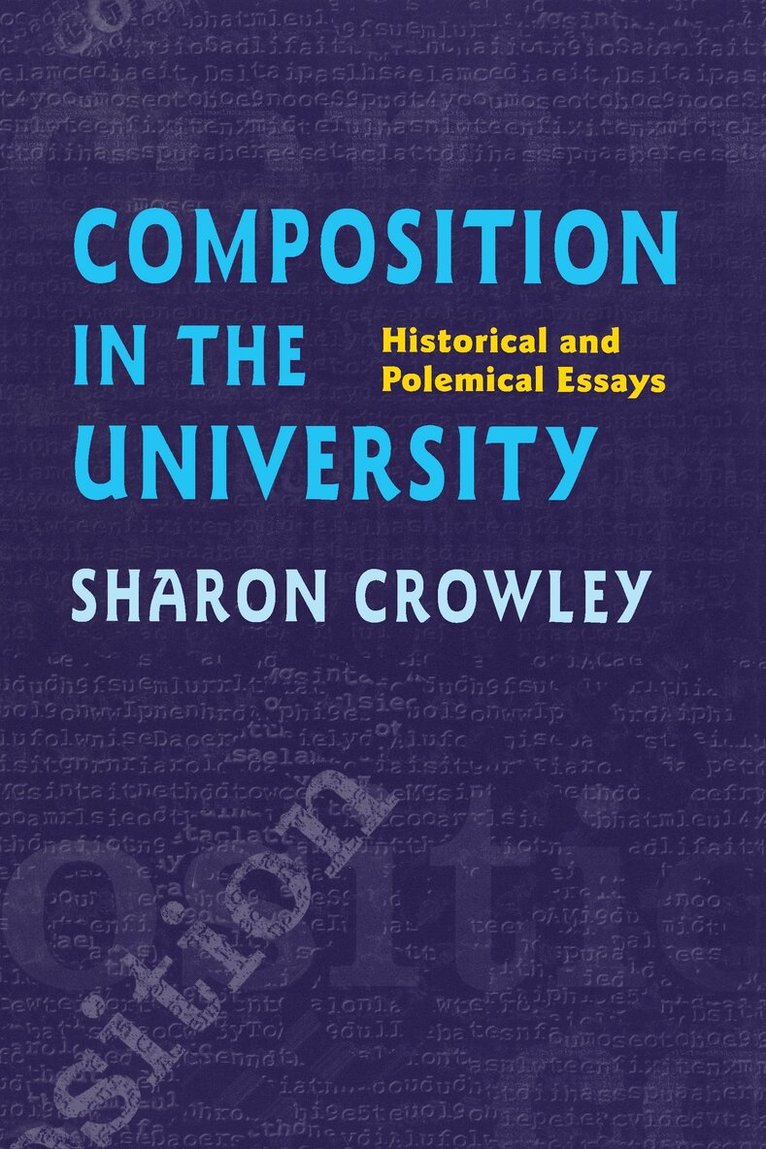
Häftad, Engelska, 1998
Composition In The University
665 kr
Skickas inom 5-8 vardagar
Beskrivning
Composition in the University examines the required introductory course in composition within American colleges and universities. Crowley argues that due to its association with literary studies in English departments, composition instruction has been inappropriately influenced by humanist pedagogy and that modern humanism is not a satisfactory rationale for the study of writing. Crowley envisions possible nonhumanist rationales that could be developed for vertical curricula in writing instruction, were the universal requirement not in place. Composition in the University examines the required introductory course in composition within American colleges and universities. According to Sharon Crowley, the required composition course has never been conceived in the way that other introductory courses have been—as an introduction to the principles and practices of a field of study. Rather it has been constructed throughout much of its history as a site from which larger educational and ideological agendas could be advanced, and such agendas have not always served the interests of students or teachers, even though they are usually touted as programs of study that students \u201cneed.\u201d If there is a master narrative of the history of composition, it is told in the institutional attitude that has governed administration, design, and staffing of the course from its beginnings—the attitude that the universal requirement is in place in order to construct docile academic subjects. Crowley argues that due to its association with literary studies in English departments, composition instruction has been inappropriately influenced by humanist pedagogy and that modern humanism is not a satisfactory rationale for the study of writing. She examines historical attempts to reconfigure the required course in nonhumanist terms, such as the advent of communications studies during the 1940s. Crowley devotes two essays to this phenomenon, concentrating on the furor caused by the adoption of a communications program at the University of Iowa. Composition in the University concludes with a pair of essays that argue against maintenance of the universal requirement. In the last of these, Crowley envisions possible nonhumanist rationales that could be developed for vertical curricula in writing instruction, were the universal requirement not in place. Crowley presents her findings in a series of essays because she feels the history of the required composition course cannot easily be understood as a coherent narrative since understandings of the purpose of the required course have altered rapidly from decade to decade, sometimes in shockingly sudden and erratic fashion. The essays in this book are informed by Crowley\u2019s long career of teaching composition, administering a composition program, and training teachers of the required introductory course. The book also draw on experience she gained while working with committees formed by the Conference on College Composition and Communication toward implementation of the Wyoming Resolution, an attempt to better the working conditions of post-secondary teachers of writing.
Produktinformation
- Utgivningsdatum: 1998-05-28
- Mått: 152 x 229 x 20 mm
- Vikt: 481 g
- Format: Häftad
- Språk: Engelska
- Serie: Composition, Literacy, and Culture
- Antal sidor: 240
- Förlag: University of Pittsburgh Press
- ISBN: 9780822956600
Utforska kategorier
Betyg & recensioner
0 recensioner
Inga recensioner tillgängliga.