• Fri frakt över 249 kr
  • •
  • Snabba leveranser
  • •
  • Billiga böcker
Kundservice

Du är på sajten för privatpersoner.

Företag, bibliotek eller offentlig verksamhet?

Du handlar på classic.bokus.com, där alla dina funktioner finns intakta.
Till classic.bokus.com
Bokus logotyp. Gå till startsidan.
  • Erbjudanden
  • Nyheter
  • Student
  • Topplistor
  • Barn & ungdom
  • Bokus Play
  • E-böcker
  • Pocketböcker
  • Spel & pussel

10% rabatt på allt med kod: NYSTART10 →

Sidfot

Mina sidor

    Hjälp

    • Kundservice
    • Vanliga frågor och svar
    • Frakt och leverans
    • Retur vid ångerrätt
    • Reklamera vara
    • Betalning
    • Köpvillkor
    • Allmänna villkor
    • Information om webbplatsens tillgänglighet

    Om Bokus

    • Om oss
    • Pressrum
    • För studenter
    • För företag
    • För bibliotek och offentlig verksamhet
    • För leverantörer
    • Hållbarhet

    Populärt

    • Aktuella erbjudanden
    • Presentkort
    • Studentlitteratur
    • Nya böcker
    • Topplistor
    • Signerade böcker
    • Engelska böcker

    Inspiration

    • Boktips
    • BookTok
    • Populära bokserier
    • Barnbokskaraktärer
    • Populära författare
    Logotyp för Bokus
    Följ oss på Facebook (extern länk)Följ oss på Instagram (extern länk)Följ oss på YouTube (extern länk)Följ oss på TikTok (extern länk)
    bokus @ CookiesAnpassa cookiesIntegritetspolicyKöpvillkor
    Till Citymail hemsida (extern länk)Till Budbee hemsida (extern länk)Till Postnord hemsida (extern länk)Till Schenker hemsida (extern länk)Till Early Bird hemsida (extern länk)Till Walleys hemsida (extern länk)
    1. Historia och arkeologi
    2. Historia
    3. Europas historia

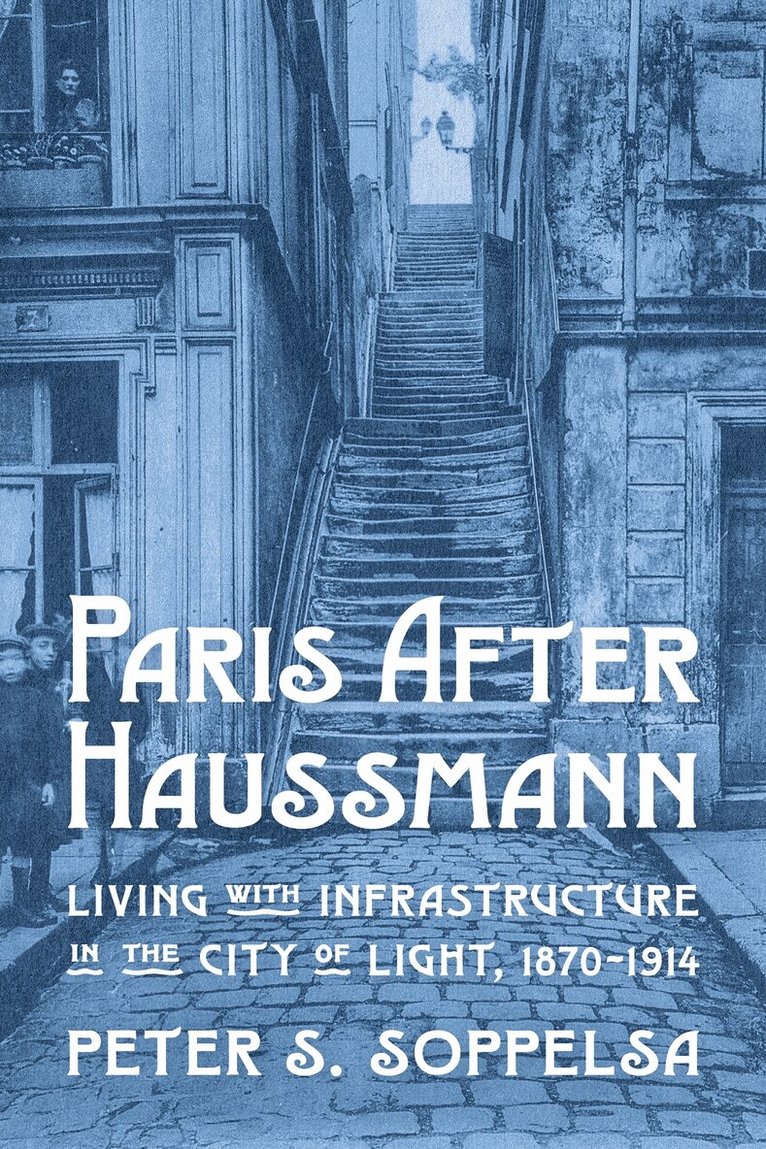
    Paris After Haussmann

    Living with Infrastructure in the City of Light, 1870–1914

    AvPeter S. Soppelsa

    Häftad, Engelska, 2026

    Del i serien History of the Urban Environment

    507 kr

    Beställningsvara. Skickas inom 5-8 vardagar. Fri frakt över 249 kr.

    Fler format och utgåvor

    Inbunden

    1 688 kr

    Beskrivning

    Modern Paris is often hailed as a capital of urban infrastructure. Baron Georges-Eugène Haussmann’s rebuilding of Paris in 1853–1870, branded “Haussmannization,” helped define urban modernity for cities worldwide. But even as infrastructures expanded and modernized, some Parisians were left behind: as late as 1928, 18 percent of houses still lacked direct sewerage. Haussmannization often hid infrastructures behind walls and floors, under streets, or in peripheral districts. In the forty years after 1870, a period that Peter Soppelsa calls “secondary Haussmannization,” Parisians inverted them—revealed their hidden components to scrutinize their workings and costs for society, environment, and health—and in turn politicized them. Drawing on French government archives, engineers’ maps, the illustrated press, and a collection of over 100 photographic postcards, Soppelsa charts the diverse embodied, emotional, and everyday experiences of living with expanding urban infrastructures—streets, housing, tramways, subways, the water supply, sewers, and rivers—in Paris from 1870 to 1914. Parisians learned that infrastructures were not simply technical solutions for the social and environmental problems of city life but could also bring about new dangers and dependencies.

    Produktinformation

    • Utgivningsdatum:2026-03-31
    • Mått:152 x 229 x 23 mm
    • Vikt:470 g
    • Format:Häftad
    • Språk:Engelska
    • Serie:History of the Urban Environment
    • Antal sidor:328
    • Förlag:University of Pittsburgh Press
    • ISBN:9780822967934

    Utforska kategorier

    • Europas historia inom Historia och arkeologi
    • Arkitektur inom Kultur
    • Historisk geografi inom Historia och arkeologi

    Mer om författaren

    Peter S. Soppelsa is an assistant professor in the University of Oklahoma Department of History of Science, Technology, and Medicine. His research combines environmental and urban history with the history of technology to explore the past of infrastructures, public works, public health, and the everyday experience of urban environments and technologies.

    Recensioner i media

    This marvelous book provides critical insight into the relationships between technology, society, and the urban environment in a modernizing Paris. Peter S. Soppelsa lays bare the visible and invisible aspects of the infrastructure that shaped both the form and the human experience of the city’s vertical, spatial, and subterranean geographies. The result is an essential portrait of the uneven reach of Paris’s infrastructures of transportation, sanitation, and organization, which both reflected and reinforced novel inequalities.