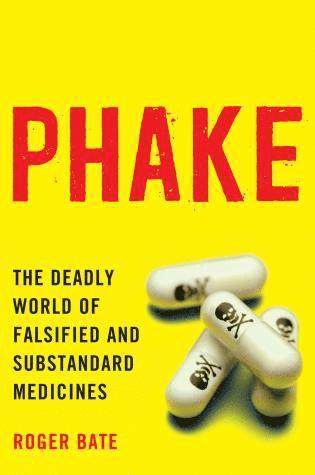
Phake
The Deadly World of Falsified and Substandard Medicines
496 kr
Beställningsvara. Skickas inom 3-6 vardagar. Fri frakt över 249 kr.
Du är på sajten för privatpersoner.
496 kr
Beställningsvara. Skickas inom 3-6 vardagar. Fri frakt över 249 kr.
Roger Bate is a visiting scholar at the American Enterprise Institute in Washington, D.C.He has spent years on the trail of stolen counterfeit and substandard medicines in Asia, Africa, and the Middle East, learning the anatomy of the nebulous, far-reaching black market that has caused countless deaths and injuries around the world. He has undertaken field research on fake medicines using handheld spectrometers and laboratory research using basic and sophisticated techniques. He has studied the laws and economics affecting the medicine trade and has published widely in the peer-reviewed scientific, legal and economic literature, including in leading journals such as The Lancet, The Journal of Health Economics, the Journal of International Criminal Justice and the Malaria Journal. He has published nearly one hundred articles on the topic in popular media outlets including the New York Times, the Washington Post and the Wall Street Journal.
This impeccably researched, well-organized book fully addresses the underworld of pharmaceutical counterfeiting and the longitudinal effects of this unsavory commerce. . . .Starting with the dark history of drug safety that had roots in the US, the book makes an impressive case regarding the difficulty/impossibility of tracking and prosecuting drug forgers, and the author provides a reasonable approach for ensuring safety for US products. He addresses the most problematic issues by country, including the intricacies of how each nation polices or ignores drug forgery. Well-designed charts/graphs assist readers to understand the volumes of data Bate has amassed during his travels. Numerous pictures clearly illustrate the difficulty of identifying fake drugs, both for health professionals and consumers. Bate's writing style is scientific and logical, but highly accessible to curious readers. He offers an honest critique of the pharmaceutical business, sharing his extraordinary insight and analysis of current drug counterfeiting issues and spot-on speculation of what the future holds for this problem. Summing Up: Highly recommended. Upper-division undergraduates and above; general readers.
Du är på sajten för privatpersoner.
496 kr
Beställningsvara. Skickas inom 3-6 vardagar. Fri frakt över 249 kr.
Roger Bate is a visiting scholar at the American Enterprise Institute in Washington, D.C.He has spent years on the trail of stolen counterfeit and substandard medicines in Asia, Africa, and the Middle East, learning the anatomy of the nebulous, far-reaching black market that has caused countless deaths and injuries around the world. He has undertaken field research on fake medicines using handheld spectrometers and laboratory research using basic and sophisticated techniques. He has studied the laws and economics affecting the medicine trade and has published widely in the peer-reviewed scientific, legal and economic literature, including in leading journals such as The Lancet, The Journal of Health Economics, the Journal of International Criminal Justice and the Malaria Journal. He has published nearly one hundred articles on the topic in popular media outlets including the New York Times, the Washington Post and the Wall Street Journal.
This impeccably researched, well-organized book fully addresses the underworld of pharmaceutical counterfeiting and the longitudinal effects of this unsavory commerce. . . .Starting with the dark history of drug safety that had roots in the US, the book makes an impressive case regarding the difficulty/impossibility of tracking and prosecuting drug forgers, and the author provides a reasonable approach for ensuring safety for US products. He addresses the most problematic issues by country, including the intricacies of how each nation polices or ignores drug forgery. Well-designed charts/graphs assist readers to understand the volumes of data Bate has amassed during his travels. Numerous pictures clearly illustrate the difficulty of identifying fake drugs, both for health professionals and consumers. Bate's writing style is scientific and logical, but highly accessible to curious readers. He offers an honest critique of the pharmaceutical business, sharing his extraordinary insight and analysis of current drug counterfeiting issues and spot-on speculation of what the future holds for this problem. Summing Up: Highly recommended. Upper-division undergraduates and above; general readers.