• Fri frakt över 249 kr
  • •
  • Snabba leveranser
  • •
  • Billiga böcker
Kundservice

Du är på sajten för privatpersoner.

Företag, bibliotek eller offentlig verksamhet?

Du handlar på classic.bokus.com, där alla dina funktioner finns intakta.
Till classic.bokus.com
Bokus logotyp. Gå till startsidan.
  • Erbjudanden
  • Nyheter
  • Student
  • Topplistor
  • Barn & ungdom
  • Bokus Play
  • E-böcker
  • Pocketböcker
  • Spel & pussel

10% rabatt på allt med kod: NYSTART10 →

Sidfot

Mina sidor

    Hjälp

    • Kundservice
    • Vanliga frågor och svar
    • Frakt och leverans
    • Retur vid ångerrätt
    • Reklamera vara
    • Betalning
    • Köpvillkor
    • Allmänna villkor
    • Information om webbplatsens tillgänglighet

    Om Bokus

    • Om oss
    • Pressrum
    • För studenter
    • För företag
    • För bibliotek och offentlig verksamhet
    • För leverantörer
    • Hållbarhet

    Populärt

    • Aktuella erbjudanden
    • Presentkort
    • Studentlitteratur
    • Nya böcker
    • Topplistor
    • Signerade böcker
    • Engelska böcker

    Inspiration

    • Boktips
    • BookTok
    • Populära bokserier
    • Barnbokskaraktärer
    • Populära författare
    Logotyp för Bokus
    Följ oss på Facebook (extern länk)Följ oss på Instagram (extern länk)Följ oss på YouTube (extern länk)Följ oss på TikTok (extern länk)
    bokus @ CookiesAnpassa cookiesIntegritetspolicyKöpvillkor
    Till Citymail hemsida (extern länk)Till Budbee hemsida (extern länk)Till Postnord hemsida (extern länk)Till Schenker hemsida (extern länk)Till Early Bird hemsida (extern länk)Till Walleys hemsida (extern länk)
    1. Naturvetenskap och teknik
    2. Teknik och industri
    3. Maskinteknik och material

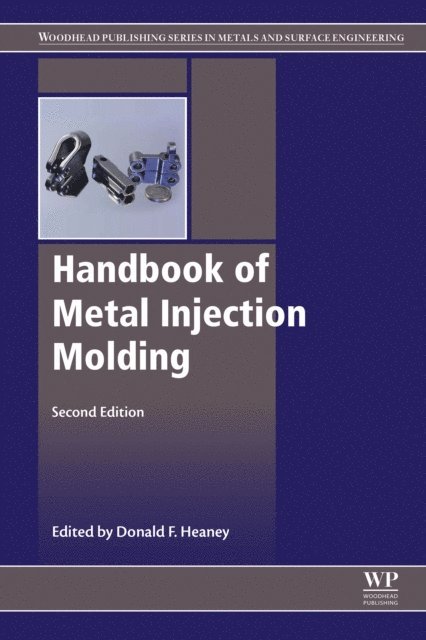
    Handbook of Metal Injection Molding

    AvDonald F. Heaney

    Inbunden, Engelska, 2012

    Del i serien Woodhead Publishing Series in Metals and Surface Engineering

    2 492 kr

    Beställningsvara. Skickas inom 10-15 vardagar. Fri frakt över 249 kr.

    Beskrivning

    Metal injection molding combines the most useful characteristics of powder metallurgy and plastic injection molding to facilitate the production of small, complex-shaped metal components with outstanding mechanical properties. The Handbook of metal injection molding provides an authoritative guide to this important technology and its applications.Part one discusses the fundamentals of the metal injection molding process with chapters on topics such as component design, important powder characteristics, compound manufacture, tooling design, molding optimization, debinding, and sintering. Part two provides a detailed review of quality issues, including feedstock characterisation, modeling and simulation, methods to qualify a MIM process, common defects and carbon content control. Special metal injection molding processes are the focus of part three, which provides comprehensive coverage of micro components, two material/two color structures, and porous metal techniques. Finally, part four explores metal injection molding of particular materials, including stainless steels, titanium and titanium alloys, thermal management alloys, high speed tool steels, heavy alloys, refractory metals, hard metals and soft magnetic alloys.With its distinguished editor and expert team of international contributors, the Handbook of metal injection molding is an essential guide for all those involved in the high-volume manufacture of small precision parts, across a wide range of high-tech industries such as microelectronics, biomedical and aerospace engineering.

    • Provides an authoritative guide to metal injection molding and its applications
    • Discusses the fundamentals of the metal injection molding processes and covers topics such as component design, important powder characteristics, compound manufacture, tooling design, molding optimization, debinding, and sintering
    • Comprehensively examines quality issues such as feedstock characterization, modeling and simulation, common defects and carbon content control

    Produktinformation

    • Utgivningsdatum:2012-06-11
    • Mått:156 x 234 x undefined mm
    • Vikt:1 140 g
    • Format:Inbunden
    • Språk:Engelska
    • Serie:Woodhead Publishing Series in Metals and Surface Engineering
    • Antal sidor:604
    • Förlag:Elsevier Science
    • ISBN:9780857090669

    Utforska kategorier

    • Maskinteknik och material inom Naturvetenskap och teknik
    • Tillverkningsteknik inom Naturvetenskap och teknik

    Mer om författaren

    Donald F. Heaney is the President and CEO of Advanced Powder Products Inc., USA. He is also an adjunct Professor of Engineering Science and Mechanics at The Pennsylvania State University.

    Recensioner i media

    "...contains very up-to-date information on market, technological, quality and practical issues...a comprehensive book with very recent research outputs and practical examples of application." --International Journal of Environmental Studies, Vol 70, Issue 1-13"This new book will be a most useful reference tool for MIM researchers, producers and end-users alike." --Power Injection Moulding International

    Innehållsförteckning

    • Contributor contact detailsPrefaceChapter 1: Metal powder injection molding (MIM): key trends and marketsAbstract:1.1 Introduction and background1.2 History of success1.3 Industry structure1.4 Statistical highlights1.5 Industry shifts1.6 Sales situation1.7 Market statistics1.8 Metal powder injection molding market by region1.9 Metal powder injection molding market by application1.10 Market opportunities1.11 Production sophistication1.12 ConclusionPart I: ProcessingChapter 2: Designing for metal injection molding (MIM)Abstract:2.1 Introduction2.2 Available materials and properties2.3 Dimensional capability2.4 Surface finish2.5 Tooling artifacts2.6 Design considerationsChapter 3: Powders for metal injection molding (MIM)Abstract:3.1 Introduction3.2 Ideal MIM powder characteristics3.3 Characterizing MIM powders3.4 Different MIM powder fabrication techniques3.5 Different alloying methodsChapter 4: Powder binder formulation and compound manufacture in metal injection molding (MIM)Abstract:4.1 Introduction: the role of binders4.2 Binder chemistry and constituents4.3 Binder properties and effects on feedstock4.4 Mixing technologies4.5 Case studies: lab scale and commercial formulationsChapter 5: Tooling for metal injection molding (MIM)Abstract:5.1 Introduction5.2 General design and function of injection molding machines5.3 Elements of the tool set5.4 Tool design options5.5 Special features and instrumentation5.6 Supporting software and economic aspectsChapter 6: Molding of components in metal injection molding (MIM)Abstract:6.1 Introduction6.2 Injection molding equipment6.3 Auxiliary equipment6.4 Injection molding process6.5 Common defects in MIMChapter 7: Debinding and sintering of metal injection molding (MIM) componentsAbstract:7.1 Introduction7.2 Primary debinding7.3 Secondary debinding7.4 Sintering7.5 MIM materials7.6 Settering7.7 MIM furnaces7.8 Furnace profiles7.9 Summary7.10 AcknowledgementsPart II: Quality issuesChapter 8: Characterization of feedstock in metal injection molding (MIM)Abstract:8.1 Introduction8.2 Rheology8.3 Thermal analysis8.4 Thermal conductivity8.5 Pressure-volume-temperature (PVT)8.6 Conclusions8.7 AcknowledgmentsChapter 9: Modeling and simulation of metal injection molding (MIM)Abstract:9.1 Modeling and simulation of the mixing process9.2 Modeling and simulation of the injection molding process9.3 Modeling and simulation of the thermal debinding process9.4 Modeling and simulation of the sintering process9.5 ConclusionChapter 10: Common defects in metal injection molding (MIM)Abstract:10.1 Introduction10.2 Feedstock10.3 Molding10.4 Debinding10.5 Sintering10.6 ConclusionChapter 11: Qualification of metal injection molding (MIM)Abstract:11.1 Introduction11.2 The metal injection molding process11.3 Product qualification method11.4 MIM prototype methodology11.5 Process control11.6 Understanding of control parameters11.7 ConclusionChapter 12: Control of carbon content in metal injection molding (MIM)Abstract:12.1 Introduction: the importance of carbon control12.2 Methods of controlling carbon, binder elimination and process parameters affecting carbon control12.3 Control of carbon in particular materials12.4 Material properties affected by carbon contentPart III: Special metal injection molding processesChapter 13: Micro metal injection molding (MicroMIM)Abstract:13.1 Introduction13.2 Potential of powder injection molding for microtechnology13.3 Micro-manufacturing methods for tool making13.4 Powder injection molding of micro-components13.5 Multi-component micro powder injection molding13.6 Simulation of MicroMIM13.7 Conclusion and future trends13.8 Sources of further information and adviceChapter 14: Two-material/two-color powder metal injection molding (2C-PIM)Abstract:14.1 Introduction14.2 Injection molding technology14.3 Debinding and sintering14.4 2C-PIM products14.5 Future trendsChapter 15: Powder space holder metal injection molding (PSH-MIM) of micro-porous metalsAbstract:15.1 Introduction15.2 Production methods for porous metals15.3 Formation of micro-porous structures by the PSH method15.4 Control of porous structure with the PSH method15.5 Liquid infiltration properties of micro-porous metals produced by the PSH method15.6 Dimensional accuracy of micro-porous MIM parts15.7 Functionally graded structures of micro-porous metals15.8 Conclusion15.9 AcknowledgementsPart IV: Special metal injection molding processesChapter 16: Metal injection molding (MIM) of stainless steelAbstract:16.1 Introduction16.2 Stainless steels in metal injection molding (MIM)16.3 Applications of MIM stainless steels16.4 AcknowledgementsChapter 17: Metal injection molding (MIM) of titanium and titanium alloysAbstract:17.1 Introduction17.2 Challenges of MIM of titanium17.3 Basics of processing17.4 Mechanical properties17.5 Cost reduction17.6 Special applications17.7 Conclusion and future trends17.8 Sources of further informationChapter 18: Metal injection molding (MIM) of thermal management materials in microelectronicsAbstract:18.1 Introduction18.2 Heat dissipation in microelectronics18.3 Copper18.4 Tungsten–copper18.5 Molybdenum–copper18.6 ConclusionsChapter 19: Metal injection molding (MIM) of soft magnetic materialsAbstract:19.1 Introduction19.2 Fe–6.5Si19.3 Fe–9.5Si–5.5Al19.4 Fe–50Ni19.5 ConclusionChapter 20: Metal injection molding (MIM) of high-speed tool steelsAbstract:20.1 Introduction20.2 Tool steel MIM processing20.3 Mechanical propertiesChapter 21: Metal injection molding (MIM) of heavy alloys, refractory metals, and hardmetalsAbstract:21.1 Introduction21.2 Applications21.3 Feedstock formulation concerns21.4 Heavy alloys21.5 Refractory metals21.6 HardmetalsIndex