• Fri frakt över 249 kr
  • •
  • Snabba leveranser
  • •
  • Billiga böcker
Kundservice

Du är på sajten för privatpersoner.

Företag, bibliotek eller offentlig verksamhet?

Du handlar på classic.bokus.com, där alla dina funktioner finns intakta.
Till classic.bokus.com
Bokus logotyp. Gå till startsidan.
  • Erbjudanden
  • Nyheter
  • Student
  • Topplistor
  • Barn & ungdom
  • Bokus Play
  • E-böcker
  • Pocketböcker
  • Spel & pussel

10% rabatt på allt med kod NYSTART10 →

Sidfot

Mina sidor

    Hjälp

    • Kundservice
    • Vanliga frågor och svar
    • Frakt och leverans
    • Retur vid ångerrätt
    • Reklamera vara
    • Betalning
    • Köpvillkor
    • Allmänna villkor
    • Information om webbplatsens tillgänglighet

    Om Bokus

    • Om oss
    • Pressrum
    • För studenter
    • För företag
    • För bibliotek och offentlig verksamhet
    • För leverantörer
    • Hållbarhet

    Populärt

    • Aktuella erbjudanden
    • Presentkort
    • Studentlitteratur
    • Nya böcker
    • Topplistor
    • Signerade böcker
    • Engelska böcker

    Inspiration

    • Boktips
    • BookTok
    • Populära bokserier
    • Barnbokskaraktärer
    • Populära författare
    Logotyp för Bokus
    Följ oss på Facebook (extern länk)Följ oss på Instagram (extern länk)Följ oss på YouTube (extern länk)Följ oss på TikTok (extern länk)
    bokus @ CookiesAnpassa cookiesIntegritetspolicyKöpvillkor
    Till Citymail hemsida (extern länk)Till Budbee hemsida (extern länk)Till Postnord hemsida (extern länk)Till Schenker hemsida (extern länk)Till Early Bird hemsida (extern länk)Till Walleys hemsida (extern länk)
    1. Medicin
    2. Medicin: allmänt
    3. Hälso- och sjukvård
    4. Hälso- och sjukvård: administration och ledning

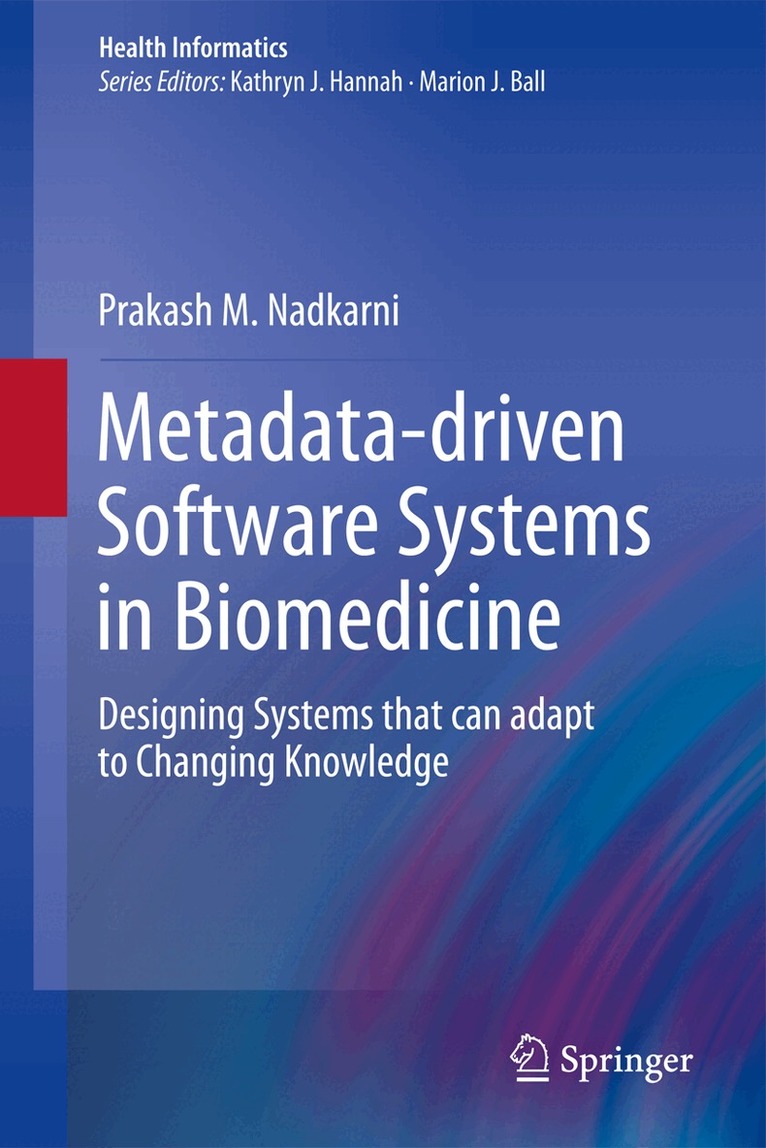
    Metadata-driven Software Systems in Biomedicine

    Designing Systems that can adapt to Changing Knowledge

    AvPrakash M. Nadkarni,Kathryn J. Hannah

    Inbunden, Engelska, 2011

    Del i serien Health Informatics

    1 118 kr

    Beställningsvara. Skickas inom 10-15 vardagar. Fri frakt över 249 kr.

    Fler format och utgåvor

    E-bok

    1 317 kr

    Häftad

    1 007 kr

    Beskrivning

    While the use of database technology is ubiquitous throughout IT (and health IT in particular), it is not generally appreciated that, as a database increases in scope, certain designs are far superior to others. In biomedical domains, new knowledge is being generated continually, and the databases that must support areas such as clinical care and research must also be able to evolve while requiring minimal or no logical / physical redesign. Appropriately designed metadata, and software designed to utilize it effectively, can provide significant insulation against change.Many of the larger EMR or clinical research database vendors have realized this, but their designs are proprietary and not described in the literature. Consequently, numerous misconceptions abound among individuals who have not had to work with large-scale biomedical systems, and graduates of a health or bioinformatics program may find that they need to unlearn what they were taught in database and software design classes in order to work productively with such systems. A working knowledge of such systems is also important for individuals who are not primarily software developers, such as health informaticians, medical information officers and data analysts. This book is, in a sense, intended to prepare all of the above individuals for the real world.

    Produktinformation

    • Utgivningsdatum:2011-05-29
    • Mått:155 x 235 x 27 mm
    • Vikt:787 g
    • Format:Inbunden
    • Språk:Engelska
    • Serie:Health Informatics
    • Antal sidor:396
    • Upplaga:2011
    • Förlag:Springer London Ltd
    • ISBN:9780857295095

    Utforska kategorier

    • Hälso- och sjukvård: administration och ledning inom Medicin
    • Medicinsk utrustning och medicinska tekniker inom Medicin
    • Tillämpad datateknik inom Data och IT

    Innehållsförteckning

    • 1. What is metadata? Types of metadata.- Descriptive (interpreted by humans).- Technical (utilized by software).- Some metadata shows characteristics of both.- How metadata is represented.- Why use metadata to build biomedical systems? Caveat: Metadata-driven systems are initially harder to build, Building for change: flexibility and maintainability, Elimination of repetitious coding tasks, Case Study: Table-driven approaches to software design.- 2. Metadata for supporting electronic medical records.- The Entity-Attribute-Value (EAV) data model:.- Why EAV is problematic without metadata-editing capabilities: the TMR experience.- Pros and Cons of EAV: When not to use EAV.- How metadata allows ad hoc query to be data-model agnostic.- Transactional operations vs. warehousing operations.- Case Study: The I2B2 clinical data warehouse model.- Providing end-user customizability, Case Study: EpicCare Flowsheets.- 3. Metadata for clinical study data management systems (CSDMS).- Critical differences between an EMR and a CSDMS.- Essential elements of a CSDMS.- HTML-based vs. non-Web interfaces: pros and cons.- Case Study: Metadata for robust interactive data validation.- Metadata and the support of basic bioscience research.- Object dictionaries and synonyms: the NCBI Entrez approach.- Fundamentals of object-oriented modeling: the use of classes.- Case study: representing neuroscience data: SenseLab.- Case study: managing phenotype data.- 4. Descriptive Metadata: Controlled Biomedical Terminologies.- Classification of Controlled Vocabularies, with examples: Collections of Terms, Taxonomies: a hierarchical structure, Thesauri: Concepts vs. Terms, Ontologies: Classes and Properties, Cimino’s criteria for a good controlled vocabulary, Fundamentals of Description Logics, Pre-coordination vs. compositional approaches to new concept definition, Challenges when the set of permissible operations is incomplete, Difficulties in end-user employment of large vocabularies, Theuse of vocabulary subsets: the 95/5 problem, Case Study: the SNOMED vocabulary.- 5. Metadata and XML.- Introduction to XML.- Strengths of XML for information interchange.- Misconceptions and common pitfalls in XML use.- Weaknesses of XML as the basis for data modeling.- The Microarray Gene Expression Data (MGED) experience.- Use of the Unified Modeling Language.- UML is intended for human visualization.- UML has an internal XML equivalent (XMI).- Case Study: Clinical text markup.- 6. Metadata and the modeling of ontologies.- Ontology modeling tools: Protégé.- Common Pitfalls in Ontology Modeling.- Scalable ontology designs.- Supporting reasoning in ontologies: classification.- An introduction to Semantic Web technologies.- Limitations: the open-world assumption.- Case Study: Implementing constraints in SNOMED.- 7. Metadata and Production-Rule Engines.- Introduction to Production-Rule Systems.- Strengths and weaknesses of rule frameworks.- Embedded rule engines.- Data that can be executed as code: the Eval function.- Designing for extensibility.- Supporting versioning.- Case Study: The Jones Criteria for Rheumatic Fever.- 8. Biomedical Metadata Standards.- Why there can be no universal standard: a metadata model is problem-specific.- Standards for Descriptive Metadata.- ISO/IEC 11179: Purpose and Limitations.- Standards for Technical Metadata.- Have been designed for individual problem domains.- CDISC for clinical study data interchange.- Interchange standards for gene expression and proteomics.- 9. The HL7 v3 Reference Information Model.- Elements of the model.- What the model is not intended to encompass.- The clinical document architecture.- The Messaging Standard: Backward Incompatibilities.- Limitations and controversies.