• Fri frakt över 249 kr
  • •
  • Snabba leveranser
  • •
  • Billiga böcker
Kundservice

Du är på sajten för privatpersoner.

Företag, bibliotek eller offentlig verksamhet?

Du handlar på classic.bokus.com, där alla dina funktioner finns intakta.
Till classic.bokus.com
Bokus logotyp. Gå till startsidan.
  • Erbjudanden
  • Nyheter
  • Student
  • Topplistor
  • Barn & ungdom
  • Bokus Play
  • E-böcker
  • Pocketböcker
  • Spel & pussel

10% rabatt på allt med kod NYSTART10 →

Sidfot

Mina sidor

    Hjälp

    • Kundservice
    • Vanliga frågor och svar
    • Frakt och leverans
    • Retur vid ångerrätt
    • Reklamera vara
    • Betalning
    • Köpvillkor
    • Allmänna villkor
    • Information om webbplatsens tillgänglighet

    Om Bokus

    • Om oss
    • Pressrum
    • För studenter
    • För företag
    • För bibliotek och offentlig verksamhet
    • För leverantörer
    • Hållbarhet

    Populärt

    • Aktuella erbjudanden
    • Presentkort
    • Studentlitteratur
    • Nya böcker
    • Topplistor
    • Signerade böcker
    • Engelska böcker

    Inspiration

    • Boktips
    • BookTok
    • Populära bokserier
    • Barnbokskaraktärer
    • Populära författare
    Logotyp för Bokus
    Följ oss på Facebook (extern länk)Följ oss på Instagram (extern länk)Följ oss på YouTube (extern länk)Följ oss på TikTok (extern länk)
    bokus @ CookiesAnpassa cookiesIntegritetspolicyKöpvillkor
    Till Citymail hemsida (extern länk)Till Budbee hemsida (extern länk)Till Postnord hemsida (extern länk)Till Schenker hemsida (extern länk)Till Early Bird hemsida (extern länk)Till Walleys hemsida (extern länk)
    1. Psykologi och pedagogik
    2. Psykologi

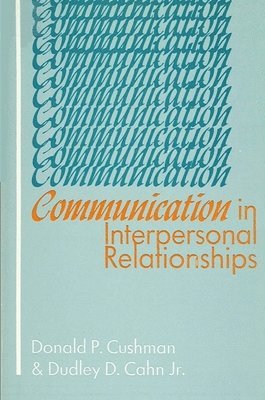
    Communication in Interpersonal Relationships

    AvDonald P. Cushman,Dudley D. Cahn

    Häftad, Engelska, 1985

    Del i serien SUNY series, Human Communication Processes

    373 kr

    Tillfälligt slut

    Beskrivning

    This book discusses communication principles, processes, and skills from four different perspectives by explaining four related propositions. First, human communication is guided by socially established rules, the knowledge of which allows interacting persons to exert influence over the outcome of their interactions. Second, self concepts are formed and sustained in our interactions with others. Third, the formation of sustained interpersonal relations depends upon the attraction resulting from reciprocal self concept support. And fourth, organizations and the cultural system provide the parameters within which self concepts and interpersonal relations are formed. The implications of these propositions are examined in chapters two through ten.The authors develop their system in terms of results. What patterns of communication-what patterns of signal exchange-increase the probability of the development of affective relationship? What patterns erode interpersonal systems or prevent them from forming? The book also examines patterns of communication within task-oriented organizations and in situations involving cultural differences.

    Produktinformation

    • Utgivningsdatum:1985-06-30
    • Mått:152 x 229 x 25 mm
    • Vikt:249 g
    • Format:Häftad
    • Språk:Engelska
    • Serie:SUNY series, Human Communication Processes
    • Antal sidor:170
    • Förlag:State University of New York Press
    • ISBN:9780873959100

    Utforska kategorier

    • Psykologi inom Psykologi och pedagogik

    Mer om författaren

    Donald P. Cushman is Professor of Communications at the State University of New York, Albany. He has published over 30 articles in scholarly journals and a book entitled Message-Attitude-Behavior Relationship. Dudley Cahn is Assistant Professor of Communications at the University of Hawaii, Honolulu.

    Innehållsförteckning

    • Preface1. Communication and its Role in Human Relationships A Major Theme of our AgeThe Need for a Paradigm ShiftA Multiple Systems AnalysisSome ImplicationsAn Overview of the Book2. Interpersonal Communication and Individual Self-Concepts A Symbolic Interactionist PerspectiveThe Nature, Function, and Scope of Individual Self-ConceptsThe Role of Self-Concept Plays in Interpersonal Communication ProcessesListening, Cueing, and Negotiation Skills3. Interpersonal Communication and the Development, Presentation, and Validation of Individual Self-Concepts Self-Concept Support and Denial: The Focus of Interpersonal InteractionSelf-Concept DevelopmentSelf-Concept PresentationThe Validation of Individual Self-Concepts4. Interpersonal Communication and the Formation and Maintenance of Interpersonal Relationships Interpersonal RelationshipsThe Friendship Formation ProcessThe Mate Formation Process5. Interpersonal Communication, Sexual Intimacy, Emotional Intimacy, and Interpersonal Relationships The Alignment of Sexual and Emotional IntimacyAligning Sexual Intimacy and Emotional Intimacy: The Communication ComplexitiesAligning Sexual and Emotional Intimacy in Context: The Communication Problems6. Interpersonal Communication and the Reassessment of Relationships Relationship Stress and SatisfactionA Quality Communication EnvironmentThe Continuation of a RelationshipThe Repair of a RelationshipThe Renegotiation of a RelationshipThe Disengagement from a Relationship7. Organizational Communication and Interpersonal Relationships Communication in OrganizationsOrganizational Communication and the Supervisor—Subordinate RelationshipEmployment InterviewEmployee AppraisalSupervisor—Subordinate Communication Problems8. Cultural Communication and Interpersonal Relationships Culture: A Tyrannizing ImageCulture and CommunicationInterpersonal Communication in American CultureAmerican Culture and Marital RelationshipsThe Cultural Repair Ritual for Marital Problems9. Cross-Cultural Communication and Interpersonal Relationships Communication Between People from Different Cultural GroupsInterpersonal Communication in Japan and the United StatesOrganizational Communication in Japan and the United States10. Telecommunication and Interpersonal Relationships Telecommunication, Interpersonal Relationships, and Post-Industrial SocietyTelecommunications: Bridging the Gap Between Man and MachineMass Communication: From Broadcasting to Narrowcasting in Communications TechnologyBoss—Employee Interpersonal Relationships in an Information AgeTeacher—Student Interpersonal Relationships in an Information AgeAuthor IndexSubject Index