• Fri frakt över 249 kr
  • •
  • Snabba leveranser
  • •
  • Billiga böcker
Kundservice

Du är på sajten för privatpersoner.

Företag, bibliotek eller offentlig verksamhet?

Du handlar på classic.bokus.com, där alla dina funktioner finns intakta.
Till classic.bokus.com
Bokus logotyp. Gå till startsidan.
  • Erbjudanden
  • Nyheter
  • Student
  • Topplistor
  • Barn & ungdom
  • Bokus Play
  • E-böcker
  • Pocketböcker
  • Spel & pussel

10% rabatt på allt med kod NYSTART10 →

Sidfot

Mina sidor

    Hjälp

    • Kundservice
    • Vanliga frågor och svar
    • Frakt och leverans
    • Retur vid ångerrätt
    • Reklamera vara
    • Betalning
    • Köpvillkor
    • Allmänna villkor
    • Information om webbplatsens tillgänglighet

    Om Bokus

    • Om oss
    • Pressrum
    • För studenter
    • För företag
    • För bibliotek och offentlig verksamhet
    • För leverantörer
    • Hållbarhet

    Populärt

    • Aktuella erbjudanden
    • Presentkort
    • Studentlitteratur
    • Nya böcker
    • Topplistor
    • Signerade böcker
    • Engelska böcker

    Inspiration

    • Boktips
    • BookTok
    • Populära bokserier
    • Barnbokskaraktärer
    • Populära författare
    Logotyp för Bokus
    Följ oss på Facebook (extern länk)Följ oss på Instagram (extern länk)Följ oss på YouTube (extern länk)Följ oss på TikTok (extern länk)
    bokus @ CookiesAnpassa cookiesIntegritetspolicyKöpvillkor
    Till Citymail hemsida (extern länk)Till Budbee hemsida (extern länk)Till Postnord hemsida (extern länk)Till Schenker hemsida (extern länk)Till Early Bird hemsida (extern länk)Till Walleys hemsida (extern länk)
    1. Naturvetenskap och teknik
    2. Matematik och naturvetenskap
    3. Matematik
    4. Tillämpad matematik

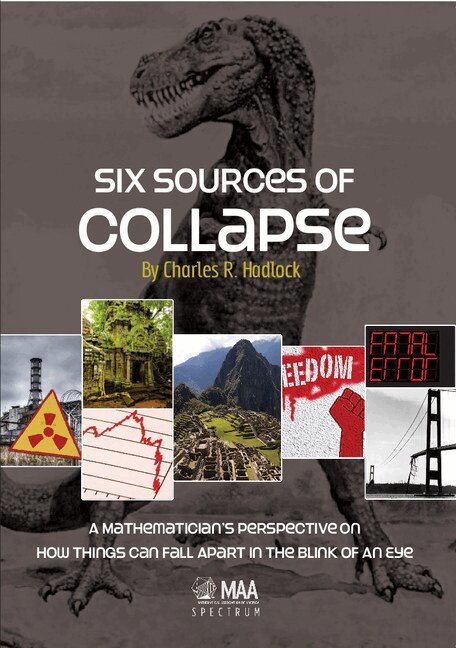
    Six Sources of Collapse

    A Mathematician's Perspective on How Things Can Fall Apart in the Blink of an Eye

    AvCharles R. Hadlock

    Inbunden, Engelska, 2013

    Del i serien Spectrum

    774 kr

    Beställningsvara. Skickas inom 5-8 vardagar. Fri frakt över 249 kr.

    Beskrivning

    Beginning with one of the most remarkable ecological collapses of recent times, that of the passenger pigeon, this book surveys collapse processes across the entire spectrum of the natural and man-made world. The reader is taken through extreme weather events, crashing financial markets and companies, the chaotic nature of Earth's orbit, revolutionary political change, the spread of disease and many other fascinating cases. The author's key observation is the consistent occurrence of one or more of six fundamental dynamics ('six sources of collapse'), all of which can be best described and investigated using fundamental mathematical concepts which include low probability events, group dynamics, evolutionary games, instability, nonlinearity and network effects. The exposition assumes a minimal mathematical background, but even professional mathematicians are likely to get rich insights from the range of examples. This book will also be of interest to readers in business and finance, engineering, ecology and political science.

    Produktinformation

    • Utgivningsdatum:2013-06-06
    • Mått:182 x 260 x 15 mm
    • Vikt:540 g
    • Format:Inbunden
    • Språk:Engelska
    • Serie:Spectrum
    • Antal sidor:220
    • Förlag:The Mathematical Association of America
    • ISBN:9780883855799

    Utforska kategorier

    • Tillämpad matematik inom Naturvetenskap och teknik

    Mer om författaren

    Charles Hadlock has worked as a risk consultant in the chemical, power, transportation and mining industries. As the dean of a business school, he witnessed collapses of corporations, currencies and markets. Combined with his scientific background, interdisciplinary collaborative work and extensive management experience at the top levels of corporations and governments, he has a uniquely broad perspective on collapse processes. He has previously authored an award-winning monograph on field theory and an acclaimed text on mathematical modelling in environmental management.

    Recensioner i media

    Based on his experience as a risk consultant, manager, and professor of finance and mathematics, Hadlock examines the phenomenon of collapse from six different technical points of view, namely low probability events, group behavior, evolutionary processes, instability, nonlinear dynamics, and network effects. In each case, we are offered a high-level, accessible presentation of the underlying mathematical notions. … all chapters are rife with real-world instances of collapse that can be explained, or at least analysed, under one or more of the six approaches. Readers are likely to find such examples one of the most compelling contributions of the book." - Marco Faella, Mathematical Reviews"Hadlock's writing is invariably clear and concise, yet informal and appealing, as befits a mathematical memoirist. The book is by no means a textbook, although it could be regarded as a compendium of modules suitable for presentation to undergraduates at various stages of development by instructors seeking to enhance their lectures with a smattering of genuine applications. For that reason alone, every teaching mathematician should own a copy of this book!" - James Case, SIAM News"… The book is organized into chapters that can be read independently, but taken as whole it provides a very broad overview of the mathematical ideas behind complexity theory. Readers need some knowledge of calculus, differential equations, and probability to fully understand the material, but this book requires less mathematical background than many other books on this topic. It would be suitable for undergraduate students in science and engineering as well as students in the social sciences and management." - B. Borchers, CHOICE

    Innehållsförteckning

    • PrefaceAcknowledgements1. Introduction2. Predicting Unpredictable Events3. Group Behavior: Crowds, Herds, and Video Games4. Evolution and Collapse: Game Playing in a Changing World5. Instability, Oscillation, and Feedback6. Nonlinearity: Invitation to Chaos and Catastrophe7. It's All About Networks8. Putting It All Together: Looking at Collapse Phenomena in "6-D"ReferencesIndexAbout the Author