• Fri frakt över 249 kr
  • •
  • Snabba leveranser
  • •
  • Billiga böcker
Kundservice

Du är på sajten för privatpersoner.

Företag, bibliotek eller offentlig verksamhet?

Du handlar på classic.bokus.com, där alla dina funktioner finns intakta.
Till classic.bokus.com
Bokus logotyp. Gå till startsidan.
  • Erbjudanden
  • Nyheter
  • Student
  • Topplistor
  • Barn & ungdom
  • Bokus Play
  • E-böcker
  • Pocketböcker
  • Spel & pussel

10% rabatt på allt med kod NYSTART10 →

Sidfot

Mina sidor

    Hjälp

    • Kundservice
    • Vanliga frågor och svar
    • Frakt och leverans
    • Retur vid ångerrätt
    • Reklamera vara
    • Betalning
    • Köpvillkor
    • Allmänna villkor
    • Information om webbplatsens tillgänglighet

    Om Bokus

    • Om oss
    • Pressrum
    • För studenter
    • För företag
    • För bibliotek och offentlig verksamhet
    • För leverantörer
    • Hållbarhet

    Populärt

    • Aktuella erbjudanden
    • Presentkort
    • Studentlitteratur
    • Nya böcker
    • Topplistor
    • Signerade böcker
    • Engelska böcker

    Inspiration

    • Boktips
    • BookTok
    • Populära bokserier
    • Barnbokskaraktärer
    • Populära författare
    Logotyp för Bokus
    Följ oss på Facebook (extern länk)Följ oss på Instagram (extern länk)Följ oss på YouTube (extern länk)Följ oss på TikTok (extern länk)
    bokus @ CookiesAnpassa cookiesIntegritetspolicyKöpvillkor
    Till Citymail hemsida (extern länk)Till Budbee hemsida (extern länk)Till Postnord hemsida (extern länk)Till Schenker hemsida (extern länk)Till Early Bird hemsida (extern länk)Till Walleys hemsida (extern länk)
    1. Samhälle och politik
    2. Samhälle och kultur
    3. Kultur och medier
    4. Referensverk och tvärvetenskap

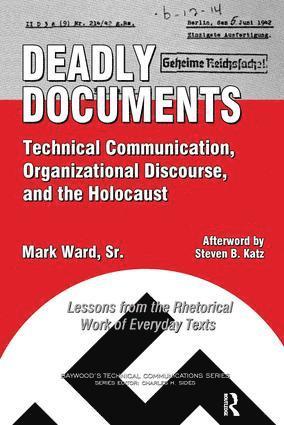
    Deadly Documents

    Technical Communication, Organizational Discourse, and the Holocaust: Lessons from the Rhetorical Work of Everyday Texts

    AvMark Ward

    Häftad, Engelska, 2014

    Del i serien Baywood's Technical Communications

    1 324 kr

    Beställningsvara. Skickas inom 10-15 vardagar. Fri frakt över 249 kr.

    Fler format och utgåvor

    E-bok

    1 264 kr

    E-bok

    1 264 kr

    Inbunden

    Tillf. slut

    Beskrivning

    Scholars, teachers, and practitioners of organizational, professional, and technical communication and rhetoric are target audiences for a new book that reaches across those disciplines to explore the dynamics of the Holocaust. More than a history, the book uses the extreme case of the Final Solution to illumine the communicative constitution of organizations and to break new ground on destructive organizational communication and ethics. Deadly Documents: Technical Communication, Organizational Discourse, and the Holocaust—Lessons from the Rhetorical Work of Everyday Texts starts with a microcosmic look at a single Nazi bureau. Through close rhetorical, visual, and discursive analyses of organizational and technical documents produced by the SS Security Police Technical Matters Group—the bureau that managed the Nazi mobile gas van program—author Mark Ward shows how everyday texts functioned as “boundary objects” on which competing organizational interests could project their own interpretations and temporarily negotiate consensus for their parts in the Final Solution.The initial chapters of Deadly Documents provide a historical ethnography of the SS technical bureau by closely describing the institutional and organizational cultures in which it operated and relating organizational stories told in postwar testimony by the desk-murderers themselves. Then, through examination of the primary material of their documents, Ward demonstrates how this Social Darwinist world of competing Nazi bureaucrats deployed rhetorical and linguistic resources to construct a social reality that normalized genocide. Ward goes beyond the usual Weberian bureaucratic paradigm and applies to the problem of the Holocaust both the interpretive view that sees organizations as socially constructed through communication and the postmodern view that denies the notion of a preexisting social object called an “organization” and instead situates it within larger discourses.The concluding chapters trace how contemporary scholars of professional communication have wrestled with the Nazi case and developed a consensus explanation that the desk-murderers were amoral technocrats. Though the explanation is dismissed by most historians, it nevertheless offers, Ward argues, a comforting distance between “us” and “them.” Yet, as Ward writes, “First, we will learn more about the dynamic role of everyday texts in organizational processes. Second, as we see these processes—perhaps inherent to all organized communities, including our own—at work even in the extreme case of the SS Technical Matters Group, the comforting distance that we now maintain between ‘them’ and ‘us’ is necessarily diminished. And third, our newfound discomfort may open productive spaces to revisit conventional wisdoms about the ethics of technical and organizational communication.”

    Produktinformation

    • Utgivningsdatum:2014-05-30
    • Mått:152 x 229 x undefined mm
    • Vikt:385 g
    • Format:Häftad
    • Språk:Engelska
    • Serie:Baywood's Technical Communications
    • Antal sidor:251
    • Förlag:Baywood Publishing Company Inc
    • ISBN:9780895038029

    Utforska kategorier

    • Referensverk och tvärvetenskap inom Samhälle och politik
    • Organisationsteori inom Ekonomi och Ledarskap
    • Folkmord och etnisk rensning inom Historia och arkeologi

    Innehållsförteckning

    • Preface by Mark Ward, Sr. Acknowledgments CHAPTER 1: Can Genocide Be Regulated? An Ontological Shift Revisiting the Final Solution Sample, Method, and Chapter Organization The Importance of the Study CHAPTER 2: From Darwin to Death Wagons Origins of European Anti-Semitism The Rise of Racial Anti-Semitism Development of the Gas Vans Operational Challenges in the Field CHAPTER 3: The People’s Community Organizations as Open Systems Unifying Principles of Institutional Culture Aspects of SS Organizational Culture Lines of Organizational Authority German Bureaucratic Document ProtocolsCHAPTER 4: The Participants and Their Motives Personnel of the Gas Van Program Individual Relationships and Motives CHAPTER 5: Documents for Destruction Setting Up the Analyses Introducing the DocumentsCHAPTER 6: A Community of Killers Constructing the Rhetorical Community A “Safety” Narrative and Protean MetaphorsDiscovering Organizational Genres in the TextsRhetorical Community in Organizational Contexts Visuality in the Rhetorical Community CHAPTER 7: Discourse of Death What Discourse Analysis Can Add The Killers’ Use of Linguistic ResourcesReconstructing an Organizational DiscourseCHAPTER 8: Revisiting “Expediency” Boundary Work in Action Lanzmann and the “Why” Question Implications of the Lanzmann Alterations CHAPTER 9: Bridging the Boundaries An Ahistorical Consensus? Expediency Without Ethics Protecting Rhetoric and Rhetoricians Safeguarding Science and Civilization Converging on a Comfortable DistanceWhat the Orderings May Reveal CHAPTER 10: Some Ethical Implications A Bias for Explanation Prescriptive and Descriptive Ethics Afterword: The Reality of Words and Their Aftermaths Steven B. Katz References Index