• Fri frakt över 249 kr
  • •
  • Snabba leveranser
  • •
  • Billiga böcker
Kundservice

Du är på sajten för privatpersoner.

Företag, bibliotek eller offentlig verksamhet?

Du handlar på classic.bokus.com, där alla dina funktioner finns intakta.
Till classic.bokus.com
Bokus logotyp. Gå till startsidan.
  • Erbjudanden
  • Nyheter
  • Student
  • Topplistor
  • Barn & ungdom
  • Bokus Play
  • E-böcker
  • Pocketböcker
  • Spel & pussel

10% rabatt på allt med kod: NYSTART10 →

Sidfot

Mina sidor

    Hjälp

    • Kundservice
    • Vanliga frågor och svar
    • Frakt och leverans
    • Retur vid ångerrätt
    • Reklamera vara
    • Betalning
    • Köpvillkor
    • Allmänna villkor
    • Information om webbplatsens tillgänglighet

    Om Bokus

    • Om oss
    • Pressrum
    • För studenter
    • För företag
    • För bibliotek och offentlig verksamhet
    • För leverantörer
    • Hållbarhet

    Populärt

    • Aktuella erbjudanden
    • Presentkort
    • Studentlitteratur
    • Nya böcker
    • Topplistor
    • Signerade böcker
    • Engelska böcker

    Inspiration

    • Boktips
    • BookTok
    • Populära bokserier
    • Barnbokskaraktärer
    • Populära författare
    Logotyp för Bokus
    Följ oss på Facebook (extern länk)Följ oss på Instagram (extern länk)Följ oss på YouTube (extern länk)Följ oss på TikTok (extern länk)
    bokus @ CookiesAnpassa cookiesIntegritetspolicyKöpvillkor
    Till Citymail hemsida (extern länk)Till Budbee hemsida (extern länk)Till Postnord hemsida (extern länk)Till Schenker hemsida (extern länk)Till Early Bird hemsida (extern länk)Till Walleys hemsida (extern länk)
    1. Filosofi och religion
    2. Religion och tro
    3. Religion: allmänt

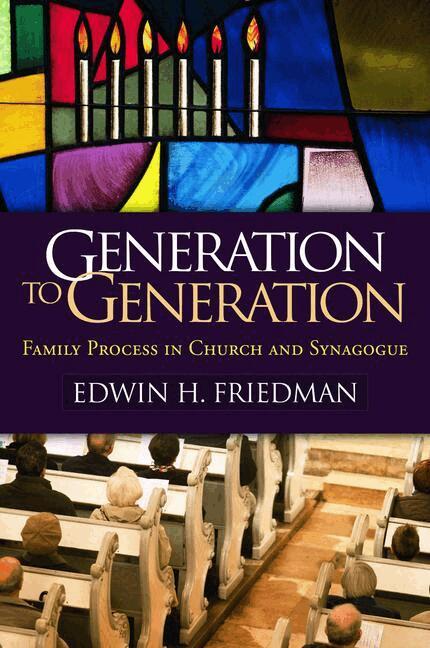
    Generation to Generation

    Family Process in Church and Synagogue

    AvEdwin H. Friedman

    Inbunden, Engelska, 1985

    Del i serien Guilford Family Therapy Series

    1 091 kr

    Beställningsvara. Skickas inom 3-6 vardagar. Fri frakt över 249 kr.

    Fler format och utgåvor

    Häftad

    513 kr

    E-bok

    604 kr

    E-bok

    604 kr

    Beskrivning

    This acclaimed, influential workapplies the concepts of systemic family therapy to the emotional life of congregations. Edwin H. Friedman shows how the same understanding of family process that can aid clergy in their pastoral role also has important ramifications for negotiating congregational dynamics and functioning as an effective leader. Clergy from diverse denominations, as well as family therapists and counselors, have found that this book directly addresses the dilemmas and crises they encounter daily. It is widely used as a text in courses on pastoral care, leadership, and family systems.

    Produktinformation

    • Utgivningsdatum:1985-12-25
    • Mått:152 x 229 x 30 mm
    • Vikt:630 g
    • Format:Inbunden
    • Språk:Engelska
    • Serie:Guilford Family Therapy Series
    • Antal sidor:319
    • Förlag:Guilford Publications
    • ISBN:9780898620597

    Utforska kategorier

    • Religion: allmänt inom Filosofi och religion
    • Kristendom inom Filosofi och religion
    • Judendom inom Filosofi och religion

    Mer om författaren

    Edwin H. Friedman, until his death in 1996, worked for more than 35 years in the Washington, DC, metropolitan area, and was in great demand as a consultant and public speaker throughout the country. A family therapist and ordained rabbi, Dr. Friedman was well known in the fields of mental health and pastoral education for his motivational style and his unique blend of systems thinking, humor, and common sense. He offered acclaimed workshops for mental health practitioners, clergy, business leaders, and others.Â

    Recensioner i media

    Friedman uses his unique position as family therapist and rabbi to explore ways to be an effective agent of change in a group. He shows how ceremonies and rituals, as developmental markers in the lives of families and organizations, can be transformed into systemic interventions that spur healing and growth. In the footsteps of Murray Bowen, Friedman moves seamlessly between a leader's self-differentiation as a person and his or her role within families and other systems, giving each their due. For family therapists, Generation to Generation is a pioneering text that illuminates the relevance of personal spirituality and religious life to the functioning of healthy families.--James L. Griffith, MD, Department of Psychiatry and Behavioral Sciences, The George Washington UniversityGeneration to Generation provides a needed corrective to the general tendency in ministry to focus on the individual. I have found the text to be useful in my Youth Ministry courses to remind Catholic missionaries that the family is the domestic church. While we may see the individual in front of us, Friedman widens our vision so we may see the larger context of the individual at home and in the congregation. Insightful and grounded in reality, Generation to Generation is a valuable resource for those intending to minister to others.--Biff Rocha, MA, Department of Theology, Benedictine College, Atchison, KansasWhen [this book] was originally written, learning about the emotional side of congregations was not part of the curriculum in most seminaries. Now it is the gold standard in this area, and Generation to Generation is a text many clergy carry with them each day....Just as the book’s title suggests, Friedman’s ideas continue to be passed down to today’s generation of leaders.--from the Foreword to the Paperback Edition by Gary Emanuel, PhD, and Mickie Crimone, MS, APRNWell written and lively...required reading for pastoral counselors of every persuasion....Any therapist will find here new techniques for bringing about changes and will enlarge his or her conceptual framework of the human dilemma. --Jay Haley- A feature throughout the book is the heavy use of story and narrative to make a point. This is very effective as the narrative often contains multi-dimensional meanings that the author then explores in an engaging way....Provides an interesting and very readable account of how to incorporate family processes into congregational life. --Journal for the Study of Marriage and Spirituality, 3/4/2011Æ’Æ’ I was shocked, surprised and disillusioned when I began to realize that hard work, sincerity and prayer weren't enough to guarantee success in pastoral ministry. I kept getting myself into tangles that I didn't understand until I read this book by a storytelling rabbi with uncommon wisdom. Friedman helped me see that the best way to engage with the factors I can't control—like the opinions and behavior of others—was to focus on the factors that I can control: my own presence, identity and behavior in the social system of the local congregation. --The Christian Century, 3/4/2011Æ’Æ’ An important contribution to...family systems thinking and pastoral care....One of the most creative aspects of this volume is the way the book is laid out. The chapters are organized around interrelated concepts that feed back on and amplify one another—a design that itself helps the reader begin to think systemically. --Journal of Pastoral Care and Counseling, 3/4/2011Æ’Æ’ A groundbreaking book in the use of family therapy....The key is not expertise, but self-definition and self-understanding. --Behavioral Studies of Religion, 3/4/2011Æ’Æ’ A must read for persons of the cloth, for it points to significant issues and considerations on the experience of living in families and working with a congregation as a family. --Review and Expositor, 1/3/2005

    Innehållsförteckning

    • Introduction I. Family Theory 1. The Idea of a Family 2. Understanding Family Process II. The Families within the Congregation 3. The Marital Bond 4. Child-Focused Families 5. Body and Soul in Family Process 6. When the Parent Becomes the Child 7. A Family Approach to Life-Cycle Ceremonies III. The Congregation as a Family System 8. Family Process and Organizational Life 9. Leadership and Self in a Congregational Family 10. Leaving and Entering a Congregational Family IV. The Personal Families of the Clergy 11. The Immediate Family: Conflict and Traps 12. The Extended Family: Its Potential for Salvation