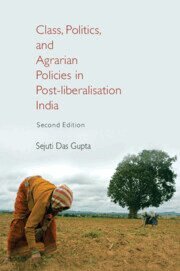
Inbunden, Engelska, 2024
Class, Politics, and Agrarian Policies in Post-liberalisation India
1526 kr
Beställningsvara. Skickas inom 7-10 vardagar. Fri frakt över 249 kr.
Beskrivning
Produktinformation
- Utgivningsdatum: 2024-11-21
- Mått: 159 x 235 x 25 mm
- Vikt: 650 g
- Format: Inbunden
- Språk: Engelska
- Antal sidor: 336
- Upplaga: 2
- Förlag: Cambridge University Press
- ISBN: 9781009481335
Utforska kategorier
Mer om författaren
Sejuti Das Gupta teaches at the Department of Sociology, James Madison College, Michigan State University. She has also taught at the School of Development Studies, Tata Institute of Social Sciences, India. Her research interests are agrarian economics, agrarian policy and development, political sociology, rural studies, economic growth and liberalisation.
Recensioner i media
'An important book that combines class analysis with subnational analysis to understand the changing nature of state-class and political economy of India in the context of ongoing globalization and economic change. In the process we are able to locate ongoing inequalities with a powerful framework and place both global and domestic change alongside agrarian crises and problems. The framework outlined in the book updates the nature of state since 2004 and how caste power also enhances class power, creating a political settlement and bargain between fractions of classes and the changing nature of the state. It is a book worth reading and digesting both for its empirical analysis of agrarian class relations across Chhattisgarh, Gujarat and Karnataka and for the notions of state-class relations, structure, and political settlement that it advances.' Aseema Sinha, Claremont McKenna College, USA
Betyg & recensioner
0 recensioner
Inga recensioner tillgängliga.