• Fri frakt över 249 kr
  • •
  • Snabba leveranser
  • •
  • Billiga böcker
Kundservice

Du är på sajten för privatpersoner.

Företag, bibliotek eller offentlig verksamhet?

Du handlar på classic.bokus.com, där alla dina funktioner finns intakta.
Till classic.bokus.com
Bokus logotyp. Gå till startsidan.
  • Erbjudanden
  • Nyheter
  • Student
  • Topplistor
  • Barn & ungdom
  • Bokus Play
  • E-böcker
  • Pocketböcker
  • Spel & pussel

10% studentrabatt med kod TERM26

Sidfot

Mina sidor

    Hjälp

    • Kundservice
    • Vanliga frågor och svar
    • Frakt och leverans
    • Retur vid ångerrätt
    • Reklamera vara
    • Betalning
    • Köpvillkor
    • Allmänna villkor
    • Information om webbplatsens tillgänglighet

    Om Bokus

    • Om oss
    • Pressrum
    • För studenter
    • För företag
    • För bibliotek och offentlig verksamhet
    • För leverantörer
    • Hållbarhet

    Populärt

    • Aktuella erbjudanden
    • Presentkort
    • Studentlitteratur
    • Nya böcker
    • Topplistor
    • Signerade böcker
    • Engelska böcker

    Inspiration

    • Boktips
    • BookTok
    • Populära bokserier
    • Barnbokskaraktärer
    • Populära författare
    Logotyp för Bokus
    Följ oss på Facebook (extern länk)Följ oss på Instagram (extern länk)Följ oss på YouTube (extern länk)Följ oss på TikTok (extern länk)
    bokus @ CookiesAnpassa cookiesIntegritetspolicyKöpvillkor
    Till Citymail hemsida (extern länk)Till Budbee hemsida (extern länk)Till Postnord hemsida (extern länk)Till Schenker hemsida (extern länk)Till Early Bird hemsida (extern länk)Till Walleys hemsida (extern länk)
    1. Naturvetenskap och teknik
    2. Matematik och naturvetenskap
    3. Matematik
    4. Optimering
    • -10% student

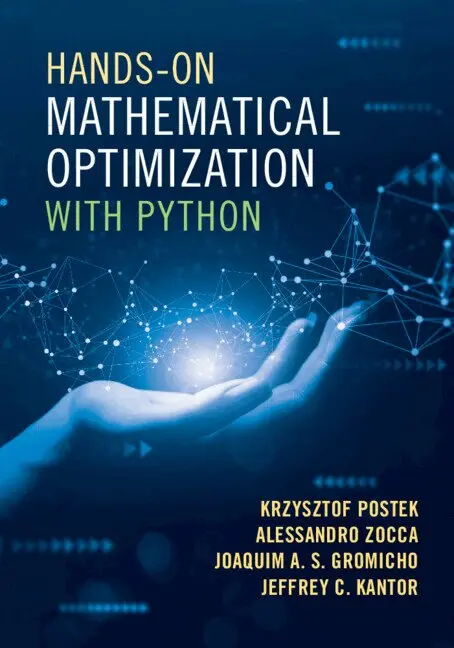
    Hands-On Mathematical Optimization with Python

    AvKrzysztof Postek,Alessandro Zocca

    Häftad, Engelska, 2025

    536 kr

    . Fri frakt över 249 kr.

    Beskrivning

    This practical guide to optimization combines mathematical theory with hands-on coding examples to explore how Python can be used to model problems and obtain the best possible solutions. Presenting a balance of theory and practical applications, it is the ideal resource for upper-undergraduate and graduate students in applied mathematics, data science, business, industrial engineering and operations research, as well as practitioners in related fields. Beginning with an introduction to the concept of optimization, this text presents the key ingredients of an optimization problem and the choices one needs to make when modeling a real-life problem mathematically. Topics covered range from linear and network optimization to convex optimization and optimizations under uncertainty. The book's Python code snippets, alongside more than 50 Jupyter notebooks on the author's GitHub, allow students to put the theory into practice and solve problems inspired by real-life challenges, while numerous exercises sharpen students' understanding of the methods discussed.

    Produktinformation

    • Utgivningsdatum:2025-01-16
    • Mått:181 x 252 x 21 mm
    • Vikt:676 g
    • Format:Häftad
    • Språk:Engelska
    • Antal sidor:354
    • Förlag:Cambridge University Press
    • ISBN:9781009493505

    Ingår i kampanjer

    -10% student

    Utforska kategorier

    • Optimering inom Naturvetenskap och teknik
    • Systemvetenskap och AI inom Data och IT
    • Tillämpad matematik inom Naturvetenskap och teknik

    Mer om författaren

    Krzysztof Postek is Senior Optimization Data Scientist with the Boston Consulting Group in Amsterdam. He received his Ph.D. in Operations Research in 2017 from Tilburg University. After his postdoc at the Technion – Israel Institute of Technology, he spent several years as a faculty member at Erasmus University Rotterdam and Delft University of Technology. His research interests revolve mostly around optimization under uncertainty. Alessandro Zocca is Assistant Professor in the Department of Mathematics at the Vrije Universiteit Amsterdam. He received his Ph.D. in Mathematics from the University of Eindhoven in 2015. He was a postdoctoral researcher first at CWI Amsterdam, and then at the California Institute of Technology, supported by a NWO Rubicon grant. His work lies in the area of applied probability, learning, and optimization, drawing motivation in particular from applications to power systems reliability. Joaquim A.S. Gromicho acts as Science and Education Officer for ORTEC and is full professor of Business Analytics at the University of Amsterdam. He received his Ph.D. in Optimization in 1995 from the Erasmus University Rotterdam, before spending two years as Assistant Professor at the University of Lisbon. He serves the Dutch Statistics and OR Society as editor in chief of STAtOR, a magazine on applications and impact, and the steering committee of the EURO Practitioner's Forum. Jeffrey C. Kantor earned his Ph.D. in Chemical Engineering from Princeton University in 1981. After a postdoc at the University of Tel Aviv, he joined the Chemical Engineering Department at the University of Notre Dame. His research interests focused on the theory and application of nonlinear control theory and techniques to chemical and biological processes. His awards have included an NSF Presidential Young Investigator Award, a Camille and Henry Dreyfus Research Scholar Award, and is a Fellow of the American Association for the Advancement of Science. He enjoyed modeling for optimization and contributed to the Pyomo community.

    Recensioner i media

    'This is a fantastic textbook on optimization! It contains the right mix of theoretical and more practical optimization aspects. Several chapters contain more recent important developments, e.g., conic and robust optimization. Moreover, the Python codes provided make this textbook really 'hands-on'. It is clear that the authors are not only experts in optimization theory, but also have applied optimization in practice themselves.' Dick den Hertog, University of Amsterdam

    Innehållsförteckning

    • 1. Mathematical optimization; 2. Linear optimization; 3. Mixed-integer linear optimization; 4. Network optimization; 5. Convex optimization; 6. Conic optimization; 7. Accounting for uncertainty: Optimization meets reality; 8. Robust optimization; 9. Stochastic optimization; 10. Two-stage problems; Appendix A. Linear algebra primer; Appendix B. Solutions of selected exercises; List of Tables; List of Figures; Index.