• Fri frakt över 249 kr
  • •
  • Snabba leveranser
  • •
  • Billiga böcker
Kundservice

Du är på sajten för privatpersoner.

Företag, bibliotek eller offentlig verksamhet?

Du handlar på classic.bokus.com, där alla dina funktioner finns intakta.
Till classic.bokus.com
Bokus logotyp. Gå till startsidan.
  • Erbjudanden
  • Nyheter
  • Student
  • Topplistor
  • Barn & ungdom
  • Bokus Play
  • E-böcker
  • Pocketböcker
  • Spel & pussel

10% rabatt på allt med kod: NYSTART10 →

Sidfot

Mina sidor

    Hjälp

    • Kundservice
    • Vanliga frågor och svar
    • Frakt och leverans
    • Retur vid ångerrätt
    • Reklamera vara
    • Betalning
    • Köpvillkor
    • Allmänna villkor
    • Information om webbplatsens tillgänglighet

    Om Bokus

    • Om oss
    • Pressrum
    • För studenter
    • För företag
    • För bibliotek och offentlig verksamhet
    • För leverantörer
    • Hållbarhet

    Populärt

    • Aktuella erbjudanden
    • Presentkort
    • Studentlitteratur
    • Nya böcker
    • Topplistor
    • Signerade böcker
    • Engelska böcker

    Inspiration

    • Boktips
    • BookTok
    • Populära bokserier
    • Barnbokskaraktärer
    • Populära författare
    Logotyp för Bokus
    Följ oss på Facebook (extern länk)Följ oss på Instagram (extern länk)Följ oss på YouTube (extern länk)Följ oss på TikTok (extern länk)
    bokus @ CookiesAnpassa cookiesIntegritetspolicyKöpvillkor
    Till Citymail hemsida (extern länk)Till Budbee hemsida (extern länk)Till Postnord hemsida (extern länk)Till Schenker hemsida (extern länk)Till Early Bird hemsida (extern länk)Till Walleys hemsida (extern länk)
    1. Historia och arkeologi
    2. Historia
    3. Historia: särskilda händelser och ämnen

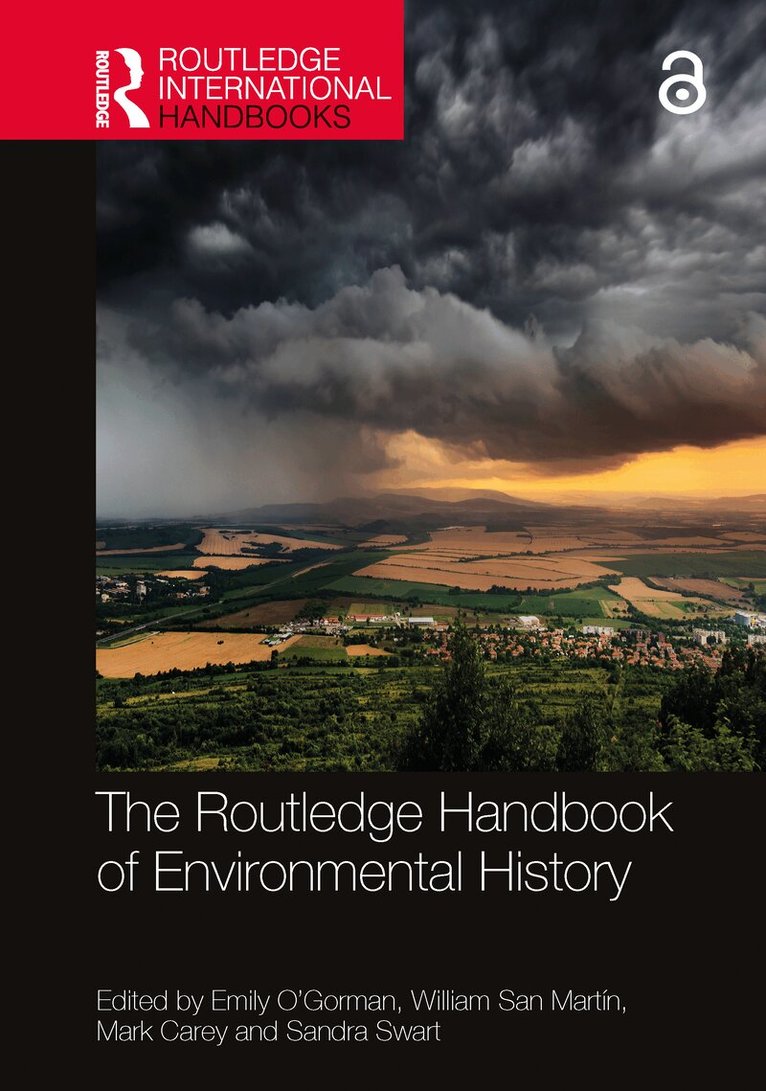
    Routledge Handbook of Environmental History

    AvEmily O'Gorman,William San Martín

    Häftad, Engelska, 2025

    Del i serien Routledge International Handbooks

    788 kr

    Beställningsvara. Skickas inom 10-15 vardagar. Fri frakt över 249 kr.

    Beskrivning

    The Routledge Handbook of Environmental History presents a cutting-edge overview of the dynamic and ever-expanding field of environmental history. It addresses recent transformations in the field and responses to shifting scholarly, political, and environmental landscapes.The handbook fully and critically engages with recent exciting changes, contextualizes them within longer-term shifts in the field, and charts potential new directions for study. It focuses on five key areas:Theories and concepts related to changing considerations of social justice, including postcolonial, antiracist, and feminist approaches, and the field’s growing emphasis on multiple human voices and agencies.The roles of non-humans and the more-than-human in the telling of environmental histories, from animals and plants to insects as vectors of disease and the influences of water and ice, the changing theoretical approaches and the influence of concepts in related areas such as animal and discard studies.How changes in theories and concepts are shaping methods in environmental history and shifting approaches to traditional sources like archives and oral histories as well as experiments by practitioners with new methods and sources.Responses to a range of current complex problems, such as climate change, and how environmental historians can best help mitigate and resolve these problems.Diverse ways in which environmental historians disseminate their research within and beyond academia, including new modes of research dissemination, teaching, and engagements with stakeholders and the policy arena.This is an important resource for environmental historians, researchers and students in the related fields of political ecology, environmental studies, natural resources management and environmental planning.Chapters 9, 10 and 26 of this book are freely available as a downloadable Open Access PDF at http://www.taylorfrancis.com under a Creative Commons Attribution-Non Commercial-No Derivatives (CC-BY-NC-ND) 4.0 license.

    Produktinformation

    • Utgivningsdatum:2025-12-26
    • Mått:174 x 246 x 26 mm
    • Vikt:880 g
    • Format:Häftad
    • Språk:Engelska
    • Serie:Routledge International Handbooks
    • Antal sidor:456
    • Förlag:Taylor & Francis Ltd
    • ISBN:9781032038421

    Utforska kategorier

    • Historia: särskilda händelser och ämnen inom Historia och arkeologi
    • Geografi inom Naturvetenskap och teknik
    • Miljövetenskap och miljöpolitik inom Naturvetenskap och teknik

    Mer om författaren

    Emily O’Gorman is an Australian Research Council Future Fellow and Associate Professor at Macquarie University, Sydney, Australia. Her research is situated within environmental history and the interdisciplinary environmental humanities, and is primarily concerned with contested knowledges within broader cultural framings of authority, expertise, and landscapes.William San Martín is Assistant Professor of Global Environmental Science, Technology, and Governance at Worcester Polytechnic Institute, USA, and a Research Fellow at the Earth System Governance Project at Utrecht University, The Netherlands. His work examines power disparities across environmental knowledge, technologies, and governance regimes.Mark Carey is Professor of Environmental Studies and Geography at the University of Oregon, USA. He runs the Glacier Lab for the Study of Ice and Society, collaborating with students and scientists to study environmental history, ice humanities, and climate justice.Sandra Swart is Professor and Chair of the History Department at Stellenbosch University, South Africa. She studies African socio-environmental history, focusing on human-animal relations.

    Innehållsförteckning

    • Introduction: Framing Environmental History Today and for the Future, Part I: New Methods, Innovative Approaches, 1. Ethics, Justice, and Environmental Histories, 2. Oral and Environmental History: Time, Place, Decolonisation and the More-Than-Human World, 3. Sounding Environments, 4. Geographical Information System, Remote Sensing and Spatial Data Infrastructure, Part II: Non-Human Agencies, 5. The Tangled Bank, 6. Multispecies Cultures and Environmental Change: The Animal (Agency) Turn, 7. Animal and Vector-Borne Diseases, Zoonoses, and One Health, 8. The Non-Human in Agriculture: Technologies of Agriculture and Non-Human Aspects of Farming, 9. (Inter)national and (Trans)regional Agents: The Coastal Sand Dunes of Mozambique, 10. Actor-Networks, Conservation Treaties, and International Environmental History: Re-assembling Conventions, 11. Hazards and Disasters: Locusts, Earthquakes, Volcanoes, Floods, Droughts, Part III: Engaging with the Planetary and the Anthropocene, 12. Planetary Boundaries, Climate Change and the Anthropocene, 13. Extinction in Environmental History: Historizing Problems of Classification and Intentionality, 14. Temporality and Environmental History in the Anthropocene: Timing Climates, Modeling Futures, 15. Fossil Fuels from Extraction to Emissions, Part IV: Power, Flows, and Knowledges, 16. Global Histories of Environment and Labour in Asia and Africa, 17. Toxicity, Racial Capitalism and Colonial Mining: Lessons from Cyanide and Gold Mining in Zimbabwe (Southern Rhodesia), 18. Local Fishermen Knowledge and Scientific Expertise in Eastern Europe and West Africa: Assessing the Unseen, 19. Historical Memory and Technocratic Failures in Environmental Impact Assessments, 20. Cities, Food, Water, and Environmental History in China, the USA and India: Making Bubbles, 21. Urban Environmental Governance: Historical and Political Ecological Perspectives from South Asia, Part V: Practices and Actions for Current Socio-Ecological Crises, 22 . Pedagogy for the Depressed: Empowerment and Hope in the Face of the Apocalypse, 23. Activist Environmental History: On War Machines and Guerrilla Strategies, 24. Communicating Environmental History: Reaching Diverse Audiences through Online Forums, 25. Environmental History in Museums: Past Practice and Future Opportunities, 26. Environmental Historians, Policy, and Governance, Future Directions in Environmental History