• Fri frakt över 249 kr
  • •
  • Snabba leveranser
  • •
  • Billiga böcker
Kundservice

Du är på sajten för privatpersoner.

Företag, bibliotek eller offentlig verksamhet?

Du handlar på classic.bokus.com, där alla dina funktioner finns intakta.
Till classic.bokus.com
Bokus logotyp. Gå till startsidan.
  • Erbjudanden
  • Nyheter
  • Student
  • Topplistor
  • Barn & ungdom
  • Bokus Play
  • E-böcker
  • Pocketböcker
  • Spel & pussel

10% rabatt på allt med kod: NYSTART10 →

Sidfot

Mina sidor

    Hjälp

    • Kundservice
    • Vanliga frågor och svar
    • Frakt och leverans
    • Retur vid ångerrätt
    • Reklamera vara
    • Betalning
    • Köpvillkor
    • Allmänna villkor
    • Information om webbplatsens tillgänglighet

    Om Bokus

    • Om oss
    • Pressrum
    • För studenter
    • För företag
    • För bibliotek och offentlig verksamhet
    • För leverantörer
    • Hållbarhet

    Populärt

    • Aktuella erbjudanden
    • Presentkort
    • Studentlitteratur
    • Nya böcker
    • Topplistor
    • Signerade böcker
    • Engelska böcker

    Inspiration

    • Boktips
    • BookTok
    • Populära bokserier
    • Barnbokskaraktärer
    • Populära författare
    Logotyp för Bokus
    Följ oss på Facebook (extern länk)Följ oss på Instagram (extern länk)Följ oss på YouTube (extern länk)Följ oss på TikTok (extern länk)
    bokus @ CookiesAnpassa cookiesIntegritetspolicyKöpvillkor
    Till Citymail hemsida (extern länk)Till Budbee hemsida (extern länk)Till Postnord hemsida (extern länk)Till Schenker hemsida (extern länk)Till Early Bird hemsida (extern länk)Till Walleys hemsida (extern länk)
    1. Filosofi och religion
    2. Filosofi
    3. Filosofiska discipliner

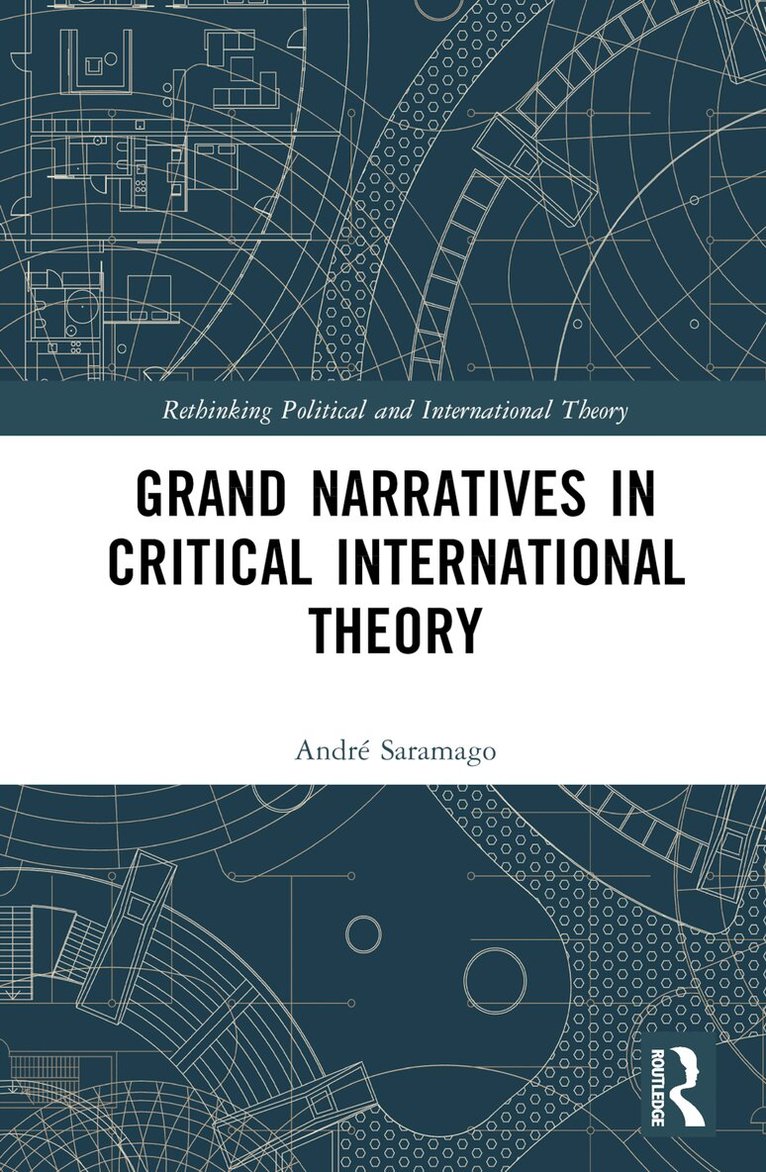
    Grand Narratives in Critical International Theory

    AvAndré Saramago

    Inbunden, Engelska, 2024

    Del i serien Rethinking Political and International Theory

    2 421 kr

    Beställningsvara. Skickas inom 10-15 vardagar. Fri frakt över 249 kr.

    Fler format och utgåvor

    E-bok

    805 kr

    E-bok

    805 kr

    Häftad

    681 kr

    Beskrivning

    Critical international theory has the task of providing orientation to human beings in better understanding their conditions of existence, how those conditions came to assume their contemporary characteristics, and what immanent potential they might hold for emancipatory transformation. The argument in this book is that this task of orientation is indissociable from a reliance on grand narratives that capture the main features of the long-term process of human development. And yet, many of these grand narratives also tend to reproduce Eurocentric worldviews that undermine critical international theory’s reliability as a means of orientation. In this book, André Saramago provides an innovative answer to the problem of orientation with which critical international theory is confronted. Through an indepth engagement with the work of Jürgen Habermas, Karl Marx, and Norbert Elias, he recovers a historical-sociological approach to grand narratives that avoids a reproduction of their Eurocentric shortcomings. In the process, he improves critical international theory’s role as a means of orientation by making it better theoretically equipped to capture the interweaving of the historical development of the human capacity for self-determination in the four key dimensions of human existence: people’s relations with themselves as individuals; social relations at both the intra- and inter-societal levels; and people’s relations with non-human nature. This book will appeal to all students and researchers interested in interdisciplinary and critical approaches to the study of world politics, long-term processes of social change, and human-nature relations, working within or across the fields of International Relations, Sociology, Political Theory, and related areas of inquiry.

    Produktinformation

    • Utgivningsdatum:2024-02-29
    • Mått:156 x 234 x undefined mm
    • Vikt:460 g
    • Format:Inbunden
    • Språk:Engelska
    • Serie:Rethinking Political and International Theory
    • Antal sidor:154
    • Förlag:Taylor & Francis Ltd
    • ISBN:9781032118390

    Utforska kategorier

    • Filosofiska discipliner inom Filosofi och religion
    • Marxism och kommunism inom Samhälle och politik
    • Politiskt förtryck inom Samhälle och politik

    Mer om författaren

    André Saramago is Assistant Professor of International Relations at the Faculty of Economics of the University of Coimbra and Researcher at the Centre for Social Studies of the University of Coimbra. His research focuses on the intersection of critical international theory, historical sociology, and environmental politics. He is the editor of Non-Human Nature in World Politics: Theory and Practice (with Joana Castro Pereira, 2020), and his research has been published in journals such as Historical Social Research, European Journal of International Relations, and International Relations.

    Recensioner i media

    This path-breaking book, which cuts across large swathes of IR, moves the non-Eurocentric historical-sociological agenda several notches along by achieving two colossal objectives: first, in confronting the stubborn, ossified binary between Eurocentric universalism and supposedly ‘non-Eurocentric’ cultural relativism; and second, in transcending the Eurocentric poststructuralist/critical trope that grand narratives are inherently Eurocentric. - John M. Hobson, University of Sheffield, UKIn this exceptionally well-written, scholarly volume, Saramago tackles head-on the seemingly intractable problem of reconciling the need for de-centred, cosmopolitan reflexivity in international theory with the critical impetus for a more secure means of orientation towards the development of human societies. The latter undertaking, characteristically, has necessitated 'grand' conceptual architecture and universal models of analysis which inevitably express certain social and epistemic contingencies, classically those of a Eurocentric character. Piece-by-piece, Saramago convincingly builds the case for a historical-sociological alternative to this impasse through reframing the problem in a radically processual, synthetic and empirically-grounded manner. The critical project, indeed, the grand narrative of emancipatory critique this engenders, is here effectively transmuted into an analysis of emergent social dynamics, their myriad forms of historical expression and variation, and an investigation of the conditions under which the human capacity for self-determination might expand or decline. This outstanding contribution to debates in the field is essential reading for scholars of international relations, sociology, and a range of cognate disciplines.- Jason Hughes, University of Leicester, UKWritten as a well-informed, sympathetic but nevertheless deep critique of canonical figures in critical theory – Kant, Marx and Habermas, the objective of this study is no less ambitious than were the works that inspired it: To salvage critical theory, especially critical international theory, from accusations of Eurocentrism or irrelevance. Saramago does this by taking lead from his teacher, Andrew Linklater, and reconstructing critical theory and its approach to grand narratives by engaging with the process sociology of Norbert Elias. In this pursuit, Saramago goes further than Linklater when he demonstrates how, firstly, Marx succeeded in avoiding some of the traps Habermas fell into, and, secondly, Elias can be utilised in improving on Marx as well as on the more recent tradition of critical international theory. He does so by expanding Elias’s – lucidly exposed – conceptual apparatus, introducing the dimension of inter-societal relations into it. The result is a compelling contribution to contemporary debates in International Relations theory and beyond. - Kamila Stullerova, Aberystwyth University, UK

    Innehållsförteckning

    • Introduction1. The problem of orientation in critical international theoryOrientation, grand narratives, and critical international theoryThe Eurocentric critique of world politicsThe possibility of a historical-sociological approach to grand narratives2. A philosophical-transcendental grand narrativeA theory of moral and social evolutionUniversal communication communityThe cosmopolitan constitutionalization of world politicsOrientation in history3. The materialist-emergentist conception of historyHumans in natureObjective ethicsA general theory of human developmentOrientation and emancipation4. Class struggles and utopian limitationsThe critique of capitalismThe interweaving of multiple forms of class struggleUtopianism and social monopolies5. Towards a reconstruction of historical-sociological grand narrativesProcess sociology and critical theorySymbol emancipation and the triad of controlsOn the concept of civilisationCivilising processes as grand narrative6. Critical orientation in world politicsFrom the triad to the tetrad of controlsClass struggles in inter-societal relationsSocialisation and planned interdependenceConcluding remarksBibliography