• Fri frakt över 249 kr
  • •
  • Snabba leveranser
  • •
  • Billiga böcker
Kundservice

Du är på sajten för privatpersoner.

Företag, bibliotek eller offentlig verksamhet?

Du handlar på classic.bokus.com, där alla dina funktioner finns intakta.
Till classic.bokus.com
Bokus logotyp. Gå till startsidan.
  • Erbjudanden
  • Nyheter
  • Student
  • Topplistor
  • Barn & ungdom
  • Bokus Play
  • E-böcker
  • Pocketböcker
  • Spel & pussel

10% rabatt på allt med kod: NYSTART10 →

Sidfot

Mina sidor

    Hjälp

    • Kundservice
    • Vanliga frågor och svar
    • Frakt och leverans
    • Retur vid ångerrätt
    • Reklamera vara
    • Betalning
    • Köpvillkor
    • Allmänna villkor
    • Information om webbplatsens tillgänglighet

    Om Bokus

    • Om oss
    • Pressrum
    • För studenter
    • För företag
    • För bibliotek och offentlig verksamhet
    • För leverantörer
    • Hållbarhet

    Populärt

    • Aktuella erbjudanden
    • Presentkort
    • Studentlitteratur
    • Nya böcker
    • Topplistor
    • Signerade böcker
    • Engelska böcker

    Inspiration

    • Boktips
    • BookTok
    • Populära bokserier
    • Barnbokskaraktärer
    • Populära författare
    Logotyp för Bokus
    Följ oss på Facebook (extern länk)Följ oss på Instagram (extern länk)Följ oss på YouTube (extern länk)Följ oss på TikTok (extern länk)
    bokus @ CookiesAnpassa cookiesIntegritetspolicyKöpvillkor
    Till Citymail hemsida (extern länk)Till Budbee hemsida (extern länk)Till Postnord hemsida (extern länk)Till Schenker hemsida (extern länk)Till Early Bird hemsida (extern länk)Till Walleys hemsida (extern länk)
    1. Samhälle och politik
    2. Samhälle och kultur
    3. Kultur och medier
    4. Medievetenskap

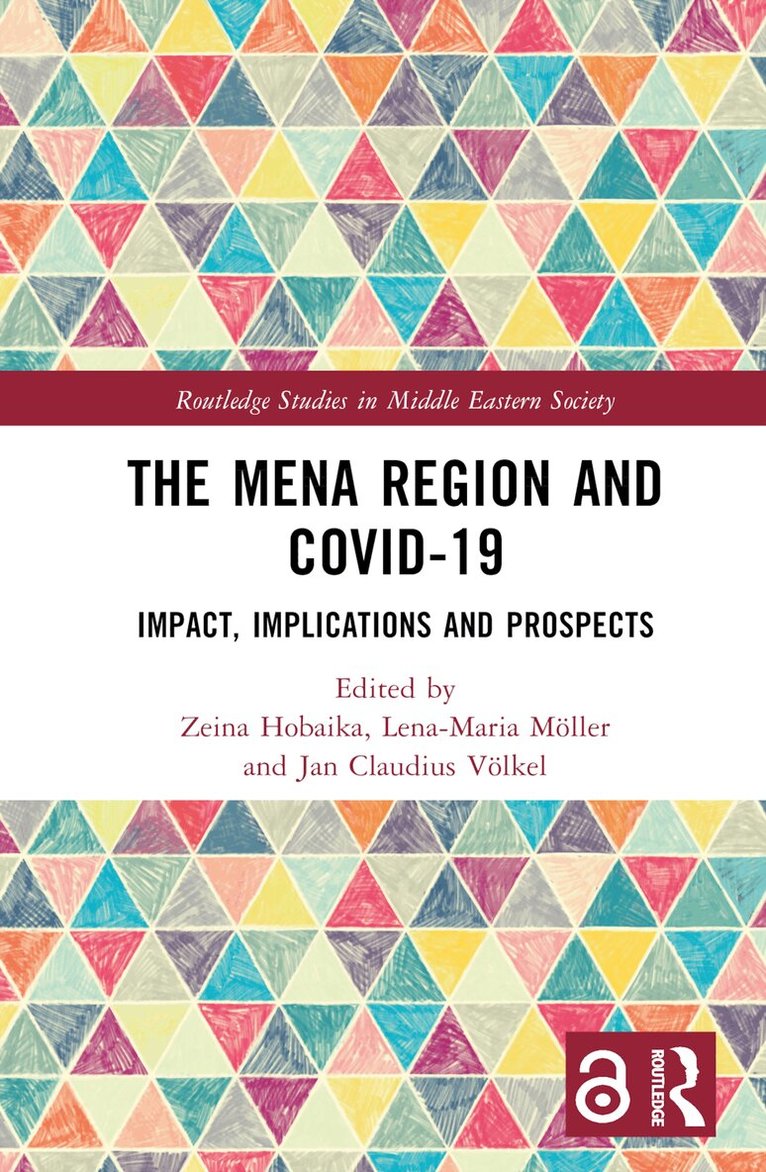
    MENA Region and COVID-19

    Impact, Implications and Prospects

    AvZeina Hobaika,Lena-Maria Möller

    Inbunden, Engelska, 2022

    Del i serien Routledge Studies in Middle Eastern Society

    2 495 kr

    Beställningsvara. Skickas inom 10-15 vardagar. Fri frakt över 249 kr.

    Beskrivning

    Focusing on the Middle East and North Africa (MENA) region, which comprises some of the world’s richest countries next to some of the poorest, this book offers excellent insights into the discriminatory consequences of the COVID-19 pandemic.With a geographic focus on the MENA region, the multidisciplinary case studies collected in this edited volume reveal that the coronavirus’s impact patterns are a question of two variables: governance performance and socioeconomic potency. Given the global, unprecedented, complex, and systemic nature of COVID-19 – and its long-term implications for societies, governments, international organisations, citizens and corporations – this volume entails a relevance to regions undergoing similar dynamics. Analyses in the book, therefore, have implications for the comparative study of the pandemic and its impact on societies around the globe. Understanding related dynamics and implications, and making use of lessons learned, are a pathway to deal with future similar crises. Questions covered in the volume are relevant to geopolitics, social implications and the relations between political leaders and citizens as beings embedded in various strategies of communication. The volume will appeal to scholars of international politics, political science, risk or crisis governance, economics and sociology, human rights and security, political communication and public health.The Open Access version of this book, available at http://www.taylorfrancis.com, has been made available under a Creative Commons Attribution- Non Commercial- No Derivatives 4.0 licence.

    Produktinformation

    • Utgivningsdatum:2022-05-31
    • Mått:156 x 234 x 16 mm
    • Vikt:530 g
    • Format:Inbunden
    • Språk:Engelska
    • Serie:Routledge Studies in Middle Eastern Society
    • Antal sidor:182
    • Förlag:Taylor & Francis Ltd
    • ISBN:9781032145815

    Utforska kategorier

    • Medievetenskap inom Samhälle och politik
    • Internationella relationer inom Samhälle och politik
    • Samhällsmedicin och preventiv medicin inom Medicin

    Mer om författaren

    Zeina Hobaika is a biochemist, holder of a PhD in Structure, Function and Proteins Engineering from Denis Diderot University and an Executive Diploma in Management and Conduct of Strategic Projects from Sciences Po in Paris. Today, she is an associate professor and serves as the head of department of Life and Earth Sciences-Biochemistry, at the Faculty of Sciences at Saint Joseph University of Beirut. She is also head of the Macromolecules Structure and Interactions Research Team. Her main research interests cover rational drug design to contribute to fighting diseases such as AIDS, cancer and Alzheimer’s. Another major project she is working on consists of the management and valorisation of agro-industrial byproducts and waste, for a sustainable future. She has been selected for various national and international prizes and awards. In 2017, she became a member of the prestigious Arab–German Young Academy of Sciences and Humanities (AGYA). Last, with a large publication record and one patent, Zeina is involved in a variety of projects with the public and private sector.Lena-Maria Möller is a visiting professor of Islamic law at the University of M ü nster and an affi liated research fellow at the Max Planck Institute for Comparative and International Private Law in Hamburg. Holding an MA in Middle East Studies and a PhD in Law (both from the University of Hamburg), her research and teaching interests concern contemporary Middle Eastern and Islamic law, with a particular focus on Muslim family law and the Gulf Cooperation Council (GCC) states, as well as comparative and private international law, and, most recently, law and popular culture in the Middle East. Lena-Maria Möller is a member and former co-president of the Arab–German Young Academy of Sciences and Humanities (AGYA) and serves as Associate Editor of the Arab Law Quarterly.Jan Claudius Völkel is Academic Dean at IES Abroad Freiburg and asociate researcher at the Arnold Bergstraesser Institute, University of Freiburg, focusing on contemporary sociopolitical developments in the Middle East and North Africa. He was a DAAD (German Academic Exchange Service) long- term lecturer in Euro- Mediterranean Studies at Cairo University, Faculty of Economics and Political Science (2013–17) and Marie Skłodowska-Curie Fellow at the Vrije Universiteit Brussel, Institute for European Studies with a research project on ‘The Role of National Parliaments in the Arab Transformation Processes’ (2017–19). In addition, he is the regional coordinator for the Middle East and North Africa at the Bertelsmann Transformation Index (BTI) and alumnus of the Arab–German Young Academy of Sciences and Humanities (AGYA). He has published widely in Mediterranean Politics, Middle East Critique, Middle East Law and Governance, The Journal of North African Studies, European Foreign Affairs Review and Comparative Migration Studies.

    Innehållsförteckning

    • 1. Introduction: The MENA region and COVID-19 – concept and content of this bookZeina Hobaika, Lena-Maria Möller and Jan Claudius VölkelPart 1: GEOPOLITICAL IMPLICATIONS2. The COVID-19 temptation? Sino–Gulf relations and autocratic linkages in times of a global pandemicThomas Demmelhuber, Julia Gurol and Tobias Zumbrägel3. The reverse impact of politics on the COVID-19 response: how Hezbollah determined the choices of the Lebanese governmentNassim AbiGhanemPart 2: COMMUNICATION STRATEGIES4. ‘American Corona’ vs. ‘The Chinese virus’: blaming and othering in Arab media Carola Richter, Abdulrahman al-Shami, Soheir Osman, Sahar Khalifa Salim and Samuel Mundua5. Securitisation dynamics and COVID-19 politics in Morocco: old wine in new bottles? Giulia Cimini and Beatriz Tomé Alonso6. Status-seeking in times of a global pandemic: the United Arab Emirates’ foreign policy during COVID-19Alexander LohsePart 3: SOCIAL RESPONSE7. Religion and pandemic: state, Islam and society in Saudi Arabia and Iran during the coronavirus crisisNoël van den Heuvel and Ulrike Freitag8. ‘On the horns of a dilemma’: human traffickers, the COVID-19 pandemic and victims of trafficking in KhartoumManara Babiker Hassan9. A paradoxal management of COVID-19 in Lebanon: challenges and lessons learntMichèle Kosremelli Asmar and Joumana Stephan Yeretzian10. Digital learning under COVID-19: challenges and opportunities – the Lebanese caseFadi El Hage and Fouad Yehya11. Conclusions: The MENA region and COVID-19 – lessons for the futureZeina Hobaika, Lena-Maria Möller and Jan Claudius Völkel