• Fri frakt över 249 kr
  • •
  • Snabba leveranser
  • •
  • Billiga böcker
Kundservice

Du är på sajten för privatpersoner.

Företag, bibliotek eller offentlig verksamhet?

Du handlar på classic.bokus.com, där alla dina funktioner finns intakta.
Till classic.bokus.com
Bokus logotyp. Gå till startsidan.
  • Erbjudanden
  • Student
  • Topplistor
  • Barn & ungdom
  • Bokus Play
  • E-böcker
  • Ljudböcker
  • Pocketböcker
  • Spel och pussel

Upp till 25% på utvalda nyheter →

Sidfot

Mina sidor

    Hjälp

    • Kundservice
    • Vanliga frågor och svar
    • Frakt och leverans
    • Retur vid ångerrätt
    • Reklamera vara
    • Betalning
    • Köpvillkor
    • Allmänna villkor
    • Information om webbplatsens tillgänglighet

    Om Bokus

    • Om oss
    • Pressrum
    • För studenter
    • För företag
    • För bibliotek och offentlig verksamhet
    • För leverantörer
    • Hållbarhet

    Populärt

    • Aktuella erbjudanden
    • Presentkort
    • Studentlitteratur
    • Nya böcker
    • Topplistor
    • Signerade böcker
    • Engelska böcker

    Inspiration

    • Boktips
    • BookTok
    • Barnbokskaraktärer
    • Populära författare
    Logotyp för Bokus
    Följ oss på Facebook (extern länk)Följ oss på Instagram (extern länk)Följ oss på YouTube (extern länk)Följ oss på TikTok (extern länk)
    bokus @ CookiesAnpassa cookiesIntegritetspolicyKöpvillkor
    Till Citymail hemsida (extern länk)Till Budbee hemsida (extern länk)Till Postnord hemsida (extern länk)Till Schenker hemsida (extern länk)Till Early Bird hemsida (extern länk)Till Walleys hemsida (extern länk)
    1. Naturvetenskap och teknik
    2. Teknik och industri
    3. Elektronik och kommunikationer

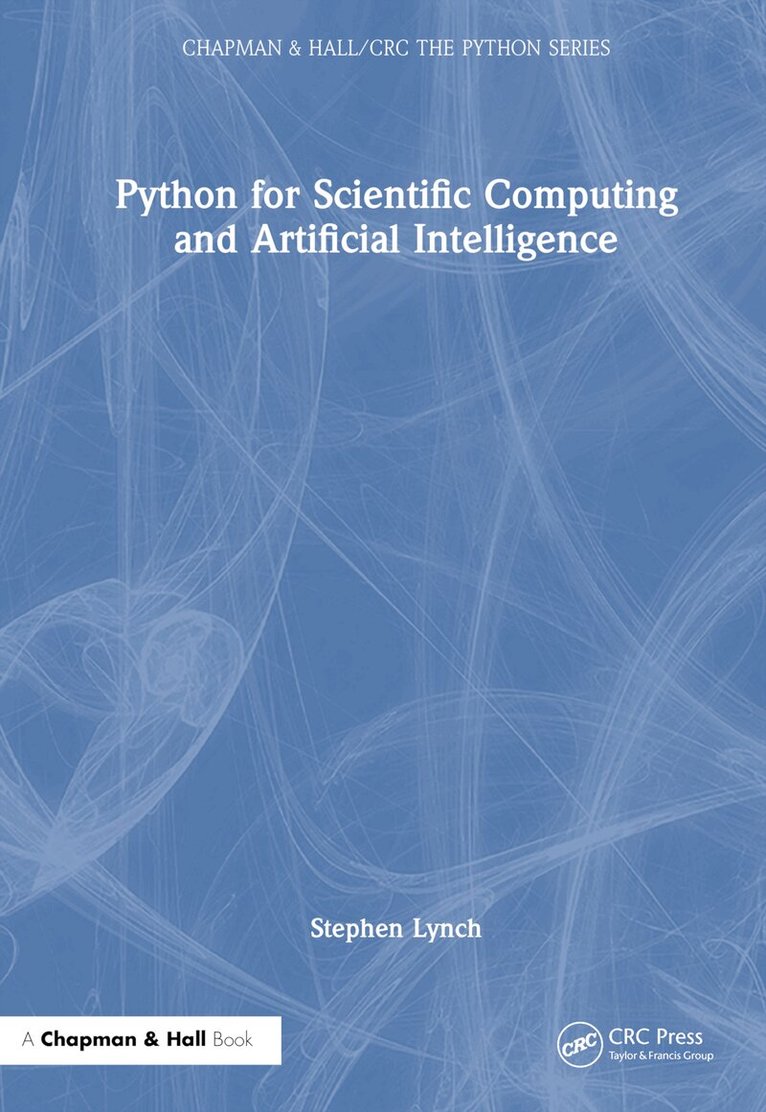
    Python for Scientific Computing and Artificial Intelligence

    AvStephen Lynch

    Inbunden, Engelska, 2023

    Del i serien Chapman & Hall/CRC The Python Series

    2 415 kr

    Beställningsvara. Skickas inom 10-15 vardagar. Fri frakt över 249 kr.

    Fler format och utgåvor

    E-bok

    1 105 kr

    E-bok

    1 056 kr

    Häftad

    903 kr

    Beskrivning

    Python for Scientific Computing and Artificial Intelligence is split into 3 parts: in Section 1, the reader is introduced to the Python programming language and shown how Python can aid in the understanding of advanced High School Mathematics. In Section 2, the reader is shown how Python can be used to solve real-world problems from a broad range of scientific disciplines. Finally, in Section 3, the reader is introduced to neural networks and shown how TensorFlow (written in Python) can be used to solve a large array of problems in Artificial Intelligence (AI).This book was developed from a series of national and international workshops that the author has been delivering for over twenty years. The book is beginner friendly and has a strong practical emphasis on programming and computational modelling.Features:No prior experience of programming is requiredOnline GitHub repository available with codes for readers to practiceCovers applications and examples from biology, chemistry, computer science, data science, electrical and mechanical engineering, economics, mathematics, physics, statistics and binary oscillator computingFull solutions to exercises are available as Jupyter notebooks on the WebSupport MaterialGitHub Repository of Python Files and Notebooks: https://github.com/proflynch/CRC-Press/Solutions to All Exercises:Section 1: An Introduction to Python: https://drstephenlynch.github.io/webpages/Solutions_Section_1.htmlSection 2: Python for Scientific Computing: https://drstephenlynch.github.io/webpages/Solutions_Section_2.htmlSection 3: Artificial Intelligence: https://drstephenlynch.github.io/webpages/Solutions_Section_3.html

    Produktinformation

    • Utgivningsdatum:2023-06-15
    • Mått:178 x 254 x 23 mm
    • Vikt:453 g
    • Format:Inbunden
    • Språk:Engelska
    • Serie:Chapman & Hall/CRC The Python Series
    • Antal sidor:314
    • Förlag:Taylor & Francis Ltd
    • ISBN:9781032258737

    Utforska kategorier

    • Elektronik och kommunikationer inom Naturvetenskap och teknik
    • Programvaruutveckling inom Data och IT
    • Tillämpad matematik inom Naturvetenskap och teknik

    Mer om författaren

    In 2022, Stephen Lynch was named a National Teaching Fellow, which celebrates and recognises individuals who have made an outstanding impact on student outcomes and teaching in higher education. He won the award for his work in programming in the STEM subjects, research feeding into teaching, and widening participation (using experiential and object-based learning). Although educated as a pure mathematician, Stephen’s many interests now include applied mathematics, cell biology, electrical engineering, computing, neural networks, nonlinear optics and binary oscillator computing, which he co-invented with a colleague. He has authored 2 international patents for inventions, 8 books, 4 book chapters, over 40 journal articles, and a few conference proceedings. Stephen is a Fellow of the Institute of Mathematics and Its Applications (FIMA) and a Senior Fellow of the Higher Education Academy (SFHEA). He is currently a Reader with MMU and was an Associate Lecturer with the Open University from 2008-2012. In 2010, Stephen volunteered as a STEM Ambassador, in 2012, he was awarded MMU Public Engagement Champion status, and in 2014 he became a Speaker for Schools. He runs national workshops on "Python for A-Level Mathematics and Beyond," and international workshops on "Python for Scientific Computing and TensorFlow for Artificial Intelligence." He has run workshops in China, Malaysia, Singapore, and the USA.

    Recensioner i media

    “For students, the book is crammed absolutely full of real-world examples to help learn Python quickly and efficiently from scratch. The content spans so many topics across so many subject areas that surely all interests are accommodated somewhere within. For instructors, it provides a gold mine of ideas for preparing our own courses and is likely one for the reading list.”—Dr Jame Christian, Mathematics Today

    Innehållsförteckning

    • Section I. An Introduction to Python. 1. The IDLE Integrated Development Learning Environment. 2. Anaconda, Spyder and the Libraries NumPy, Matplotlib and SymPy. 3. Jupyter Notebooks and Google Colab. 4. Python for AS-Level (High School) Mathematics. 5. Python for A-Level (High School) Mathematics. Section II. Python for Scientific Computing. 6. Biology. 7. Chemistry. 8. Data Science. 9. Economics. 10. Engineering. 11. Fractals and Multifractals. 12. Image Processing. 13. Numerical Methods for Ordinary and Partial Differential Equations. 14. Physics. 15. Statistics. Section III. Artificial Intelligence. 16. Brain Inspired Computing. 17. Neural Networks and Neurodynamics. 18. TensorFlow and Keras. 19. Recurrent Neural Networks. 20. Convolutional Neural Networks, TensorBoard, and Further Reading. 21. Answers and Hints to Exercises.