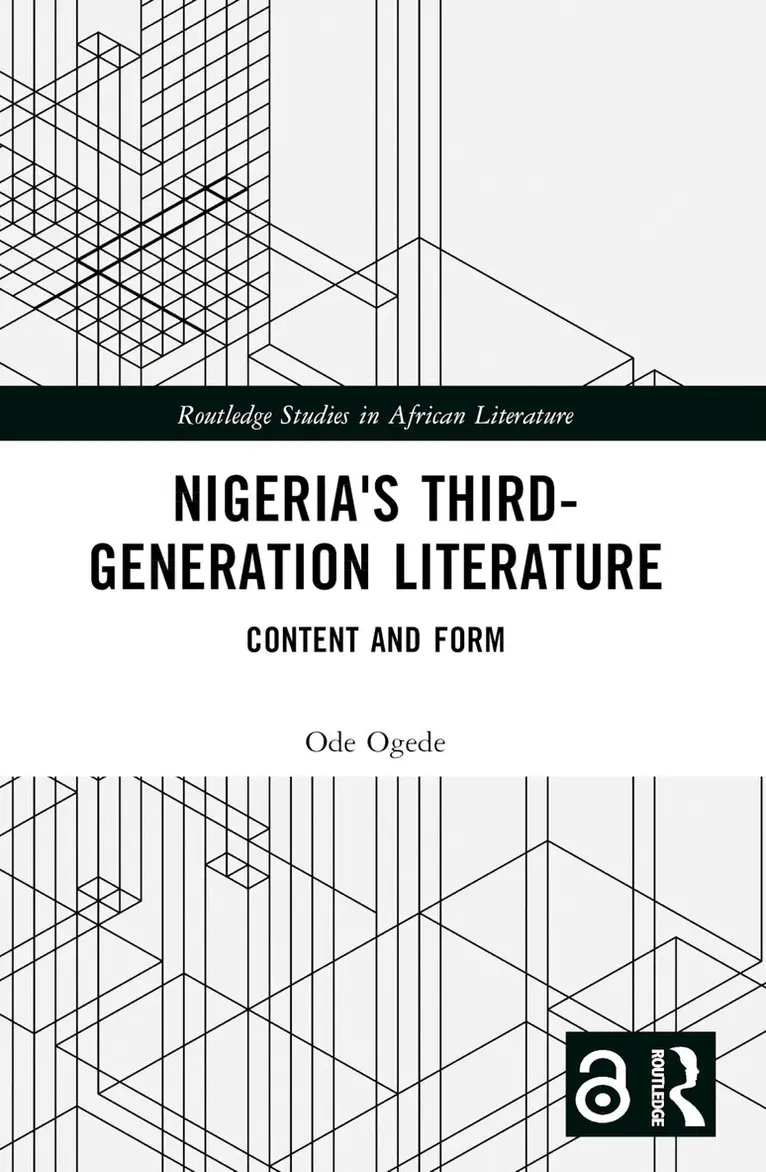
Häftad, Engelska, 2024
Nigeria's Third-Generation Literature
Content and Form
Av Ode Ogede
Del i serien Routledge Studies in African Literature
753 kr
Beställningsvara. Skickas inom 10-15 vardagar. Fri frakt över 249 kr.
Fler format och utgåvor
Beskrivning
Produktinformation
- Utgivningsdatum: 2024-08-26
- Mått: 156 x 234 x 18 mm
- Vikt: 600 g
- Format: Häftad
- Språk: Engelska
- Serie: Routledge Studies in African Literature
- Antal sidor: 316
- Förlag: Taylor & Francis Ltd
- ISBN: 9781032268439
Utforska kategorier
Mer om författaren
Ode Ogede is Former Vice-President of the Modern Language Association of Nigeria and is currently Professor of English at North Carolina Central University, USA, as well as author of several books.
Recensioner i media
"This is a new and refreshing insight into the world of contemporary Nigerian literature. It brings the critical debate about Nigerian literary criticism into sharp focus, offering readers a careful, knowledgeable, and critical view of a new tradition of Nigerian writing that is quickly emerging. It summons to the table past literary accomplishments as the author deftly introduces a new crop of Nigerian writers. There is nothing like it in the field at the moment."Onookome Okome, currently Senior Fellow, FRAIS, Freiburg Institute for Advanced Studies, Albert-Ludwigs Universitat, Freiburg, Germany; Professor, Department of English and Film Studies,University of Alberta, Edmonton, Canada.“Nigeria’s Third-Generation Literature: Content and Form [...] offers a wide-ranging, theoretically grounded, and unapologetically evaluative study of Nigerian literary production from the late 1980s to the early 21st century. . . a major contribution to Nigerian and African literary criticism. Its combination of historical sweep, formal analysis, and unapologetically evaluative judgment makes it essential reading for scholars, postgraduate students, and serious readers of African literature. Ogede does not merely map a literary generation; he mounts a sustained argument for what literary criticism should be and do — attentive to form, anchored in evidence, and willing to make discriminating judgments.”Karen Ferreira-Meyers, Institute of Distance Education, University of Eswatini, Eswatini, writing in New Trends in Social and Liberal Sciences: An Interdisciplinary Journal..
Betyg & recensioner
0 recensioner
Inga recensioner tillgängliga.